Leidian: Difference between revisions
infobox |
No edit summary |
||
| (4 intermediate revisions by 3 users not shown) | |||
| Line 3: | Line 3: | ||
Authors: {{PAGEAUTHORS}} | Authors: {{PAGEAUTHORS}} | ||
---- | ---- | ||
[[File:Leidian profileCard SadeghFaghanpour-IAU-WGSN.jpg|thumb|Leidian profile card (CC BY M.Sadegh Faghanpour for IAU WGSN).]] | |||
{{Infobox constellation | {{Infobox constellation | ||
| name = Leidian | | name = Leidian | ||
| Line 28: | Line 29: | ||
| cat = IAU-Star Name | | cat = IAU-Star Name | ||
}} | }} | ||
[[File:Leidian stickfigure SadeghFaghanpour-IAU-WGSN.jpg|thumb|Leidian stick figure (CC BY M.Sadegh Faghanpour for IAU WGSN).]] | |||
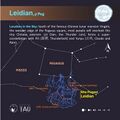
Léi Diàn (Thunder and Lightning, 雷電) is a six-star Chinese asterism belonging to the outer asterisms of the Gan school. It lies south of [[Yingshi and Ligong|Yingshi]]. Although modern reconstructions of its membership and outline vary, all major identifications place it in the present-day constellation [[Pegasus]]. This asterism might have been created in late Western Han. Its primary image is thunder and lightning. In the same sector of the sky, it forms a meteorological cluster with Pīlì (Thunderclap) and Yúnyǔ (Cloud and Rain). | Léi Diàn (Thunder and Lightning, 雷電) is a six-star Chinese asterism belonging to the outer asterisms of the Gan school. It lies south of [[Yingshi and Ligong|Yingshi]]. Although modern reconstructions of its membership and outline vary, all major identifications place it in the present-day constellation [[Pegasus]]. This asterism might have been created in late Western Han. Its primary image is thunder and lightning. In the same sector of the sky, it forms a meteorological cluster with Pīlì (Thunderclap) and Yúnyǔ (Cloud and Rain). | ||
| Line 33: | Line 35: | ||
== Concordance, Etymology, History == | == Concordance, Etymology, History == | ||
The two elements of the name already distinguished sound from light in early lexical thought. The ''Shuowen jiezi'' 說文解字explains the archaic graph 靁 as the movement caused when ''yin'' and ''yang'' press against one another, with 畾 evoking a revolving form; it defines 電 as the flash produced by the excitation of ''yin'' and ''yang''. The Eastern Han ''Shiming''釋名 gives phonetic glosses: thunder (léi) resembles the rumble of objects turning against an obstruction, while lightning (diàn) | The two elements of the name already distinguished sound from light in early lexical thought. The ''Shuowen jiezi'' 說文解字explains the archaic graph 靁 as the movement caused when ''yin'' and ''yang'' press against one another, with 畾 evoking a revolving form; it defines 電 as the flash produced by the excitation of ''yin'' and ''yang''. The Eastern Han ''Shiming''釋名 gives phonetic glosses: thunder (léi) resembles the rumble of objects turning against an obstruction, while lightning (diàn) vanishes as soon as it appears. These are not modern meteorology, but they show a clear conceptual pairing of two related yet distinct phenomena. | ||
[[File:The Thunder Lord Beating a Drum in a Han-Dynasty Pictorial Stone Relief from Wubaizhuang, Linyi, Shandong.jpeg|thumb|The Thunder Lord Beating a Drum in a Han-Dynasty Pictorial Stone Relief from Wubaizhuang, Linyi, Shandong]] | [[File:The Thunder Lord Beating a Drum in a Han-Dynasty Pictorial Stone Relief from Wubaizhuang, Linyi, Shandong.jpeg|thumb|The Thunder Lord Beating a Drum in a Han-Dynasty Pictorial Stone Relief from Wubaizhuang, Linyi, Shandong]] | ||
Because thunder is invisible, it was rendered through the tangible technology of the drum. In the Eastern Han ''Lunheng''論衡, Wang Chong王充 reports that painters represented thunder as a string of connected drums and portrayed Leigong, the Thunder Lord, as a strongman pulling the drums with one hand and striking them with a mallet in the other. Wang’s purpose was to refute a literal divine-drum explanation, but his criticism preserves evidence for a visual convention: by the Eastern Han, the Thunder Lord, linked drums, and the striking mallet formed a recognizable image. The asterism thus stood between two modes of knowledge—natural interaction between ''yin'' and ''yang'', and a materialized image of drums, divinity, and heavenly authority. | Because thunder is invisible, it was rendered through the tangible technology of the drum. In the Eastern Han ''Lunheng''論衡, Wang Chong王充 reports that painters represented thunder as a string of connected drums and portrayed Leigong, the Thunder Lord, as a strongman pulling the drums with one hand and striking them with a mallet in the other. Wang’s purpose was to refute a literal divine-drum explanation, but his criticism preserves evidence for a visual convention: by the Eastern Han, the Thunder Lord, linked drums, and the striking mallet formed a recognizable image. The asterism thus stood between two modes of knowledge—natural interaction between ''yin'' and ''yang'', and a materialized image of drums, divinity, and heavenly authority. | ||
=== Identification of stars === | === Identification of stars === | ||
Leidian underwent a substantial change in membership. Yang Boshun dates the major alteration to the Huangyou period ( | Leidian underwent a substantial change in membership. Yang Boshun dates the major alteration to the Huangyou period (1049–1054 CE) of the Northern Song and distinguishes an early to Jingyou pattern from the Huangyou pattern; Yi Shitong’s Qing numbering represents another catalogue tradition influenced by European astronomy. | ||
| Line 53: | Line 55: | ||
|- | |- | ||
|1st | |1st | ||
| valign="center" |σ Peg (determinative) | |||
| valign="center" |σ Peg (determinative) | |||
| valign="center" |σ Peg determinative) | |||
| valign="center" |σ Peg (determinative) | |||
| valign="center" |σ Peg | | valign="center" |σ Peg | ||
| valign="center" |ζ Peg (42 Peg) | |||
| valign="center" |ζ Peg | |||
(42 Peg) | |||
|- | |- | ||
|2nd | |2nd | ||
| Line 75: | Line 67: | ||
| valign="center" |HIP 113445 | | valign="center" |HIP 113445 | ||
| valign="center" |52 Peg | | valign="center" |52 Peg | ||
| valign="center" |ρ Peg | | valign="center" |ρ Peg (determinative) | ||
| valign="center" |ξ Peg (46 Peg) | |||
| valign="center" |ξ Peg | |||
(46 Peg) | |||
|- | |- | ||
|3rd | |3rd | ||
| valign="center" |55 Peg | | valign="center" |55 Peg | ||
| valign="center" |ρ Peg | | valign="center" |ρ Peg (50 Peg) | ||
| valign="center" |ρ Peg (50 Peg) | |||
(50 Peg) | |||
| valign="center" |ρ Peg | |||
(50 Peg) | |||
| valign="center" |55 Peg | | valign="center" |55 Peg | ||
| valign="center" |59 Peg | | valign="center" |59 Peg | ||
| valign="center" |σ Peg | | valign="center" |σ Peg (49 Peg) | ||
(49 Peg) | |||
|- | |- | ||
|4th | |4th | ||
| Line 133: | Line 115: | ||
!same in Stellarium | !same in Stellarium | ||
|- | |- | ||
|[[File:Leidian inLeidian in Cheonsang Yeolcha Bunyajido.jpg|thumb|Leidian | |[[File:Leidian inLeidian in Cheonsang Yeolcha Bunyajido.jpg|thumb|Leidian in ''Cheonsang Yeolcha Bunyajido'']] | ||
| rowspan="3" |[[File:Leidian before Tang dynasty reconstructed by Boshun Yang.jpg|thumb|Leidian before Tang dynasty reconstructed by Boshun Yang]] | | rowspan="3" |[[File:Leidian before Tang dynasty reconstructed by Boshun Yang.jpg|thumb|Leidian before Tang dynasty reconstructed by Boshun Yang]] | ||
| rowspan="3" |[[File:Leidian before Tang dynasty in Stellarium.jpg|thumb|'''Leidian before Tang dynasty in Stellarium''']] | | rowspan="3" |[[File:Leidian before Tang dynasty in Stellarium.jpg|thumb|'''Leidian before Tang dynasty in Stellarium''']] | ||
| Line 157: | Line 139: | ||
|[[File:Leidian in 18th century in Stellarium.jpg|thumb|Leidian in 18th century in Stellarium]] | |[[File:Leidian in 18th century in Stellarium.jpg|thumb|Leidian in 18th century in Stellarium]] | ||
|} | |} | ||
== IAU Working Group on Star Names == | == IAU Working Group on Star Names == | ||
In 2026, the name of the historical constellation "Leidian" was | In 2026, the name of the historical constellation "Leidian" was proposed to be used for the star '''ρ Peg''', as it is one of the brighter stars in this constellation, and considered by some to be its determinative star. | ||
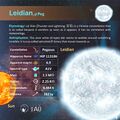
In August 2026, the name '''Leidian''' was adopted by IAU WGSN for the star designated [https://simbad.cds.unistra.fr/simbad/sim-id?Ident=rho+Peg ρ Peg (50 Peg, HR 8717, HD 216735, HIP 113186)]. Leidian has an apparent V magnitude of 4.91 star and lies 89 parsecs away. The star is a spectral type A1IV standard star, and it is nearly a twin in terms of brightness, spectrum, and distance compared to another naked eye star in Pegasus -- omicron Peg. While the star has not had any stellar or planetary companion reported, multiple studies have reported that the long-term proper motion of the star is clearly perturbed ([https://ui.adsabs.harvard.edu/abs/2005AJ....129.2420M/abstract Makarov & Kaplan 2005], [https://ui.adsabs.harvard.edu/abs/2007A%26A...464..377F/abstract Frankowski et al. 2007], [https://ui.adsabs.harvard.edu/abs/2022A%26A...657A...7K/abstract Kervella et al. 2022]). [https://ui.adsabs.harvard.edu/abs/2022A%26A...657A...7K/abstract Kervella et al. (2022)] estimate that between the mean epoch of Hipparcos (1991.25) and Gaia DR3 (2016), the tangential motion of ρ Peg had shifted by about 3.5 kilometers per second over that ~25 year interval. <gallery> | |||
File:Leidian profileCard SadeghFaghanpour-IAU-WGSN.jpg|(CC BY M.Sadegh Faghanpour for IAU WGSN). | |||
File:Leidian stickfigure SadeghFaghanpour-IAU-WGSN.jpg|(CC BY M.Sadegh Faghanpour for IAU WGSN). | |||
</gallery> | |||
==References == | ==References == | ||
Latest revision as of 06:38, 16 September 2026
Authors: Boshun YANG, Eric Mamajek, Susanne M Hoffmann, ASE Tech Team

| Asterism Info | |
| Native | 雷電 |
|---|---|
| Translation | Thunder and Lightning |
| Position (2000) | |
| Right ascension | 343.8069537 |
| Declination | 8.81618146 |
| Area | 0 sq. deg. |
| Stars | |
| Bright stars | 1 |
| Bayer/Flamsteed stars | 1 |
| Stars brighter than 3.00m | 0 |
| Brightest star | Leidian (4.9m) |
| Taxonomy | |
| category of asterism | IAU-Star Name |
| IAU- constellations | Peg |

Léi Diàn (Thunder and Lightning, 雷電) is a six-star Chinese asterism belonging to the outer asterisms of the Gan school. It lies south of Yingshi. Although modern reconstructions of its membership and outline vary, all major identifications place it in the present-day constellation Pegasus. This asterism might have been created in late Western Han. Its primary image is thunder and lightning. In the same sector of the sky, it forms a meteorological cluster with Pīlì (Thunderclap) and Yúnyǔ (Cloud and Rain).
Since August 2026, Leidian is also a modern IAU-star name; it refers to the star ρ Peg in Pegasus.
Concordance, Etymology, History
The two elements of the name already distinguished sound from light in early lexical thought. The Shuowen jiezi 說文解字explains the archaic graph 靁 as the movement caused when yin and yang press against one another, with 畾 evoking a revolving form; it defines 電 as the flash produced by the excitation of yin and yang. The Eastern Han Shiming釋名 gives phonetic glosses: thunder (léi) resembles the rumble of objects turning against an obstruction, while lightning (diàn) vanishes as soon as it appears. These are not modern meteorology, but they show a clear conceptual pairing of two related yet distinct phenomena.

Because thunder is invisible, it was rendered through the tangible technology of the drum. In the Eastern Han Lunheng論衡, Wang Chong王充 reports that painters represented thunder as a string of connected drums and portrayed Leigong, the Thunder Lord, as a strongman pulling the drums with one hand and striking them with a mallet in the other. Wang’s purpose was to refute a literal divine-drum explanation, but his criticism preserves evidence for a visual convention: by the Eastern Han, the Thunder Lord, linked drums, and the striking mallet formed a recognizable image. The asterism thus stood between two modes of knowledge—natural interaction between yin and yang, and a materialized image of drums, divinity, and heavenly authority.
Identification of stars
Leidian underwent a substantial change in membership. Yang Boshun dates the major alteration to the Huangyou period (1049–1054 CE) of the Northern Song and distinguishes an early to Jingyou pattern from the Huangyou pattern; Yi Shitong’s Qing numbering represents another catalogue tradition influenced by European astronomy.
| Star Names or Orders(Qing) | Han Dynasty (SUN X. & J. Kistemaker[1]) | 3rd to 6th Century (Boshun Yang[2]) | Song Dynaty (Boshun Yang[2], 1034 CE) | Song Dynasty (Pan Nai[3], 1052 CE) | Song Dynasty (Boshun Yang[2], 1052 CE) | Qing Dynaty (Yi Shitong[4], 18th Century) |
|---|---|---|---|---|---|---|
| 1st | σ Peg (determinative) | σ Peg (determinative) | σ Peg determinative) | σ Peg (determinative) | σ Peg | ζ Peg (42 Peg) |
| 2nd | ρ Peg | HIP 113445 | HIP 113445 | 52 Peg | ρ Peg (determinative) | ξ Peg (46 Peg) |
| 3rd | 55 Peg | ρ Peg (50 Peg) | ρ Peg (50 Peg) | 55 Peg | 59 Peg | σ Peg (49 Peg) |
| 4th | 58 Peg | 55 Peg | 55 Peg | 58 Peg | 58 Peg | 55 Peg |
| 5th | 66 Peg | 58 Peg | 58 Peg | 66 Peg | 66 Peg | 66 Peg |
| 6th | 70 Peg | 57 Peg | 57 Peg | 77 Peg | 70 Peg | 70 Peg |
Maps (Gallery)
The configurations of Leidian depicted in the three early star maps share a common pattern, whereas the Suzhou star map, engraved in the thirteenth century during the Song dynasty, begins to show noticeable changes.
When European Jesuits in the late Ming dynasty (1630s) reidentified this asterism on the basis of European star catalogues, they not only assigned different constituent stars to it but also failed to reconstruct it in full, leaving three stars unaccounted for. Jesuits in the Qing dynasty restored the asterism to its full complement, although their identification of its stars had already diverged from the traditional one.
Moreover, although the star maps in the Xin Yixiang Fayao used by Pan Nai ultimately derive from the Song dynasty, they actually belong to a revised Qing-dynasty edition and therefore display a high degree of similarity to eighteenth-century versions.
| historical map | modern identification | same in Stellarium |
|---|---|---|
 |
 |
 |
 | ||
 | ||
 |
_reconstructed_by_Pan_Nai.jpg) |
_in_Stellarium.jpg) |
 |
_reconstructed_by_Boshun_Yang.jpg) |
_by_Boshun_Yang_in_Stellarium.jpg) |
 |
||
 |
 |
 |
IAU Working Group on Star Names
In 2026, the name of the historical constellation "Leidian" was proposed to be used for the star ρ Peg, as it is one of the brighter stars in this constellation, and considered by some to be its determinative star.
In August 2026, the name Leidian was adopted by IAU WGSN for the star designated ρ Peg (50 Peg, HR 8717, HD 216735, HIP 113186). Leidian has an apparent V magnitude of 4.91 star and lies 89 parsecs away. The star is a spectral type A1IV standard star, and it is nearly a twin in terms of brightness, spectrum, and distance compared to another naked eye star in Pegasus -- omicron Peg. While the star has not had any stellar or planetary companion reported, multiple studies have reported that the long-term proper motion of the star is clearly perturbed (Makarov & Kaplan 2005, Frankowski et al. 2007, Kervella et al. 2022). Kervella et al. (2022) estimate that between the mean epoch of Hipparcos (1991.25) and Gaia DR3 (2016), the tangential motion of ρ Peg had shifted by about 3.5 kilometers per second over that ~25 year interval.
-
 (CC BY M.Sadegh Faghanpour for IAU WGSN).
 -
 (CC BY M.Sadegh Faghanpour for IAU WGSN).
References
- ↑ Sun Xiaochun. & Kistemaker J. The Chinese sky during the Han. Leiden: Brill. 1997, Pp241-6.
- ↑ 2.0 2.1 2.2 B.-S. Yang杨伯顺, Zhongguo Chuantong Hengxing Guance Jingdu ji Xingguan Yanbian Yanjiu 中国传统恒星观测精度及星官演变研究 (A Research on the Accuracy of Chinese Traditional Star Observation and the Evolution of Constellations), PhD thesis, (Hefei: University of Science and Technology of China, 2023).
- ↑ Pan Nai潘鼐. Zhongguo Hengxing Guance shi中国恒星观测史[M]. Shanghai: Xuelin Pree. 1989.
- ↑ Yi Shitong伊世同. Zhongxi Duizhao Hengxing Tubiao中西对照恒星图表1950. Beijing: Science Press.1981.