Ilan Usiha: Difference between revisions
HaochengLyu (talk | contribs) Created page "Ilan Usiha" |
HaochengLyu (talk | contribs) m theta1 Ori |
||
| (5 intermediate revisions by the same user not shown) | |||
| Line 5: | Line 5: | ||
Authors: {{PAGEAUTHORS}} | Authors: {{PAGEAUTHORS}} | ||
---- | ---- | ||
[[File:Ilan Usiha and Ceku Mama in Stellarium.png|alt=Ilan Usiha and Ceku Mama in Stellarium|thumb|Ilan Usiha and Ceku Mama in Stellarium]] | |||
[[File:A painting about Ceku Mama.png|alt=A painting about Tumu Mama / Ceku Mama (Swing Goddess)|thumb|A painting about Tumu Mama / Ceku Mama (Swing Goddess)]] | |||
{{Infobox constellation | |||
| name = Ilan Usiha | |||
| native = ᡳᠯᠠᠨ ᡠᠰᡳᡥᠠ | |||
| translation = Three Stars | |||
| pronounce = Ilan Usiha | |||
| IPA = /i.län u.ɕi.χä/ | |||
| culture = Chinese Manchu | |||
| RA = 83.00720833 to 85.19529167 | |||
| dec = -1.943 to -0.299472222 | |||
| areatotal = 0 | |||
| numbermainstars = 3 | |||
| numberbfstars = 3 | |||
| numberstarsplanets = | |||
| numberbrightstars = 3 | |||
| numbernearbystars = | |||
| brighteststarname = [[Alnitak|ζ Ori]] | |||
| starmagnitude = 1.74 | |||
| neareststarname = | |||
| stardistance = | |||
| numbermessierobjects = | |||
| meteorshowers = | |||
| bordering = Ori | |||
| notes = | |||
| cat = constellation | |||
}} | |||
[[ | '''Ilan Usiha''' (Manchu: ᡳᠯᠠᠨ ᡠᠰᡳᡥᠠ, "the Three Stars"), a Manchu shamanic asterism identified with the three Belt stars of [[Orion]] (ζ Ori, ε Ori, δ Ori). In Manchu tradition it is the standard clock of the winter night, read by the hour at which the Belt crosses the meridian. | ||
Ilan Usiha ( | Legend has it that Ilan Usiha was created by '''Tumu''', the goddess of fire. There is a faint small star below Ilan Usiha, called '''Ceku Mama''' (Swing Goddess), which is the last remaining ember of Tumu. | ||
== Concordance, Etymology, History == | == Concordance, Etymology, History == | ||
| Line 14: | Line 41: | ||
=== Etymology === | === Etymology === | ||
... | The name ''Ilan Usiha'' is written in Manchu as ᡳᠯᠠᠨ ᡠᠰᡳᡥᠠ. ''ilan'' means "three" and ''usiha'' means "star, star-group". The related star name ''Ceku Mama'' means "Swing Goddess" in Manchu<ref name="norman"/>, and it was regarded as the lingering embers of fire goddess Tumu.<ref name="fu2009"/><ref name="huang2000"/><ref name="dzd1993"/> | ||
'''Ilan Usiha''' is the name of the asterism (the three stars). '''Tumu''' is a mythic persona, not a star-name: she is the goddess who created the stars and who, stripped of her light, became a white stone "hanging on the Three Stars, swinging from east to west".<ref name="fu2009"/> '''Ceku Mama''' is a folk name for the small flickering star beneath the Belt, the surviving spark of Tumu.<ref name="fu2009"/> | |||
=== Myth and ritual === | |||
The Manchu creation myth ''Heavenly War'' records the deeds of the Fire Goddess Tumu and the origins of Ilan Usiha and Ceku Mama. | |||
Banam Hehe (the Earth Goddess) sends the fire goddess Tumu, who grew on her heart, to the star-spreading goddess [[Nadan Narhūn|Elden Hehe]] to light her way with her light-hair and fire. The dry lightning seen in the sky is Tumu's shadow; the "sky-fallen stones" (meteorites) are the mud on her feet.<ref name="fu2009"/> When the nine-headed demon Yeruri belched black wind and fog that covered the sky and swept up the stars and clouds, Tumu tore the light-hair from her own body and flung it into the black sky, where it became Ilan Usiha (the Three Stars), Nadan Usiha (the Seven Stars, Big Dipper), Minggan Usiha (the Thousand Stars, [[Gasha]]), and Tumen Usiha (the Ten-Thousand Stars), helping Elden Hehe spread the stars.<ref name="fu2009"/> Tumu herself was left bare, turned into a naked white stone that "hangs on the Three Stars, swinging from east to west", still glowing faintly to benefit all living things.<ref name="fu2009"/> A popular retelling has Tumu and Elden Hehe place the southern Three Stars and the northern Seven Stars as guiding lights for night travel, so that people could find their way in the dark.<ref name="zhang2008"/> | |||
The "hanging on the Three Stars, swinging from east to west" is a personification of the Three Stars' east-to-west motion across the sky — the white stone hangs under the Belt as it rises in the east and sets in the west. | |||
==== Tumu's ember and Ceku Mama ==== | |||
Beneath the Three Stars in the southern sky there is a small star that twinkles and flickers — "the only tiny fire of the goddess Tumu still shining, like a sky-lamp lighting the dome". Later people called it '''Ceku Mama''', the "Swing Goddess".<ref name="fu2009"/> From this came the Manchu custom of swinging on a tall swing-pole with a fish-oil lamp on one's head, and of raising tall birch poles with beast-skull oil-lamps to "light the sky-lamp", and of lighting ice-lamps and bonfires each year to drive away Yeruri and sacrifice to Goddess Tumu.<ref name="fuwang1995"/> In one retelling Tumu first tried to light the world by erecting a tall swing-frame and carrying an oil-lamp on her head, swinging as high as she could, but the mountains blocked her; only then did she pluck her light-hair to make the stars — the mythological precedent of the fire-swing custom.<ref name="zhang2008"/> The same retelling describes Tumu's white stone as hanging "below the Three Stars, flickering and swaying unsteadily", matching the Ceku Mama / M42 identification below the Belt.<ref name="zhang2008"/> | |||
==== Dungbule Mama and the three gems ==== | |||
Another Manchu myth, ''Sirin Amban Mafa'', gives a second Ilan Usiha narrative that complements the first: the former tells where the stars came from, this tells what the star-goddess did.<ref name="fu2009"/> The soul of Sirin Amban Mafa travelled out in search of healing and came to the dwelling of Goddess Ilan Usiha. When Abka Hehe and Yeruri wrestled for the sky and were unable to move, Elden Hehe sent Ilan Usiha with ten-thousand little bright stars to battle, blinding Yeruri's demon eye so he fled underground. But Ilan Usiha was wounded and fell into the sea, becoming a towering reef. Abka Hehe plucked three gems from the shawl and gave them to Elden Hehe, who re-made Ilan Usiha in her own likeness; the new star slept a hundred days in the star-bag, gained radiant power, and was scattered back into the sky. This star-goddess "Ilan Usiha" is named '''Dungbule Mama''' (董布乐妈妈; Manchu spelling reconstructed), an endearing name given by Elden Hehe, who especially governs the propagation of humankind. | |||
=== Ritual practice === | |||
In the evening-sacrifice (the lamp-extinguished rite) and the star-sacrifice, Ilan Usiha is offered on its own and is not grouped with the Pleiades ([[Nadan Narhūn]]) into a single sacrifice.<ref name="fu1988"/> At the same time, the evening-sacrifice hymn recorded by Stary invokes Ilan Usiha, Nadan Usiha and [[Nadan Narhūn]] (the Pleiades) together, so the Three Stars, the Seven Stars and the Pleiades belong to the same night-sacrifice sequence even though each keeps its own offering.<ref name="backer2000"/> | |||
[[File:A Paper Cuttings of Ceku Mama.png|alt=A Paper Cuttings of Ceku Mama|thumb|A Paper Cuttings of Ceku Mama and Ilan Usiha]] | |||
A star-sacrifice hymn addresses the asterism directly: "O Three Stars, in the south of the sky, the time-keeping stars, hastening the winter hunt, hastening the winter hunt."<ref name="guo2003"/> | |||
Lighting the sky-lamp and swinging on the fire-swing formed part of the observances. Before clan forts and ''coron'' huts, tall birch poles or hilltop trees were raised bearing beast-skull lamps of badger or wild-boar oil to light the sky; each year ice-lamps were lit and bonfires raised to drive away Yeruri and to sacrifice to Tumu. The fire-swing is kept in memory of Ceku Mama. At the New Year, Manchu families compete to raise the tallest lantern-pole, make the most delicate ice-lamps, swing the highest, and keep the reddest fire-basin; these customs commemorate Tumu's self-sacrifice for humankind.<ref name="zhang2008"/> | |||
The four-tier star hierarchy of Manchu star lore — the Ten-Thousand Stars (''Tumen Usiha''), the Thousand Stars (''Minggan Usiha'', the eagle-star [[Gasha]]), the Three Stars (''Ilan Usiha'') and the Seven Stars (''Nadan Usiha'', the Big Dipper) — is also attested in the Manchu ''tuibumbi'' (the lamp-extinguished, "praying-in-the-darkness" rite). The hymns collected by Giovanni Stary from the Guwalgiya (瓜尔佳) clan of Jilin in 1981, together with a manuscript of 1892, both invoke them in sequence: <ref name="stary1993"/> | |||
{| class="wikitable" | |||
|+ | |||
!'''Manchu''' | |||
!'''English''' | |||
|- | |||
|... | |||
|... | |||
|- | |||
|tumen usiha tucike erin kai. | |||
|It is the hour in which 10,000 stars come up. | |||
|- | |||
|minggan usiha mitaha erin kai. | |||
|It is the hour in which 1,000 stars appear. | |||
|- | |||
|'''ilan usiha''' ilaha erin kai. | |||
|It is the hour in which 3 stars come out. | |||
|- | |||
|nadan usiha nariha erin kai. | |||
|It is the hour in which 7 stars sparkle. | |||
|- | |||
|ejeku usiha eldeke erin kai. | |||
|It is the hour in which the comets shine. | |||
|- | |||
|[[Nadan Narhūn|nadan narhūn]] hiyangci enduri be soliki. | |||
|We invite the goddess Nadan Narhūn Hiyangci. | |||
|- | |||
|... | |||
|... | |||
|- | |||
|[[Gasha|daimin gasha]] enduri be soliki. | |||
|We invite the god Daimin gasha. | |||
|- | |||
|... | |||
|... | |||
|} | |||
An independent recording of the Shi-clan "star-sequencing" (顺星) hymn likewise summons in order the Lord of the Thousand Stars, the Lord of the Ten-Thousand Stars and the Lodge-Official of the Three Stars (''Ilan Usiha'').<ref name="song1993"/> | |||
=== The Three Stars among neighbouring peoples === | |||
The Three Stars serve as a winter-night clock beyond the Manchu themselves. Neighbouring Tungusic peoples read Orion's Belt's passage across the meridian in the same way. The Hezhe tribe (赫哲) also refers to the Three Stars as "Ilan Osikta". They divide the night by the Belt's position: "when the Three Stars have moved east it is the first half of the night, when due south it is midnight, when west it is the second half".<ref name="wang1981"/> The Oroqen (鄂伦春) say "when the Three Stars are due south at the meridian, it is midnight; when they set in the west, dawn is near".<ref name="deng1981"/> | |||
In Han Chinese uranography the same three stars are the three belt stars of Shenxiu (参宿, Shēn) — commonly called "the three stars of Shen" (参宿三星) — and the Manchu literati rendered the Chinese vernacular proverb "the Three Stars stand in for Shen and Shang" (三星权且作参商) from the novel ''Jin Ping Mei'' into Manchu as ''Ilan usiha taka ishun cashūn oho'', using ''Ilan Usiha'' for the Chinese "Three Stars" (三星).<ref name="jinpingmei"/> The Chinese "Shen and Shang" (参商, [[Orion]] and [[Antares]]) is the classic image of separated lovers who never meet. | |||
=== Identification of stars === | === Identification of stars === | ||
[[File:Manchu constellations recorded by Fu Yuguang (page 2).png|alt=Ilan Usiha recorded by Fu Yuguang|thumb|Ilan Usiha recorded by Fu Yuguang]] | |||
''Ilan Usiha'' was recorded during fieldwork. The shamanic tradition has its own star charts, but since photography was not permitted, they were hand-copied; on this basis Ilan Usiha is identified with Orion's Belt.<ref name="fu1988"/><ref name="fumeng1991"/> | |||
. | The text describes "a single" star names "Ceku Mama" that "twinkles and flickers" and "hangs below the Three Stars". The descriptions point to ι Ori or θ Ori (near the Orion Nebula M42). | ||
=== Maps (Gallery) === | === Maps (Gallery) === | ||
< | <gallery widths="200" heights="200" caption="Ilan Usiha"> | ||
File:Star chart of Ilan Usiha, drawn by Fu Yuguang.png|Star chart of Ilan Usiha, drawn by Fu Yuguang.png | |||
File:Ilan Usiha and Ceku Mama in Stellarium.png|Ilan Usiha and Ceku Mama in Stellarium.png | |||
</gallery> | |||
== IAU Working Group on Star Names == | == IAU Working Group on Star Names == | ||
In | In 2026, the name of the Manchu star name "Ceku" was suggested to be used for θ1 Ori in this constellation. ... | ||
Decision: ... | Decision: ... | ||
| Line 29: | Line 132: | ||
==References == | ==References == | ||
[[References (Chinese)]] | [[References (Chinese)]] | ||
<references> | |||
<ref name="fu1988">Fu, Yuguang富育光. (1988). A Study of Manchu Shamanic Star Rituals and Customs满族萨满教星祭俗考. ''Northern Ethnicities北方民族'', (1), 98–108. — star table pp.103–105 (reprinted in Fu 1990 pp.107–109; Fu & Meng 1991 pp.232–235).</ref> | |||
<ref name="fumeng1991">Fu, Yuguang富育光, & Meng, Huiying孟慧英. (1991). A Study of Manchu Shamanism满族萨满教研究. Beijing: Beijing University Press. — traditional star-name table, pp.232–235.</ref> | |||
<ref name="fuwang1995">Fu, Yuguang富育光, & Wang, Honggang王宏刚. (1995). ''Shamanic Goddesses萨满教女神''. Shenyang: Liaoning People's Publishing House. — pp.34–35 (Qi Fei Ling), pp.38–39, 51 (fire-swing).</ref> | |||
<ref name="fu2009">Fu, Yuguang富育光, & Jing, Wenli荆文礼 (eds.). (2009). ''The Great Battle of Heaven · Xilin Anban Mafa天宫大战·西林安班玛发''. Changchun: Jilin People's Publishing House. — Qi Fei Ling pp.47–49; Ba Fei Ling pp.56–57; Dungbule Mama pp.196–203.</ref> | |||
<ref name="dzd1993">Editorial Board编辑委员会. (1993). ''Dictionary of the Religions and Myths of China's Ethnic Groups中国各民族宗教与神话大词典''. Beijing: Xueyuan Publishing House. — p.400 (tuwa enduri), p.401 (Tumu Mama), p.402 (Ilan Usiha, Gasiha, Enduri Senggu, Nadan Narhūn).</ref> | |||
<ref name="huang2000">Huang, Renyuan黄任远. (2000). ''Studies in Tungusic–Manchu Mythology通古斯—满语族神话研究''. Harbin: Heilongjiang People's Publishing House. — p.119 (star-goddess table), p.120 ("The Fire Goddess Tumu Mama"), p.194 (Xu-clan oracle "Fire Grandmother").</ref> | |||
<ref name="guo2003">Guo, Shuyun郭淑云. (2003). Shamanic Star Worship and the Budding of Northern Astronomy萨满教星辰崇拜与北方天文学的萌芽. ''World Religious Culture世界宗教研究'', (1). — Three Stars hymn (original verified; see Notes).</ref> | |||
<ref name="wang1981">Wang, Shengli王胜利, & Deng, Wenkuan邓文宽. (1981). Report on the Astronomy and Calendar of the Hezhe赫哲族天文历法调查报告. In: ''Collected Papers on the History of Chinese Astronomy中国天文学史文集'', vol. 2. Beijing: Science Press, pp.71–76. — Three Stars as direction/southern marker and night-divider.</ref> | |||
<ref name="deng1981">Deng, Wenkuan邓文宽. (1981). Report on the Astronomy and Calendar of the Oroqen鄂伦春族天文历法调查报告. In: ''Collected Papers on the History of Chinese Astronomy中国天文学史文集'', vol. 2. Beijing: Science Press, pp.61–70. — Three Stars at meridian = midnight.</ref> | |||
<ref name="backer2000">Bäcker, J. (2000). The shaman's sky: Manchu mythology and starlore in the Amur Valley. ''Ad Seres et Tungusos. Festschrift für Martin Gimm'', 1–17. — §2 (Ilan Usiha), §3 (Nadan Usiha shared origin), p.4 fn.8.</ref> | |||
<ref name="norman">Norman, J. (1978). ''A Concise Manchu-English Lexicon''. Seattle: University of Washington Press. — ''ilan'' / ''usiha'' / ''tuwa'' / ''eme'' / ''mama'' / ''ceku'' / ''tumen''.</ref> | |||
<ref name="stary1993">Stary, G. (1993). "Praying in the Darkness": New Texts for a Little-Known Manchu Shamanic Rite. ''Shaman: An International Journal for Shamanistic Research'', 1(1), 91–94. — Manchu ''tuibumbi'' hymns of the Guwalgiya (瓜尔佳) clan of Jilin (1981 fieldwork; 1892 manuscript) invoking, in sequence, Tumen Usiha, Minggan Usiha, Ilan Usiha and Nadan Usiha.</ref> | |||
<ref name="song1993">Song, Heping 宋和平 (trans., annot.). (1993). ''Translations and Annotations of Manchu Shamanic Hymns 满族萨满神歌译注''. Beijing: Social Sciences Documentation Publishing House. — pp.269 ff. (Shi-clan "star-sequencing" / 順星 hymn: Lords of the Thousand, Ten-Thousand and Three Stars).</ref> | |||
<ref name="jinpingmei">Manchu block-print edition of ''Jin Ping Mei'' (Chin P'ing Mei), ch. 92 — the vernacular proverb 三星权且作参商 rendered into Manchu as ''Ilan usiha taka ishun cashūn oho''.</ref> | |||
<ref name="zhang2008">Zhang, Zhenjiang 张振江 (ill.), & Zhang, Xiaoguang 张晓光 (text). (2008). ''Illustrated Manchu Shaman Myths 萨满神话图说''. Beijing: People's Fine Arts Publishing House. — Tumu Mama (swing goddess): origin from the earth goddess's fiery heart; first swung a lamp-topped swing to light the world but the mountains blocked her; plucked her light-hair to re-spread the stars; placed the southern Three Stars and northern Seven Stars as guiding lights for night travel; turned into a white stone hanging below the Three Stars, flickering and swaying; New-Year customs (lantern-pole, ice-lamps, swing, fire-basin) commemorate her sacrifice.</ref> | |||
</references> | |||
[[Category:Asterism ]][[Category:Constellation ]] | [[Category:Asterism ]][[Category:Constellation ]] | ||
Latest revision as of 08:51, 13 November 2026
Authors: Lyu Haocheng


| Asterism Info | |
| Native | ᡳᠯᠠᠨ ᡠᠰᡳᡥᠠ |
|---|---|
| Romanisation | Ilan Usiha |
| IPA | /i.län u.ɕi.χä/ |
| Translation | Three Stars |
| Position (2000) | |
| Right ascension | 83.00720833 to 85.19529167 |
| Declination | -1.943 to -0.299472222 |
| Area | 0 sq. deg. |
| Stars | |
| Bright stars | 3 |
| Bayer/Flamsteed stars | 3 |
| Stars brighter than 3.00m | 3 |
| Brightest star | ζ Ori (1.74m) |
| Taxonomy | |
| category of asterism | constellation |
| IAU- constellations | Ori |
Ilan Usiha (Manchu: ᡳᠯᠠᠨ ᡠᠰᡳᡥᠠ, "the Three Stars"), a Manchu shamanic asterism identified with the three Belt stars of Orion (ζ Ori, ε Ori, δ Ori). In Manchu tradition it is the standard clock of the winter night, read by the hour at which the Belt crosses the meridian.
Legend has it that Ilan Usiha was created by Tumu, the goddess of fire. There is a faint small star below Ilan Usiha, called Ceku Mama (Swing Goddess), which is the last remaining ember of Tumu.
Concordance, Etymology, History
Etymology
The name Ilan Usiha is written in Manchu as ᡳᠯᠠᠨ ᡠᠰᡳᡥᠠ. ilan means "three" and usiha means "star, star-group". The related star name Ceku Mama means "Swing Goddess" in Manchu[1], and it was regarded as the lingering embers of fire goddess Tumu.[2][3][4]
Ilan Usiha is the name of the asterism (the three stars). Tumu is a mythic persona, not a star-name: she is the goddess who created the stars and who, stripped of her light, became a white stone "hanging on the Three Stars, swinging from east to west".[2] Ceku Mama is a folk name for the small flickering star beneath the Belt, the surviving spark of Tumu.[2]
Myth and ritual
The Manchu creation myth Heavenly War records the deeds of the Fire Goddess Tumu and the origins of Ilan Usiha and Ceku Mama.
Banam Hehe (the Earth Goddess) sends the fire goddess Tumu, who grew on her heart, to the star-spreading goddess Elden Hehe to light her way with her light-hair and fire. The dry lightning seen in the sky is Tumu's shadow; the "sky-fallen stones" (meteorites) are the mud on her feet.[2] When the nine-headed demon Yeruri belched black wind and fog that covered the sky and swept up the stars and clouds, Tumu tore the light-hair from her own body and flung it into the black sky, where it became Ilan Usiha (the Three Stars), Nadan Usiha (the Seven Stars, Big Dipper), Minggan Usiha (the Thousand Stars, Gasha (ᡤᠠᠰᡥᠠ)), and Tumen Usiha (the Ten-Thousand Stars), helping Elden Hehe spread the stars.[2] Tumu herself was left bare, turned into a naked white stone that "hangs on the Three Stars, swinging from east to west", still glowing faintly to benefit all living things.[2] A popular retelling has Tumu and Elden Hehe place the southern Three Stars and the northern Seven Stars as guiding lights for night travel, so that people could find their way in the dark.[5]
The "hanging on the Three Stars, swinging from east to west" is a personification of the Three Stars' east-to-west motion across the sky — the white stone hangs under the Belt as it rises in the east and sets in the west.
Tumu's ember and Ceku Mama
Beneath the Three Stars in the southern sky there is a small star that twinkles and flickers — "the only tiny fire of the goddess Tumu still shining, like a sky-lamp lighting the dome". Later people called it Ceku Mama, the "Swing Goddess".[2] From this came the Manchu custom of swinging on a tall swing-pole with a fish-oil lamp on one's head, and of raising tall birch poles with beast-skull oil-lamps to "light the sky-lamp", and of lighting ice-lamps and bonfires each year to drive away Yeruri and sacrifice to Goddess Tumu.[6] In one retelling Tumu first tried to light the world by erecting a tall swing-frame and carrying an oil-lamp on her head, swinging as high as she could, but the mountains blocked her; only then did she pluck her light-hair to make the stars — the mythological precedent of the fire-swing custom.[5] The same retelling describes Tumu's white stone as hanging "below the Three Stars, flickering and swaying unsteadily", matching the Ceku Mama / M42 identification below the Belt.[5]
Dungbule Mama and the three gems
Another Manchu myth, Sirin Amban Mafa, gives a second Ilan Usiha narrative that complements the first: the former tells where the stars came from, this tells what the star-goddess did.[2] The soul of Sirin Amban Mafa travelled out in search of healing and came to the dwelling of Goddess Ilan Usiha. When Abka Hehe and Yeruri wrestled for the sky and were unable to move, Elden Hehe sent Ilan Usiha with ten-thousand little bright stars to battle, blinding Yeruri's demon eye so he fled underground. But Ilan Usiha was wounded and fell into the sea, becoming a towering reef. Abka Hehe plucked three gems from the shawl and gave them to Elden Hehe, who re-made Ilan Usiha in her own likeness; the new star slept a hundred days in the star-bag, gained radiant power, and was scattered back into the sky. This star-goddess "Ilan Usiha" is named Dungbule Mama (董布乐妈妈; Manchu spelling reconstructed), an endearing name given by Elden Hehe, who especially governs the propagation of humankind.
Ritual practice
In the evening-sacrifice (the lamp-extinguished rite) and the star-sacrifice, Ilan Usiha is offered on its own and is not grouped with the Pleiades (Nadan Narhūn (ᠨᠠᡩᠠᠨ ᠨᠠᡵᡥᡡᠨ)) into a single sacrifice.[7] At the same time, the evening-sacrifice hymn recorded by Stary invokes Ilan Usiha, Nadan Usiha and Nadan Narhūn (ᠨᠠᡩᠠᠨ ᠨᠠᡵᡥᡡᠨ) (the Pleiades) together, so the Three Stars, the Seven Stars and the Pleiades belong to the same night-sacrifice sequence even though each keeps its own offering.[8]

A star-sacrifice hymn addresses the asterism directly: "O Three Stars, in the south of the sky, the time-keeping stars, hastening the winter hunt, hastening the winter hunt."[9]
Lighting the sky-lamp and swinging on the fire-swing formed part of the observances. Before clan forts and coron huts, tall birch poles or hilltop trees were raised bearing beast-skull lamps of badger or wild-boar oil to light the sky; each year ice-lamps were lit and bonfires raised to drive away Yeruri and to sacrifice to Tumu. The fire-swing is kept in memory of Ceku Mama. At the New Year, Manchu families compete to raise the tallest lantern-pole, make the most delicate ice-lamps, swing the highest, and keep the reddest fire-basin; these customs commemorate Tumu's self-sacrifice for humankind.[5]
The four-tier star hierarchy of Manchu star lore — the Ten-Thousand Stars (Tumen Usiha), the Thousand Stars (Minggan Usiha, the eagle-star Gasha (ᡤᠠᠰᡥᠠ)), the Three Stars (Ilan Usiha) and the Seven Stars (Nadan Usiha, the Big Dipper) — is also attested in the Manchu tuibumbi (the lamp-extinguished, "praying-in-the-darkness" rite). The hymns collected by Giovanni Stary from the Guwalgiya (瓜尔佳) clan of Jilin in 1981, together with a manuscript of 1892, both invoke them in sequence: [10]
| Manchu | English |
|---|---|
| ... | ... |
| tumen usiha tucike erin kai. | It is the hour in which 10,000 stars come up. |
| minggan usiha mitaha erin kai. | It is the hour in which 1,000 stars appear. |
| ilan usiha ilaha erin kai. | It is the hour in which 3 stars come out. |
| nadan usiha nariha erin kai. | It is the hour in which 7 stars sparkle. |
| ejeku usiha eldeke erin kai. | It is the hour in which the comets shine. |
| nadan narhūn hiyangci enduri be soliki. | We invite the goddess Nadan Narhūn Hiyangci. |
| ... | ... |
| daimin gasha enduri be soliki. | We invite the god Daimin gasha. |
| ... | ... |
An independent recording of the Shi-clan "star-sequencing" (顺星) hymn likewise summons in order the Lord of the Thousand Stars, the Lord of the Ten-Thousand Stars and the Lodge-Official of the Three Stars (Ilan Usiha).[11]
The Three Stars among neighbouring peoples
The Three Stars serve as a winter-night clock beyond the Manchu themselves. Neighbouring Tungusic peoples read Orion's Belt's passage across the meridian in the same way. The Hezhe tribe (赫哲) also refers to the Three Stars as "Ilan Osikta". They divide the night by the Belt's position: "when the Three Stars have moved east it is the first half of the night, when due south it is midnight, when west it is the second half".[12] The Oroqen (鄂伦春) say "when the Three Stars are due south at the meridian, it is midnight; when they set in the west, dawn is near".[13]
In Han Chinese uranography the same three stars are the three belt stars of Shenxiu (参宿, Shēn) — commonly called "the three stars of Shen" (参宿三星) — and the Manchu literati rendered the Chinese vernacular proverb "the Three Stars stand in for Shen and Shang" (三星权且作参商) from the novel Jin Ping Mei into Manchu as Ilan usiha taka ishun cashūn oho, using Ilan Usiha for the Chinese "Three Stars" (三星).[14] The Chinese "Shen and Shang" (参商, Orion and Antares) is the classic image of separated lovers who never meet.
Identification of stars

Ilan Usiha was recorded during fieldwork. The shamanic tradition has its own star charts, but since photography was not permitted, they were hand-copied; on this basis Ilan Usiha is identified with Orion's Belt.[7][15]
The text describes "a single" star names "Ceku Mama" that "twinkles and flickers" and "hangs below the Three Stars". The descriptions point to ι Ori or θ Ori (near the Orion Nebula M42).
Maps (Gallery)
- Ilan Usiha
-
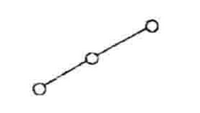 Star chart of Ilan Usiha, drawn by Fu Yuguang.png
-
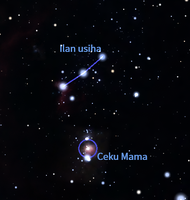 Ilan Usiha and Ceku Mama in Stellarium.png

IAU Working Group on Star Names
In 2026, the name of the Manchu star name "Ceku" was suggested to be used for θ1 Ori in this constellation. ...
Decision: ...
References
- ↑ Norman, J. (1978). A Concise Manchu-English Lexicon. Seattle: University of Washington Press. — ilan / usiha / tuwa / eme / mama / ceku / tumen.
- ↑ 2.0 2.1 2.2 2.3 2.4 2.5 2.6 2.7 Fu, Yuguang富育光, & Jing, Wenli荆文礼 (eds.). (2009). The Great Battle of Heaven · Xilin Anban Mafa天宫大战·西林安班玛发. Changchun: Jilin People's Publishing House. — Qi Fei Ling pp.47–49; Ba Fei Ling pp.56–57; Dungbule Mama pp.196–203.
- ↑ Huang, Renyuan黄任远. (2000). Studies in Tungusic–Manchu Mythology通古斯—满语族神话研究. Harbin: Heilongjiang People's Publishing House. — p.119 (star-goddess table), p.120 ("The Fire Goddess Tumu Mama"), p.194 (Xu-clan oracle "Fire Grandmother").
- ↑ Editorial Board编辑委员会. (1993). Dictionary of the Religions and Myths of China's Ethnic Groups中国各民族宗教与神话大词典. Beijing: Xueyuan Publishing House. — p.400 (tuwa enduri), p.401 (Tumu Mama), p.402 (Ilan Usiha, Gasiha, Enduri Senggu, Nadan Narhūn).
- ↑ 5.0 5.1 5.2 5.3 Zhang, Zhenjiang 张振江 (ill.), & Zhang, Xiaoguang 张晓光 (text). (2008). Illustrated Manchu Shaman Myths 萨满神话图说. Beijing: People's Fine Arts Publishing House. — Tumu Mama (swing goddess): origin from the earth goddess's fiery heart; first swung a lamp-topped swing to light the world but the mountains blocked her; plucked her light-hair to re-spread the stars; placed the southern Three Stars and northern Seven Stars as guiding lights for night travel; turned into a white stone hanging below the Three Stars, flickering and swaying; New-Year customs (lantern-pole, ice-lamps, swing, fire-basin) commemorate her sacrifice.
- ↑ Fu, Yuguang富育光, & Wang, Honggang王宏刚. (1995). Shamanic Goddesses萨满教女神. Shenyang: Liaoning People's Publishing House. — pp.34–35 (Qi Fei Ling), pp.38–39, 51 (fire-swing).
- ↑ 7.0 7.1 Fu, Yuguang富育光. (1988). A Study of Manchu Shamanic Star Rituals and Customs满族萨满教星祭俗考. Northern Ethnicities北方民族, (1), 98–108. — star table pp.103–105 (reprinted in Fu 1990 pp.107–109; Fu & Meng 1991 pp.232–235).
- ↑ Bäcker, J. (2000). The shaman's sky: Manchu mythology and starlore in the Amur Valley. Ad Seres et Tungusos. Festschrift für Martin Gimm, 1–17. — §2 (Ilan Usiha), §3 (Nadan Usiha shared origin), p.4 fn.8.
- ↑ Guo, Shuyun郭淑云. (2003). Shamanic Star Worship and the Budding of Northern Astronomy萨满教星辰崇拜与北方天文学的萌芽. World Religious Culture世界宗教研究, (1). — Three Stars hymn (original verified; see Notes).
- ↑ Stary, G. (1993). "Praying in the Darkness": New Texts for a Little-Known Manchu Shamanic Rite. Shaman: An International Journal for Shamanistic Research, 1(1), 91–94. — Manchu tuibumbi hymns of the Guwalgiya (瓜尔佳) clan of Jilin (1981 fieldwork; 1892 manuscript) invoking, in sequence, Tumen Usiha, Minggan Usiha, Ilan Usiha and Nadan Usiha.
- ↑ Song, Heping 宋和平 (trans., annot.). (1993). Translations and Annotations of Manchu Shamanic Hymns 满族萨满神歌译注. Beijing: Social Sciences Documentation Publishing House. — pp.269 ff. (Shi-clan "star-sequencing" / 順星 hymn: Lords of the Thousand, Ten-Thousand and Three Stars).
- ↑ Wang, Shengli王胜利, & Deng, Wenkuan邓文宽. (1981). Report on the Astronomy and Calendar of the Hezhe赫哲族天文历法调查报告. In: Collected Papers on the History of Chinese Astronomy中国天文学史文集, vol. 2. Beijing: Science Press, pp.71–76. — Three Stars as direction/southern marker and night-divider.
- ↑ Deng, Wenkuan邓文宽. (1981). Report on the Astronomy and Calendar of the Oroqen鄂伦春族天文历法调查报告. In: Collected Papers on the History of Chinese Astronomy中国天文学史文集, vol. 2. Beijing: Science Press, pp.61–70. — Three Stars at meridian = midnight.
- ↑ Manchu block-print edition of Jin Ping Mei (Chin P'ing Mei), ch. 92 — the vernacular proverb 三星权且作参商 rendered into Manchu as Ilan usiha taka ishun cashūn oho.
- ↑ Fu, Yuguang富育光, & Meng, Huiying孟慧英. (1991). A Study of Manchu Shamanism满族萨满教研究. Beijing: Beijing University Press. — traditional star-name table, pp.232–235.