Gasha: Difference between revisions
HaochengLyu (talk | contribs) mNo edit summary |
HaochengLyu (talk | contribs) mNo edit summary |
||
| (3 intermediate revisions by the same user not shown) | |||
| Line 28: | Line 28: | ||
[[File:People's Republic of China Exhibit- Eagle & Serpent.jpg|thumb|China Pavilion, 1982 World's Fair, Knoxville, Tennessee, digital copy of slide. Complete indexed photo collection at www.WorldHistoryPics.com. (CC0)]] | [[File:People's Republic of China Exhibit- Eagle & Serpent.jpg|thumb|China Pavilion, 1982 World's Fair, Knoxville, Tennessee, digital copy of slide. Complete indexed photo collection at www.WorldHistoryPics.com. (CC0)]] | ||
'''Gasha''' (Manchu: ᡤᠠᠰᡥᠠ; literally | '''Gasha''' (Manchu: ᡤᠠᠰᡥᠠ; literally "large bird"; in myth the Divine Eagle; read ''gas-ha'', IPA /qäs.χä/), also called '''Minggan Usiha''', "the Thousand Stars", is the largest constellation in the Manchu sky. It is drawn as an eagle with spread wings: the head lies in [[Auriga]], the body in [[Taurus]], the two wings in [[Gemini]] and [[Perseus]], and the two feet in [[Orion]] and [[Taurus]]. A rope is tied to the left leg (in [[Orion]]); that rope is [[Eridanus]], and it has a Manchu name of its own, '''hūyasun''' — the fetters put on a trained hunting eagle.<ref name="fuwang1995"/><ref name="norman"/> | ||
It occupies the mid-sky of winter, formed of more than a thousand stars drawn as an eagle with spread wings. Its deity is ranked the foremost of the gods in the Manchu wild-animal sacrifice, is the resting place of shamanic souls, and is the personification of the shaman's power of flight. | It occupies the mid-sky of winter, formed of more than a thousand stars drawn as an eagle with spread wings. Its deity is ranked the foremost of the gods in the Manchu wild-animal sacrifice, is the resting place of shamanic souls, and is the personification of the shaman's power of flight. | ||
| Line 36: | Line 36: | ||
=== The common noun and the proper name === | === The common noun and the proper name === | ||
The Manchu word ''gasha'' means | The Manchu word ''gasha'' means "(larger) bird" — an upper-level bird term, not a word for eagle specifically.<ref name="hauer"/><ref name="norman"/> | ||
The name of this asterism must be read on two levels. ''gasha'' is an ordinary Manchu noun meaning | The name of this asterism must be read on two levels. ''gasha'' is an ordinary Manchu noun meaning "(larger) bird"; '''Gasha''' as a star-name is the proper name of this asterism, and the word was chosen because the eagle is, in Manchu thinking, first of all a bird — and the large one among birds.<ref name="hauer"/><ref name="norman"/> | ||
=== Titles and deity names === | === Titles and deity names === | ||
| Line 56: | Line 56: | ||
| personal divine name || ''Daimin Gege'' / ''Daimin Mama'' || 代敏格格/代敏妈妈 || ''Lady Daimin'' / ''Mother Daimin'' | | personal divine name || ''Daimin Gege'' / ''Daimin Mama'' || 代敏格格/代敏妈妈 || ''Lady Daimin'' / ''Mother Daimin'' | ||
|- | |- | ||
| class name (fullest form) || '''Daimin Gasha Enduri''' / ''Daimin Enduri'' / ''Gasha Enduri'' || | | class name (fullest form) || '''Daimin Gasha Enduri''' / ''Daimin Enduri'' / ''Gasha Enduri'' || 代敏嘎思哈恩都力/代敏恩都力/嘎斯哈恩都力 || ''deity of the daimin bird'' / ''eagle-owl deity'' | ||
|} | |} | ||
The two honorific forms are synonymous and both mean | The two honorific forms are synonymous and both mean "foremost eagle, foremost eagle-owl", i.e. the first of all animal deities.<ref name="fuwang1995"/><ref name="fumeng1991"/> ''dalaha'' is glossed in the dictionary as "leading, at the head"; compare ''dalaha hūlha'' "chief of bandits" and ''dalaha urse'' "headmen", and the verb ''dalambi'' "to be leader, to be at the head, to occupy first place".<ref name="hujian1994"/> | ||
The dictionary form of | The dictionary form of "eagle-owl" is ''damin''.<ref name="norman"/> The manuscript form ''daimin'' is nonetheless not a misspelling: the Manchu ritual text itself reads ''daimin gasha enduri be soliki'', "let us invite the daimin-bird deity".<ref name="stary1993"/> | ||
''giyahūn'' is the general term for accipitrine birds (hawks, falcons and eagles).<ref name="norman"/> The "giyahūn 加浑" of the Chinese transcription ''Dalaha Giyahūn'' (达拉加浑) is its rendering. Manchu also has ''giyahūn i ošoho'', | ''giyahūn'' is the general term for accipitrine birds (hawks, falcons and eagles).<ref name="norman"/> The "giyahūn 加浑" of the Chinese transcription ''Dalaha Giyahūn'' (达拉加浑) is its rendering. Manchu also has ''giyahūn i ošoho'', "the talon of an eagle" — the talon being, in Manchu, a part of the bird that can be named on its own, which accords with the "two golden talons" of the star description below. | ||
''Daimin Gasha Enduri'' is the fullest of the names, with all three elements present: ''daimin'' (eagle-owl) + ''gasha'' (bird) + ''enduri'' (deity). It is also the only complete form attested in a Manchu original: the ''tuibumbi'' (evening-sacrifice) invocation reads ''daimin gasha enduri be soliki''.<ref name="stary1993"/> By contrast the honorifics ''Dalaha Daimin'' and ''Dalaha Giyahūn'' are known only from Chinese-language transcription. | ''Daimin Gasha Enduri'' is the fullest of the names, with all three elements present: ''daimin'' (eagle-owl) + ''gasha'' (bird) + ''enduri'' (deity). It is also the only complete form attested in a Manchu original: the ''tuibumbi'' (evening-sacrifice) invocation reads ''daimin gasha enduri be soliki''.<ref name="stary1993"/> By contrast the honorifics ''Dalaha Daimin'' and ''Dalaha Giyahūn'' are known only from Chinese-language transcription. | ||
| Line 100: | Line 100: | ||
Two details of the shape are recorded with unusual precision: Orion and Taurus form the "two golden talons", and Eridanus forms the "rope tied to the left leg".<ref name="fuwang1995"/> | Two details of the shape are recorded with unusual precision: Orion and Taurus form the "two golden talons", and Eridanus forms the "rope tied to the left leg".<ref name="fuwang1995"/> | ||
This rope has a Manchu name of its own, and the name is a falconry term: '''hūyasun''', glossed as "foot fetters (for hawks and falcons)".<ref name="norman"/> Related entries in the same semantic field include ''hūyambi'' | This rope has a Manchu name of its own, and the name is a falconry term: '''hūyasun''', glossed as "foot fetters (for hawks and falcons)".<ref name="norman"/> Related entries in the same semantic field include ''hūyambi'' "to cry, of eagles and falcons". The word is not a general term for rope — that is ''futa'' — but the jess fastened to a hawk's leg.<ref name="norman"/> | ||
Fieldwork gives a direct explanation of the rope.<ref name="fuwang1995"/> In Manchu hunting life the eagle was a chief instrument of the hunt: a wild bird taken in a net was tamed by keeping it awake and by "running the rope" (熬鹰、跑绳) until it became a "made" eagle answering its keeper, and a small cord was then tied to its leg so that the falconer could control the moment of release. Three causes thus converge: | Fieldwork gives a direct explanation of the rope.<ref name="fuwang1995"/> In Manchu hunting life the eagle was a chief instrument of the hunt: a wild bird taken in a net was tamed by keeping it awake and by "running the rope" (熬鹰、跑绳) until it became a "made" eagle answering its keeper, and a small cord was then tied to its leg so that the falconer could control the moment of release. Three causes thus converge: | ||
| Line 110: | Line 110: | ||
=== Season and visibility === | === Season and visibility === | ||
Gasha is seen in the | Gasha is seen in the middle sky at the ''chou'' double-hour (丑时, c. 01:00–03:00) after the autumn equinox, or in the western sky at the ''hai'' double-hour (c. 21:00–23:00) in the first lunar month; it is not visible on summer nights.<ref name="fuwang1995"/><ref name="dzd1993"/> A hymn has the line "O eagle star, in the west of the sky", which agrees with this.<ref name="fuwang1995"/> | ||
=== Note: Gasha is not Aquila === | === Note: Gasha is not Aquila === | ||
| Line 124: | Line 122: | ||
A small seal rescued a man and a woman from the flood; the eagle deity reared their daughter to become the ancestress of humankind and the first woman shaman.<ref name="fuwang1995"/><ref name="dzd1993"/> | A small seal rescued a man and a woman from the flood; the eagle deity reared their daughter to become the ancestress of humankind and the first woman shaman.<ref name="fuwang1995"/><ref name="dzd1993"/> | ||
The ''Heavenly War'' has a second version: Abka Hehe (the Sky Goddess) sent the divine eagle to suckle a baby girl and make her the first great shaman in the world, and the same passage states that "the great eagle star in the sky was tied by the left foot with a rope by Elden Hehe, who commanded her to assist the goddess | The ''Heavenly War'' has a second version: Abka Hehe (the Sky Goddess) sent the divine eagle to suckle a baby girl and make her the first great shaman in the world, and the same passage states that "the great eagle star in the sky was tied by the left foot with a rope by Elden Hehe, who commanded her to assist the goddess Dekden in guarding the vault of heaven".<ref name="fuwang1995"/> The same passage also offers a mythological explanation of the asterism's massive appearance: Yeruri tore the eagle's divine rope, and therefore the eagle star "changes more than any other, its star-feathers flashing in and out".<ref name="fuwang1995"/> | ||
The two versions differ in sequence, as Bäcker has also noted: in the Bai Menggu recension the rearing of the ancestress takes place '''before''' the flood, whereas in the other recensions the ancestress is at the same time the daughter of the couple rescued by the seal during the flood.<ref name="backer2000"/> | The two versions differ in sequence, as Bäcker has also noted: in the Bai Menggu recension the rearing of the ancestress takes place '''before''' the flood, whereas in the other recensions the ancestress is at the same time the daughter of the couple rescued by the seal during the flood.<ref name="backer2000"/> | ||
| Line 163: | Line 161: | ||
Three points deserve emphasis. | Three points deserve emphasis. | ||
'''Precedence.''' "Because of her invincible divine power she is often placed first in the wild-animal sacrifice, or called the | '''Precedence.''' "Because of her invincible divine power she is often placed first in the wild-animal sacrifice, or called the "leading deity"; ''Dalaha Daimin'' (达拉代敏) means 'foremost eagle-owl deity'."<ref name="fuwang1995"/> | ||
'''Gender.''' The original figure is a goddess: the oracle of the seven Kuren clans describes her as "a goddess with full breasts".<ref name="fuwang1995"/> This is the most easily overlooked and most important point in the study of the eagle deity — its oldest layer is female. The entry accordingly uses ''goddess'' throughout. | '''Gender.''' The original figure is a goddess: the oracle of the seven Kuren clans describes her as "a goddess with full breasts".<ref name="fuwang1995"/> This is the most easily overlooked and most important point in the study of the eagle deity — its oldest layer is female. The entry accordingly uses ''goddess'' throughout. | ||
| Line 258: | Line 256: | ||
== IAU Working Group on Star Names == | == IAU Working Group on Star Names == | ||
In 2026, the name of the historical constellation "'''Gasha'''" was suggested to be used for ''' | In 2026, the name of the historical constellation "'''Gasha'''" was suggested to be used for '''π Aur''' in this constellation. Because α Aur ([[Capella]]) and β Aur ([[Menkalinan]]) are the two eyes of the eagle, while π Aur is very close to β Aur. | ||
== References == | == References == | ||
| Line 265: | Line 263: | ||
<references> | <references> | ||
<ref name="backer2000">Bäcker, J. (2000). The shaman's sky: Manchu mythology and starlore in the Amur Valley. In: ''Ad Seres et Tungusos. Festschrift für Martin Gimm'', 1–17. — §8, pp.10–11 (Gasha); fn.8 (the Pleiades/Big Dipper confusion); fn.24 (Hauer on ''gasha'' and ''daimin'').</ref> | <ref name="backer2000">Bäcker, J. (2000). The shaman's sky: Manchu mythology and starlore in the Amur Valley. In: ''Ad Seres et Tungusos. Festschrift für Martin Gimm'', 1–17. — §8, pp.10–11 (Gasha); fn.8 (the Pleiades/Big Dipper confusion); fn.24 (Hauer on ''gasha'' and ''daimin'').</ref> | ||
<ref name="norman">Norman, J. (1978). ''A Concise Manchu-English Lexicon''. Seattle: University of Washington Press. — ''GASHA'' p.102 (large bird; ''GASHANGGA'', ''GASHATU''); ''DAMIN'' p.53; ''DALAMBI'' p.53; ''DARA'' p.54; ''GIYAHŪN'' p.109 (''GIYAHŪN I OŠOHO''); ''HÛYASUN'' p.142 (foot fetters for hawks and falcons); ''HÛYAMBI''; ''FUTA''.</ref> | <ref name="norman">Norman, J. (1978). ''A Concise Manchu-English Lexicon''. Seattle: University of Washington Press. — ''GASHA'' p.102 (large bird; ''GASHANGGA'', ''GASHATU''); ''DAMIN'' p.53; ''DALAMBI'' p.53; ''DARA'' p.54; ''GIYAHŪN'' p.109 (''GIYAHŪN I OŠOHO''); ''HÛYASUN'' p.142 (foot fetters for hawks and falcons); ''HÛYAMBI''; ''FUTA''.</ref> | ||
<ref name="stary1993">Stary, G. (1993). "Praying in the Darkness": New Texts for a Little-Known Manchu Shamanic Rite. ''Shaman: An International Journal for Shamanistic Research'', 1(1), 91–94. — Manchu ''tuibumbi'' invocation, pp.92, 94, 99; ''daimin gasha enduri be soliki''.</ref> | <ref name="stary1993">Stary, G. (1993). "Praying in the Darkness": New Texts for a Little-Known Manchu Shamanic Rite. ''Shaman: An International Journal for Shamanistic Research'', 1(1), 91–94. — Manchu ''tuibumbi'' invocation, pp.92, 94, 99; ''daimin gasha enduri be soliki''.</ref> | ||
<ref name="fuwang1995">Fu, Yuguang 富育光, & Wang, Honggang 王宏刚. (1995). ''Shamanic Goddesses 萨满教女神''. Shenyang: Liaoning People's Publishing House. — p.48 (Elden Hehe fetters the eagle's left foot); pp.101–103 (the star-spreading goddess and the summoning of the stars); pp.106–110 (form of the eagle star, the two golden talons, Eridanus, falconry).</ref> | <ref name="fuwang1995">Fu, Yuguang 富育光, & Wang, Honggang 王宏刚. (1995). ''Shamanic Goddesses 萨满教女神''. Shenyang: Liaoning People's Publishing House. — p.48 (Elden Hehe fetters the eagle's left foot); pp.101–103 (the star-spreading goddess and the summoning of the stars); pp.106–110 (form of the eagle star, the two golden talons, Eridanus, falconry).</ref> | ||
<ref name="fumeng1991">Fu, Yuguang 富育光, & Meng, Huiying 孟慧英. (1991). ''A Study of Manchu Shamanism 满族萨满教研究''. Beijing: Beijing University Press. — p.213 (the white-water-bird deity); p.214 (eagle-owl terms; foremost eagle and foremost eagle-owl; fire and water messengers; the praise on carrying the sun); p.215 (the Zari praise; the stone egg; the mother eagle and fire); p.216 (mimesis of the eagle; the Hezhen k'ori); p.217 (Gasha Enduri); pp.232–235 (star-name table).</ref> | <ref name="fumeng1991">Fu, Yuguang 富育光, & Meng, Huiying 孟慧英. (1991). ''A Study of Manchu Shamanism 满族萨满教研究''. Beijing: Beijing University Press. — p.213 (the white-water-bird deity); p.214 (eagle-owl terms; foremost eagle and foremost eagle-owl; fire and water messengers; the praise on carrying the sun); p.215 (the Zari praise; the stone egg; the mother eagle and fire); p.216 (mimesis of the eagle; the Hezhen k'ori); p.217 (Gasha Enduri); pp.232–235 (star-name table).</ref> | ||
<ref name="hujian1994">Hu, Zengyi 胡增益 (ed.). (1994). ''New Manchu-Chinese Dictionary 新满汉大词典''. Ürümqi: Xinjiang People's Publishing House. — ''dalambi''; ''dalaha hūlha''; ''dalaha urse''.</ref> | <ref name="hujian1994">Hu, Zengyi 胡增益 (ed.). (1994). ''New Manchu-Chinese Dictionary 新满汉大词典''. Ürümqi: Xinjiang People's Publishing House. — ''dalambi''; ''dalaha hūlha''; ''dalaha urse''.</ref> | ||
<ref name="fu1988">Fu, Yuguang 富育光. (1988). A Study of the Manchu Shamanic Star Sacrifice 满族萨满教星祭俗考. ''Northern Ethnicities 北方民族'', (1), 98–108. — star table pp.103–105 (reprinted in Fu 1990, pp.107–109, and Fu & Meng 1991, pp.232–235).</ref> | <ref name="fu1988">Fu, Yuguang 富育光. (1988). A Study of the Manchu Shamanic Star Sacrifice 满族萨满教星祭俗考. ''Northern Ethnicities 北方民族'', (1), 98–108. — star table pp.103–105 (reprinted in Fu 1990, pp.107–109, and Fu & Meng 1991, pp.232–235).</ref> | ||
<ref name="dzd1993">Editorial Board 编辑委员会. (1993). ''Dictionary of the Religions and Myths of China's Ethnic Groups 中国各民族宗教与神话大词典''. Beijing: Xueyuan Publishing House. — pp.401–402 (Mother Elden 卧拉多妈妈; Nadan Narhūn; Gasiha); pp.492–493 (Daimin Gege).</ref> | <ref name="dzd1993">Editorial Board 编辑委员会. (1993). ''Dictionary of the Religions and Myths of China's Ethnic Groups 中国各民族宗教与神话大词典''. Beijing: Xueyuan Publishing House. — pp.401–402 (Mother Elden 卧拉多妈妈; Nadan Narhūn; Gasiha); pp.492–493 (Daimin Gege).</ref> | ||
<ref name="ling1934">Ling, Chunsheng 凌纯声. (1934). ''The Hezhen of the Lower Sunggari 松花江下游的赫哲族''. Nanjing: Academia Sinica. — vol. 1, p.127 and fig. 226 (p.416); vol. 2, p.572.</ref> | <ref name="ling1934">Ling, Chunsheng 凌纯声. (1934). ''The Hezhen of the Lower Sunggari 松花江下游的赫哲族''. Nanjing: Academia Sinica. — vol. 1, p.127 and fig. 226 (p.416); vol. 2, p.572.</ref> | ||
<ref name="onenko">Onenko, S. N. Оненко, С. Н. (ed.). ''Nanai-Russian Dictionary Нанайско-Русский Словарь: 12 800 слов''. — p.227, s.v. ''кōри'' [қōрі].</ref> | |||
<ref name="onenko">Onenko, S. N. Оненко, С. Н. (ed.). ''Nanai-Russian Dictionary Нанайско-Русский Словарь: 12 800 слов''. — p.227, s.v. ''кōри'' [ | |||
<ref name="hauer">Hauer, E. ''Handwörterbuch der Mandschusprache''. — ''gasha'' "(größerer) Vogel", as cited in Bäcker (2000), fn.24.</ref> | <ref name="hauer">Hauer, E. ''Handwörterbuch der Mandschusprache''. — ''gasha'' "(größerer) Vogel", as cited in Bäcker (2000), fn.24.</ref> | ||
</references> | </references> | ||
Latest revision as of 06:57, 19 November 2026
Authors: Lyu Haocheng, Susanne M Hoffmann

| Asterism Info | |
| Native | ᡤᠠᠰᡥᠠ |
|---|---|
| Romanisation | gasha |
| IPA | /qäs.χä/ |
| Translation | (Large) Bird |
| Position (2000) | |
| Right ascension | 56.08470833 to 116.3352083 |
| Declination | −9.670194444 to 45.99913889 |
| Stars | |
| Bright stars | 19+ |
| Stars brighter than 3.00m | 19 |
| Brightest star | α Aur (Capella) (0.08m) |
| Taxonomy | |
| category of asterism | Constellation |
| IAU- constellations | Aur, Tau, Gem, Per, Ori, Eri |
Drawn as a spread eagle; the Pleiades are its western (right-hand) point of attachment, Eridanus its left-foot fetter. | |


Gasha (Manchu: ᡤᠠᠰᡥᠠ; literally "large bird"; in myth the Divine Eagle; read gas-ha, IPA /qäs.χä/), also called Minggan Usiha, "the Thousand Stars", is the largest constellation in the Manchu sky. It is drawn as an eagle with spread wings: the head lies in Auriga, the body in Taurus, the two wings in Gemini and Perseus, and the two feet in Orion and Taurus. A rope is tied to the left leg (in Orion); that rope is Eridanus, and it has a Manchu name of its own, hūyasun — the fetters put on a trained hunting eagle.[1][2]
It occupies the mid-sky of winter, formed of more than a thousand stars drawn as an eagle with spread wings. Its deity is ranked the foremost of the gods in the Manchu wild-animal sacrifice, is the resting place of shamanic souls, and is the personification of the shaman's power of flight.
Spelling variants and etymology
The common noun and the proper name
The Manchu word gasha means "(larger) bird" — an upper-level bird term, not a word for eagle specifically.[3][2]
The name of this asterism must be read on two levels. gasha is an ordinary Manchu noun meaning "(larger) bird"; Gasha as a star-name is the proper name of this asterism, and the word was chosen because the eagle is, in Manchu thinking, first of all a bird — and the large one among birds.[3][2]
Titles and deity names
The deity of the eagle star carries several designations, which belong to different levels and must not be conflated:
| Level | Manchu | Chinese transcription | English rendering |
|---|---|---|---|
| common noun | gasha | 嘎斯哈/嘎思哈 | bird |
| proper name (star-name) | Gasha | 嘎思哈 | Gasha |
| honorific title | Dalaha Daimin / Dalaha Giyahūn | 达拉呆敏/达拉加浑 | Foremost Eagle-owl / Foremost Eagle |
| personal divine name | Daimin Gege / Daimin Mama | 代敏格格/代敏妈妈 | Lady Daimin / Mother Daimin |
| class name (fullest form) | Daimin Gasha Enduri / Daimin Enduri / Gasha Enduri | 代敏嘎思哈恩都力/代敏恩都力/嘎斯哈恩都力 | deity of the daimin bird / eagle-owl deity |
The two honorific forms are synonymous and both mean "foremost eagle, foremost eagle-owl", i.e. the first of all animal deities.[1][4] dalaha is glossed in the dictionary as "leading, at the head"; compare dalaha hūlha "chief of bandits" and dalaha urse "headmen", and the verb dalambi "to be leader, to be at the head, to occupy first place".[5]
The dictionary form of "eagle-owl" is damin.[2] The manuscript form daimin is nonetheless not a misspelling: the Manchu ritual text itself reads daimin gasha enduri be soliki, "let us invite the daimin-bird deity".[6]
giyahūn is the general term for accipitrine birds (hawks, falcons and eagles).[2] The "giyahūn 加浑" of the Chinese transcription Dalaha Giyahūn (达拉加浑) is its rendering. Manchu also has giyahūn i ošoho, "the talon of an eagle" — the talon being, in Manchu, a part of the bird that can be named on its own, which accords with the "two golden talons" of the star description below.
Daimin Gasha Enduri is the fullest of the names, with all three elements present: daimin (eagle-owl) + gasha (bird) + enduri (deity). It is also the only complete form attested in a Manchu original: the tuibumbi (evening-sacrifice) invocation reads daimin gasha enduri be soliki.[6] By contrast the honorifics Dalaha Daimin and Dalaha Giyahūn are known only from Chinese-language transcription.
Identification of stars
Five-part structure
The shape of the asterism is divided into five parts, each corresponding to a segment of a modern constellation:
| Part | Modern constellation |
|---|---|
| head | Auriga |
| body | Taurus |
| wings | Gemini (one wing), Perseus (one wing) |
| feet | Orion (left foot, where the fetter is tied), Taurus (right foot) |
| fetter of the left leg | Eridanus |
The nature of the drawn chart
The shamanic tradition has star charts of its own, but photography was not permitted, and Fu Yuguang had to copy the charts of all the constellations by hand.[7]
The lines of the eagle in those charts are schematic. Many of the line-endings correspond to no actual star: they were added to complete the outline of the bird. The "thousand stars" of the alternative name is likewise a figure of speech, not a measured count.[7]

Gasha is therefore not an object that can be given precise coordinates. It is a set of directional shapes, and its real boundary is set by the bright stars that the region naturally presents. What can be said with confidence is that the eagle star contains all the bright stars of that region of sky.
The two golden talons and the fetter of the left leg
Two details of the shape are recorded with unusual precision: Orion and Taurus form the "two golden talons", and Eridanus forms the "rope tied to the left leg".[1]
This rope has a Manchu name of its own, and the name is a falconry term: hūyasun, glossed as "foot fetters (for hawks and falcons)".[2] Related entries in the same semantic field include hūyambi "to cry, of eagles and falcons". The word is not a general term for rope — that is futa — but the jess fastened to a hawk's leg.[2]
Fieldwork gives a direct explanation of the rope.[1] In Manchu hunting life the eagle was a chief instrument of the hunt: a wild bird taken in a net was tamed by keeping it awake and by "running the rope" (熬鹰、跑绳) until it became a "made" eagle answering its keeper, and a small cord was then tied to its leg so that the falconer could control the moment of release. Three causes thus converge:
- the mythic cause — the star-spreading goddess Elden Hehe ties the eagle's left foot with a rope;
- the visual cause — Eridanus looks like a rope;
- the ethnographic and lexical cause — a jess, hūyasun, is tied to the leg of a trained eagle.[1][2]
Season and visibility
Gasha is seen in the middle sky at the chou double-hour (丑时, c. 01:00–03:00) after the autumn equinox, or in the western sky at the hai double-hour (c. 21:00–23:00) in the first lunar month; it is not visible on summer nights.[1][8] A hymn has the line "O eagle star, in the west of the sky", which agrees with this.[1]
Note: Gasha is not Aquila
Earlier research has stated the point plainly: "It is far away from the summer constellation Aquila, and almost opposite to it. Thus, there is no reason to assume a connection between both."[9]
Myth
The eagle rears the first ancestress
A small seal rescued a man and a woman from the flood; the eagle deity reared their daughter to become the ancestress of humankind and the first woman shaman.[1][8]
The Heavenly War has a second version: Abka Hehe (the Sky Goddess) sent the divine eagle to suckle a baby girl and make her the first great shaman in the world, and the same passage states that "the great eagle star in the sky was tied by the left foot with a rope by Elden Hehe, who commanded her to assist the goddess Dekden in guarding the vault of heaven".[1] The same passage also offers a mythological explanation of the asterism's massive appearance: Yeruri tore the eagle's divine rope, and therefore the eagle star "changes more than any other, its star-feathers flashing in and out".[1]
The two versions differ in sequence, as Bäcker has also noted: in the Bai Menggu recension the rearing of the ancestress takes place before the flood, whereas in the other recensions the ancestress is at the same time the daughter of the couple rescued by the seal during the flood.[9]
The stone egg from the fire
The eagle deity first took a stone egg out of the fire, and from it was born a woman shaman — the "Khan with seven-branched antlers" of the ninety-nine tribes of the East Sea, the most ancient ancestress and female khan of that region.[1][8] The sources differ only in fullness of naming, some giving merely "the remotest ancestress and female khan of the East Sea" and others the full title; the referent is one deity, not two variant traditions.[4]
The mother eagle brings fire
At the beginning of the world the earth was like a lump of ice. Abka Hehe made a mother eagle fly past the sun and shake the light and heat of the sun into her feathers, and carry it to the world; only then did the ice and snow melt. The mother eagle grew so tired that she dozed, and the fire in her feathers fell out and set the forests and stones ablaze. The divine eagle beat the flames down with her great wings and carried earth in her talons to smother the fire, but the flames destroyed her wings and she died in the sea, and her eagle soul became a woman shaman.[1][8]
The structure — take fire, be consumed, be transformed — is the same as that of the fire goddess Tumu, but the goal of the transformation differs: the eagle becomes a woman shaman, Tumu becomes a star. The two are not merged into one deity; the parallel is noted as a shared motif family only.
Deity
Four roles
The personal name Daimin Gege (代敏格格) is glossed in the Chinese dictionary as the Manchu eagle-head goddess: in the flood myth the seal saves the couple, their daughter is born, and Daimin Gege carries her off and rears her, so that she becomes the first shaman and ancestress of humankind; Dalaha Giyahūn (达拉加浑), Dalaha Daimin (达拉代敏) and Daimin Enduri (代敏恩都里) all denote eagle-owl deities; and the eagle deity is the messenger of fire and the symbol of light and heat.[8]
Four roles can be distinguished, each with textual support:
| Role | Evidence |
|---|---|
| the shaman's soul-resting place | the hymn "O eagle star, in the west of the sky, resting place of shaman souls, shine, O shine!"[1] |
| symbol of the shaman's power and sky-whirling | the mila (弥罗) whirl, the splayed "eagle step", the nine or seventeen eagles on the divine cap[1] |
| the shaman's guardian and guide | in the Nišan Saman (尼山萨满) the eagle deity helps the shamaness descend to the underworld and bring back a soul[1] |
| symbol of light and heat, messenger of fire | see above; the oracle's praise "golden wings that cover clouds and hide the earth, cradling two silver talons, carrying the sun in on her back by day and carrying it away at night"[4][8] |
Precedence, gender, and the shaman's mimesis
Three points deserve emphasis.
Precedence. "Because of her invincible divine power she is often placed first in the wild-animal sacrifice, or called the "leading deity"; Dalaha Daimin (达拉代敏) means 'foremost eagle-owl deity'."[1]
Gender. The original figure is a goddess: the oracle of the seven Kuren clans describes her as "a goddess with full breasts".[1] This is the most easily overlooked and most important point in the study of the eagle deity — its oldest layer is female. The entry accordingly uses goddess throughout.
Ritual behaviour. The shaman's own manner is a mimesis of the eagle: swallowing liver, preening, shaking, whirling, the splayed "eagle step".[8] The number of eagles on the divine cap is fixed by rule, at nine or seventeen.[1] The significance of this layer is that the eagle is not only the object of sacrifice but the formal model of shamanic technique: the shape of the deity and the movement of the officiant are one and the same.
Hymns
Two texts may be quoted in translation.
The praise of the attendant Jari, from the epic Umesiben Mama:[4]
- Je, je — you come flying down from heaven like wind, thunder and lightning;
- je, je — you come down from the mountains like golden light blinding the eye;
- je — your left wing spreads and covers the sun,
- je — your right wing spreads and covers the moon;
- the tips of your front talons rest on the Sunggari Ula (Songhua River),
- the tips of your hind talons hook into the Bakajin Holo of the East Sea.
The oracle of the Nimaca clan:[1]
- The martial eagle deity draped in golden light,
- the divine lord who carries the sunlight,
- spreads his divine wings and covers sun and moon,
- his tail feathers screen the seven layers of forest
- and the waters of the great sea.
When she comes "the divine wind howls and the villages of the valleys tremble"; "she circled nine rings of cloud and gave nine long cries", so that "gods and ghosts all fled in alarm and the deities drew back".[1]
Ritual
The evening sacrifice (tuibumbi)
A Manchu invocation of the evening sacrifice (the Guwalgiya manuscript of 1892, collected in Jilin in 1981) sings in sequence: tumen usiha tucike "the ten thousand stars have come out", minggan usiha mitaha "the thousand stars have spread", Ilan Usiha (ᡳᠯᠠᠨ ᡠᠰᡳᡥᠠ) ilaha "the three stars have bloomed", Nadan Usiha nicušaha "the seven stars have gathered", eriku usiha eldehe "the comet star shines" — and then, immediately, Daimin Gasha Enduri be soliki, "let us invite the daimin-bird deity".[6]
This is the hardest original-language evidence to date that the eagle is a star deity. The eagle deity is not mentioned in passing: it is an invited party within the same ritual unit as the Three Stars, the Seven Stars and the comet. Hitherto the argument could only rest on Chinese translations of hymns; now there is a Manchu text. A further point: the Three Stars and the Seven Stars serve in the invocation as markers of the hour — the appearance of a star marks the progress of the rite, which shows from another side how tightly the star sacrifice is bound to the night ritual.
The ritual context of the eagle star deity is therefore the evening sacrifice (nocturnal, with female deities predominating), which meshes with the astronomical properties "west of the sky" and "visible at night".
Gasha and Nadan Narhūn (Pleiades)
The eagle's shape and its ritual both bring in another Manchu asterism, Nadan Narhūn (ᠨᠠᡩᠠᠨ ᠨᠠᡵᡥᡡᠨ) — the Pleiades, the "seven maidens" who are the star-spreading goddess Elden Hehe herself.
The great eagle star in the sky was tied by the left foot with a rope by Elden Hehe, who commanded her to assist the goddess Dedeng in guarding the vault of heaven.[1] That rope is Eridanus, the jess hūyasun described above. At the other end, being the Pleiades, she is herself the point at the eagle's right side.
On an early-winter evening the Pleiades are the first of this group to come up in the east; the body of the eagle then follows from that same western end — Auriga first, then Orion and Gemini. To the eye it is the star-spreading goddess leading the bright winter stars up into the sky: she comes up first, and the "thousand stars" rise behind her, part after part.
In the star sacrifice she is not a subsidiary figure: the chief offering of the blood sacrifice goes to her, and the Pleiades are, in the recorder's phrase, "the star chart of Elden Mama" — her own form in the sky.[1] The summoning hymn treats her the same way. It does not invite her to come and stand beside the eagle; it calls her from within it — "among the thousand stars", "among the eagle star that perches high in the cloudy sky", and where "the rope is drawn out afar". Eagle, rope and goddess therefore fall in one passage of the hymn, not in three separate entries of a list.

The evening rite points the same way. In the lamp-extinguished sacrifice she is one of the three deities to whom offering is made; the shaman's soul on its way to heaven asks her for two things — white wings to fly with, and the shining stars of heaven appointed to guide and guard it — and rests on the "star bridge" overhead.[8]
Cross-cultural parallels
Eagle deities of three peoples
The following three eagle deities are commonly discussed together,[1] and the comparison is summed up in one sentence: "all the later skills and powers of the eagle deity derive from the ancient eagle-star goddess."[1]
| People | Name | Form and function |
|---|---|---|
| Manchu | Gasha / Dalaha Giyahūn | the thousand-star asterism; foremost deity; rears the ancestress, governs fire |
| Oroqen | 涉刻 (two-headed eagle) | guardian deity of the shaman |
| Hezhen / Nanai | [k'ori] / кōри | wooden idol (guiding souls to the other world); the shape into which the woman hero of the yimakan transforms |
Hezhen and Nanai k'ori
The eagle deity of the Hezhen, [k'ori] (written 阔里 in Chinese; the literature usually has 阔力), is recorded as follows: a wooden idol used to guide souls on their way; and in the yimakan narratives the woman hero, transforming herself for battle, also takes this bird's form.[10] The Nanai dictionary agrees exactly:[11]
- кōри [қōрі] 1) shaman. the mythical bird on which the shaman flies to the other world; 2) folk. the wondrous bird into which the hero of a tale transforms.
The two register labels divide the two senses, and they correspond one-to-one to the two things recorded separately: the guiding of souls in ritual, and the transformation of the woman hero in narrative. This is the first time that the ritual sense and the transformation sense of the Hezhen/Nanai divine eagle have been given authoritative lexicographic support.
Manchu Gasha and Hezhen [k'ori] are a cognate motif, not a cognate term: the roots differ. Moreover the Hezhen k'ori has no astronomical identification whatever, and nothing may suggest that it is the same asterism. The Chinese literature also argues only at the level of motif ("a typical instance of the ancient goddess cult surviving into modern times"), never for identity of word.[1]
Gallery
- Gasha
-
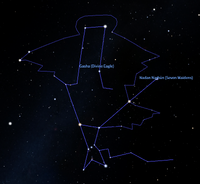 Gasha and Nadan Narhūn in Stellarium
-
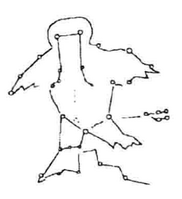 Star chart of Gasha, drawn by Fu Yuguang
-
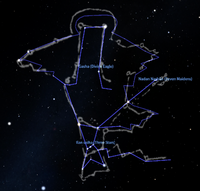 The superposition of traditional star chart and actual stars
-
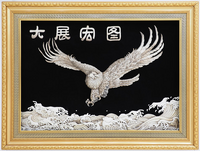 Engraved eagle totem
-
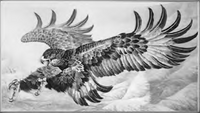 Fish-skin openwork: the divine eagle "k'ori"
-
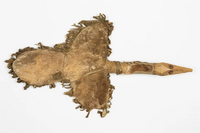 An image of the shamanic bird, "Koori"
-
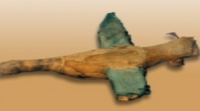 The koori bird. Second half of the 19th century. Nanai. Wood, cloth. School museum, Sikachi-Alyan village


IAU Working Group on Star Names
In 2026, the name of the historical constellation "Gasha" was suggested to be used for π Aur in this constellation. Because α Aur (Capella) and β Aur (Menkalinan) are the two eyes of the eagle, while π Aur is very close to β Aur.
References
- ↑ 1.00 1.01 1.02 1.03 1.04 1.05 1.06 1.07 1.08 1.09 1.10 1.11 1.12 1.13 1.14 1.15 1.16 1.17 1.18 1.19 1.20 1.21 1.22 1.23 1.24 Fu, Yuguang 富育光, & Wang, Honggang 王宏刚. (1995). Shamanic Goddesses 萨满教女神. Shenyang: Liaoning People's Publishing House. — p.48 (Elden Hehe fetters the eagle's left foot); pp.101–103 (the star-spreading goddess and the summoning of the stars); pp.106–110 (form of the eagle star, the two golden talons, Eridanus, falconry).
- ↑ 2.0 2.1 2.2 2.3 2.4 2.5 2.6 2.7 Norman, J. (1978). A Concise Manchu-English Lexicon. Seattle: University of Washington Press. — GASHA p.102 (large bird; GASHANGGA, GASHATU); DAMIN p.53; DALAMBI p.53; DARA p.54; GIYAHŪN p.109 (GIYAHŪN I OŠOHO); HÛYASUN p.142 (foot fetters for hawks and falcons); HÛYAMBI; FUTA.
- ↑ 3.0 3.1 Hauer, E. Handwörterbuch der Mandschusprache. — gasha "(größerer) Vogel", as cited in Bäcker (2000), fn.24.
- ↑ 4.0 4.1 4.2 4.3 Fu, Yuguang 富育光, & Meng, Huiying 孟慧英. (1991). A Study of Manchu Shamanism 满族萨满教研究. Beijing: Beijing University Press. — p.213 (the white-water-bird deity); p.214 (eagle-owl terms; foremost eagle and foremost eagle-owl; fire and water messengers; the praise on carrying the sun); p.215 (the Zari praise; the stone egg; the mother eagle and fire); p.216 (mimesis of the eagle; the Hezhen k'ori); p.217 (Gasha Enduri); pp.232–235 (star-name table).
- ↑ Hu, Zengyi 胡增益 (ed.). (1994). New Manchu-Chinese Dictionary 新满汉大词典. Ürümqi: Xinjiang People's Publishing House. — dalambi; dalaha hūlha; dalaha urse.
- ↑ 6.0 6.1 6.2 Stary, G. (1993). "Praying in the Darkness": New Texts for a Little-Known Manchu Shamanic Rite. Shaman: An International Journal for Shamanistic Research, 1(1), 91–94. — Manchu tuibumbi invocation, pp.92, 94, 99; daimin gasha enduri be soliki.
- ↑ 7.0 7.1 Fu, Yuguang 富育光. (1988). A Study of the Manchu Shamanic Star Sacrifice 满族萨满教星祭俗考. Northern Ethnicities 北方民族, (1), 98–108. — star table pp.103–105 (reprinted in Fu 1990, pp.107–109, and Fu & Meng 1991, pp.232–235).
- ↑ 8.0 8.1 8.2 8.3 8.4 8.5 8.6 8.7 Editorial Board 编辑委员会. (1993). Dictionary of the Religions and Myths of China's Ethnic Groups 中国各民族宗教与神话大词典. Beijing: Xueyuan Publishing House. — pp.401–402 (Mother Elden 卧拉多妈妈; Nadan Narhūn; Gasiha); pp.492–493 (Daimin Gege).
- ↑ 9.0 9.1 Bäcker, J. (2000). The shaman's sky: Manchu mythology and starlore in the Amur Valley. In: Ad Seres et Tungusos. Festschrift für Martin Gimm, 1–17. — §8, pp.10–11 (Gasha); fn.8 (the Pleiades/Big Dipper confusion); fn.24 (Hauer on gasha and daimin).
- ↑ Ling, Chunsheng 凌纯声. (1934). The Hezhen of the Lower Sunggari 松花江下游的赫哲族. Nanjing: Academia Sinica. — vol. 1, p.127 and fig. 226 (p.416); vol. 2, p.572.
- ↑ Onenko, S. N. Оненко, С. Н. (ed.). Nanai-Russian Dictionary Нанайско-Русский Словарь: 12 800 слов. — p.227, s.v. кōри [қōрі].