Udang: Difference between revisions
No edit summary |
|||
| Line 22: | Line 22: | ||
[[File:AlfredMaas1929 Astrologische Kalender der Balinesen ocr IdentTab cut.jpg|thumb|Identification of Balinese constellations (Maaß 1929, appendix). ]] | [[File:AlfredMaas1929 Astrologische Kalender der Balinesen ocr IdentTab cut.jpg|thumb|Identification of Balinese constellations (Maaß 1929, appendix). ]] | ||
The astronomical identification of the constellation is taken from Maaß (1929)<ref name=":1" /> who explains in general that these constellations and the according ritual practice <blockquote>"sind seit alten Zeiten in einem Werk ,,wariga" niedergelegt, in dem wir zwei Kulturschichten, nämlich indische | The astronomical identification of the constellation is taken from Maaß (1929)<ref name=":1" /> who explains in general that these constellations and the according ritual practice <blockquote>"sind seit alten Zeiten in einem Werk ,,wariga" niedergelegt, in dem wir zwei Kulturschichten, nämlich indische und malaio-polynesische Bestandteile wiederfinden." </blockquote><blockquote>'''English:''' "are written down in a work called "wariga" since old times; there we recognise two cultural layers, i.e. the Indian and the Malayo-Polynesian."</blockquote>He also quotes other scholars<ref>Friedrich, R. (1849). Voorloopig verslag van het eiland Bali, Batavia, Verb. Bat Gen. Deel 23, Nr. 13</ref><ref>HINLOOPEN LABBERT0N, D. VAN (1910). Geillustreerd handboek van Insulinde. Amsterdam: "Vivat"</ref><ref>PIGEAUD, TH. (1925). Een stuk over sterrenkunde uit het Anggastyaparwwa ...... Weltevreden: Albrecht. Tijdsch. v. lnd, T.-, L.- en Vk. deel LXV</ref><ref>Nieuwenkamp, W. O. J. (1905), Schetsen van Bali en Lombok. (Eigen Haard)</ref> and his earlier work<ref>MAASS, ALFRED (1920). Sterne und Sternbilder im malaiischen Archipel. Berlin. Zeitschrift für Ethnologie Jg. 1920/21, H. 1</ref><ref>MAASS, ALFRED (1924). Sternkunde und Sterndeuterei im malaiischen Archipel. Batavia, den Haag. Tijdsch. v. T.-, L.-en Vk. deel LX IV</ref> reporting that this work dates back to the 9th century CE when Bali was part of a Hindu empire on the neighbouring island of Java.<ref name=":1" /> Neubronner van der Tuuk even uses the Old Javanese spelling. | ||
==== Identification ==== | ==== Identification ==== | ||
Revision as of 15:40, 29 January 2026
Authors: Youla Azkarrula, Susanne M Hoffmann

Udang is an Oceanic name from Bali (Indonesia). The lintang of udang is found in intersection of Sukra (Friday, in saptawara) and Kliwon (in pancawara) in a series of palelintangan. Lintang udang means prawn constellation.[1]
Etymology and History
Udang (IPA: [ˈu.daŋ]), means shrimp.
Spelling Variants
- hudang
- urang
- makara
Origin of Constellation
For Balinese people, shrimp is primarily viewed as a food commodity with high economic value and a key ingredient in Balinese cuisine. Shrimp, particularly whiteleg and tiger shrimp, is a leading fishery commodity in Bali with significant economic potential. The local and central governments fully support the development of shrimp cultivation in various regions in Bali, such as Jembrana and Buleleng, to meet local and export market demand. Shrimp is considered a source of high-quality protein with health benefits. Government campaigns to promote the consumption of fish and seafood, including shrimp, are also being promoted in Bali.[2]
Furthermore, shrimp symbolize good fortune and fertility, which are expected to bring prosperity to the community. This is reflected in the Balinese batik art, Batik Ulamsari Mas, which depicts fish and shrimp.
General information

The astronomical identification of the constellation is taken from Maaß (1929)[3] who explains in general that these constellations and the according ritual practice
"sind seit alten Zeiten in einem Werk ,,wariga" niedergelegt, in dem wir zwei Kulturschichten, nämlich indische und malaio-polynesische Bestandteile wiederfinden."
English: "are written down in a work called "wariga" since old times; there we recognise two cultural layers, i.e. the Indian and the Malayo-Polynesian."
He also quotes other scholars[4][5][6][7] and his earlier work[8][9] reporting that this work dates back to the 9th century CE when Bali was part of a Hindu empire on the neighbouring island of Java.[3] Neubronner van der Tuuk even uses the Old Javanese spelling.
Identification
The identifications, Maaß (1929) gives according to the aforementioned and his own studies during visits of the country and in European and Batavian libraries (p.150).[3]
Transfer and Transformation of the Constellation
Mythology / Religion
Pura Dalem Sempua, located in Dalung Village, North Kuta District, Badung Regency, is known as a sacred Balinese Hindu site filled with mystical aura. Anyone entering this area must strictly adhere to a number of taboos. One of them is that the entire family of the priest is also strictly prohibited from consuming shrimp. This is because the "due" (guardian of the temple area) at Pura Dalem Sempua is in the form of tailless julit fish, tailless snakehead fish, and shrimp.
Image Variants
-
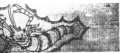 Lintang Hudang (CC-BY Alfred Maaß, (1929), Astrologische Kalender der Balinesen)
 -
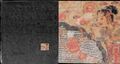 Lintang Udang in the cloth (CC-BY UPTD Museum Bali Inventary no. 09.746)
 -
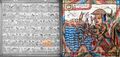 Lintang Makara in the cloth (CC-BY UPTD Museum Bali Inventary no. 09.752)
 -
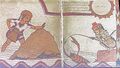 Lintang Urang (CC-BY Youla Azkarrula taken in the ceiling of Taman Gili Klungkung Palace Bali)


Cultural Beliefs
Numerology (Neptu/Urip)
Sukra (Friday, in saptawara) has a value of 6 and Kliwon (in pancawara) has a value of 8. Thus, the total urip on this lintang is 14.[10]
Astrological Characteristics
Initially living in poverty but in old age can find happiness, rich in gold and silver, their fortune comes quickly. They are skilled in leading so that prosperity quickly comes to their followers.[10]
Matching Gemstones
Mirah (ruby), Nila (saphire).[10]
Weblinks
All HIP Stars within this constellation
Stars within the Constellation Area
| id | Label | IAU design. | description | Vmag |
|---|---|---|---|---|
| 1 | Deneb Algedi | HIP 107556 | within constellation lines | 2.83 |
| 2 | Dabih | HIP 100345 | within constellation lines | 3.08 |
| 3 | Algedi | HIP 100064 | within constellation lines | 3.58 |
| 4 | Nashira | HIP 106985 | within constellation lines | 3.67 |
| 5 | ζ Capricorni | HIP 105881 | within constellation lines | 3.74 |
| 6 | θ Capricorni | HIP 104139 | Inside the Hull | 4.07 |
| 7 | ω Capricorni | HIP 102978 | within constellation lines | 4.12 |
| 8 | ψ Capricorni | HIP 102485 | within constellation lines | 4.122 |
| 9 | ι Capricorni | HIP 105515 | Inside the Hull | 4.27 |
| 10 | Alshat | HIP 100310 | Inside the Hull | 4.76 |
| 11 | η Capricorni | HIP 104019 | Inside the Hull | 4.84 |
| 12 | * rho Cap A | HIP 101027 | Inside the Hull | 4.93 |
| 13 | υ Capricorni | HIP 101984 | Inside the Hull | 5.1 |
| 14 | ϕ Capricorni | HIP 104963 | Inside the Hull | 5.152 |
| 15 | χ Capricorni | HIP 104365 | Inside the Hull | 5.316 |
| 16 | 29 Cap | HIP 104974 | Inside the Hull | 5.317 |
| 17 | 33 Cap | HIP 105665 | Inside the Hull | 5.366 |
| 18 | * 14 Cap A | HIP 101923 | Inside the Hull | 5.38 |
| 19 | 30 Cap | HIP 105143 | Inside the Hull | 5.383 |
| 20 | - | HIP 105576 | Inside the Hull | 5.6 |
| 21 | 35 Cap | HIP 105928 | Inside the Hull | 5.76 |
| 22 | 19 Cap | HIP 103226 | Inside the Hull | 5.782 |
| 23 | - | HIP 102026 | Inside the Hull | 5.799 |
| 24 | - | HIP 102772 | Inside the Hull | 5.849 |
| 25 | - | HIP 103460 | Inside the Hull | 5.869 |
| 26 | 17 Cap | HIP 102487 | Inside the Hull | 5.902 |
| 27 | DV Aqr | HIP 103545 | Inside the Hull | 5.963 |
| 28 | - | HIP 104914 | Inside the Hull | 6.037 |
| 29 | 21 Cap | HIP 103703 | Inside the Hull | 6.05 |
| 30 | - | HIP 101221 | Inside the Hull | 6.11 |
| 31 | - | HIP 101507 | Inside the Hull | 6.116 |
| 32 | - | HIP 104297 | Inside the Hull | 6.17 |
| 33 | - | HIP 101608 | Inside the Hull | 6.177 |
| 34 | - | HIP 102780 | Inside the Hull | 6.193 |
| 35 | 27 Cap | HIP 104452 | Inside the Hull | 6.242 |
| 36 | 20 Cap | HIP 103616 | Inside the Hull | 6.25 |
| 37 | - | HIP 101011 | Inside the Hull | 6.41 |
| 38 | - | HR 7989 | Inside the Hull | 6.47 |
References
- References (general)
- ↑ Maass, Alfred, “Astrologische Kalender der Balinesen,” in Koninklijk Bataviaasch Genootschap van Kunsten en Wetenschappen, Feestbundel bij gelegenheid van zijn 150 jarig bestaan 1778-1928, 2 vols. (Weltevreden, 1929), Vol. 2, 126-157.
- ↑ Susanto, Agus, "KKP Mendorong Inovasi Konsumsi Udang—Lezat, Praktis, Bernutrisi!" (2025) https://kabarnusa.com/kkp-mendorong-inovasi-konsumsi-udang-lezat-praktis-bernutrisi/
- ↑ 3.0 3.1 3.2 Cite error: Invalid
<ref>tag; no text was provided for refs named:1 - ↑ Friedrich, R. (1849). Voorloopig verslag van het eiland Bali, Batavia, Verb. Bat Gen. Deel 23, Nr. 13
- ↑ HINLOOPEN LABBERT0N, D. VAN (1910). Geillustreerd handboek van Insulinde. Amsterdam: "Vivat"
- ↑ PIGEAUD, TH. (1925). Een stuk over sterrenkunde uit het Anggastyaparwwa ...... Weltevreden: Albrecht. Tijdsch. v. lnd, T.-, L.- en Vk. deel LXV
- ↑ Nieuwenkamp, W. O. J. (1905), Schetsen van Bali en Lombok. (Eigen Haard)
- ↑ MAASS, ALFRED (1920). Sterne und Sternbilder im malaiischen Archipel. Berlin. Zeitschrift für Ethnologie Jg. 1920/21, H. 1
- ↑ MAASS, ALFRED (1924). Sternkunde und Sterndeuterei im malaiischen Archipel. Batavia, den Haag. Tijdsch. v. T.-, L.-en Vk. deel LX IV
- ↑ 10.0 10.1 10.2 Tim Kajian Palelintangan, “Gabungan Kajian Palelintangan,” Museum Bali (2021), 1-149.