Rohini: Difference between revisions
No edit summary |
|||
| Line 113: | Line 113: | ||
File:Nakshatra temple magDraw lbl.jpg|Display of all 28th nakshatras in silver arch with candles in Tirupperunthurai (Athmanathaswamy temple) near Aranthangi, India, 10th century CE. (SMH 2025). | File:Nakshatra temple magDraw lbl.jpg|Display of all 28th nakshatras in silver arch with candles in Tirupperunthurai (Athmanathaswamy temple) near Aranthangi, India, 10th century CE. (SMH 2025). | ||
File:Nakshatras in Temple draw+lbl 4ase.jpg|Display of all 28th nakshatras in a door frame in Tirupperunthurai (Athmanathaswamy temple) near Aranthangi, India, 10th century CE. (SMH 2025). | File:Nakshatras in Temple draw+lbl 4ase.jpg|Display of all 28th nakshatras in a door frame in Tirupperunthurai (Athmanathaswamy temple) near Aranthangi, India, 10th century CE. (SMH 2025). | ||
File:畢宿(仏像図彙).png|Rohini Chinese | File:畢宿(仏像図彙).png|Rohini Chinese, matching the [[Bixiu|Bi]] lunar mansion | ||
File:4 Rohini draw.png|Rohini as reconstructed by Jones (1720) | File:4 Rohini draw.png|Rohini as reconstructed by Jones (1720) | ||
File:ChandraRohini.jpg|Chandra Rohini | File:ChandraRohini.jpg|Chandra Rohini | ||
Revision as of 11:52, 4 May 2026
Authors: Susanne M Hoffmann, Youla Azkarrula, Shylaja


Rohiṇī (रोहिणी), The Red One, is one of the nakshatras in the Vedic tradition. The asterism is represented by the star cluster of the Hyades with Aldebaran as the brightest star (physically not connected but seen in the same direction). "Rohini" literally means "red", which clearly refers to Aldebaran only. Thus, over time, it obviously became a name for the brightest star of the group, used by the Indian Vedic tradition.
Etymology and History

Name Variants
- Brahmya,
- Brahmabha,
- Brāhmī
Origin of Constellation
Rohiṇī (रोहिणी) is a prominent goddess in Hinduism, recognized as the favorite consort of Chandra (the moon god) and the daughter of Daksha and Asikni.
The asterism is depicted roughly V-shaped in historical drawings in India and China, obviously matching the star pattern in the sky created by the Hyades star cluster, sometimes (in China) even connected to the star λ Tauri (which forms part of the Chinese lunar mansion asterism Bi, The Net, in this area). The V-shaped geometry forms a chariot (Śakata) for the goddess Rohini.
Stars within the Constellation Area
| id | Label | IAU design. | description | Vmag |
|---|---|---|---|---|
| 1 | Aldebaran | HIP 21421 | Constellation lines (Vertex) | 0.86 |
| 2 | Chamukuy | HIP 20894 | Constellation lines (Vertex) | 3.41 |
| 3 | Ain | HIP 20889 | Constellation lines (Vertex) | 3.53 |
| 4 | Prima Hyadum | HIP 20205 | Constellation lines (Vertex) | 3.65 |
| 5 | Secunda Hyadum | HIP 20455 | Constellation lines (Vertex) | 3.76 |
| 6 | θ 1 Tauri | HIP 20885 | Inside the hull | 3.84 |
| 7 | δ 3 Tauri | HIP 20648 | Inside the hull | 4.298 |
| 8 | - | HIP 21029 | Inside the hull | 4.764 |
| 9 | δ 2 Tauri | HIP 20542 | Inside the hull | 4.8 |
| 10 | 75 Tau | HIP 20877 | Inside the hull | 4.969 |
| 11 | 63 Tau | HIP 20484 | Inside the hull | 5.625 |
| 12 | 70 Tau | HIP 20661 | Inside the hull | 6.439 |
| 13 | - | HIP 21053 | Inside the hull | 6.491 |
Transfer and Transformation of the Constellation
-
 Rohini 10th centry CE
 -
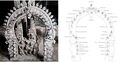 Display of all 28th nakshatras in silver arch with candles in Tirupperunthurai (Athmanathaswamy temple) near Aranthangi, India, 10th century CE. (SMH 2025).
 -
 Display of all 28th nakshatras in a door frame in Tirupperunthurai (Athmanathaswamy temple) near Aranthangi, India, 10th century CE. (SMH 2025).
 -
 Rohini Chinese, matching the Bi lunar mansion
 -
 Rohini as reconstructed by Jones (1720)
 -
 Chandra Rohini


Mythology
mnemonic tales and cultural significance
Weblinks
References
- References (general)





