Al-Ḫibā’: Difference between revisions
| Line 58: | Line 58: | ||
!Original | !Original | ||
!Translation | !Translation | ||
! | !Map | ||
Adams (2018) | |||
!Map | !Map | ||
AlAJaji | AlAJaji | ||
!Map | !Map | ||
Laffitte | Laffitte | ||
|- | |||
| colspan="2" |لسانُ العرَب، باب الواو والياء المعُتَل فصَل الخاء المعُجَمةُ al-ʿarab, Lisān | |||
| | |||
| | |||
| | |||
|- | |- | ||
| | | | ||
|al-Ḫibāʾ (الِخَبــاء) is a tent made of camel wool or sheep’s wool, never of goat hair. It usually stands on two or three poles; anything larger than that is called a بيْت (large tent). | |al-Ḫibāʾ (الِخَبــاء) is a tent made of camel wool or sheep’s wool, never of goat hair. It usually stands on two or three poles; anything larger than that is called a بيْت (large tent). | ||
| | | | ||
|[[File:SouthernTent AlAjaji2025.png|thumb|Al-Ḫibāʾ1: Southern Tent (uي ز اليمُا الخباء), alḪibāʾ alYamānī in Corvus (CC BY Khalid AlAjaji).]] | |[[File:SouthernTent AlAjaji2025.png|thumb|Al-Ḫibāʾ1: Southern Tent (uي ز اليمُا الخباء), alḪibāʾ alYamānī in Corvus (CC BY Khalid AlAjaji).]] | ||
|[[File:AlHibaY Laffitte2025 bothMaps.jpg|thumb|Arabian constellation of The Yemenite Tent (CC BY Laffitte 2025).]] | |[[File:AlHibaY Laffitte2025 bothMaps.jpg|thumb|Arabian constellation of The Yemenite Tent (CC BY Laffitte 2025).]] | ||
|- | |||
| colspan="2" |al-Ṣūfī: Lucky Tent | |||
| | |||
| | |||
| | |||
|- | |- | ||
| | | | ||
|Saʿd al-Aḫbiya (“Saad of the Tents”), the twenty-fifth of the lunar stations. It was given this name because it consists of four stars: three form a triangle, and one lies at the center of that triangle — the eleventh star [of Aquarius]. They considered the central one Saʿd, and the three surrounding it like the tent that shelters Saʿd. | |Saʿd al-Aḫbiya (“Saad of the Tents”), the twenty-fifth of the lunar stations. It was given this name because it consists of four stars: three form a triangle, and one lies at the center of that triangle — the eleventh star [of Aquarius]. They considered the central one Saʿd, and the three surrounding it like the tent that shelters Saʿd. | ||
| | | | ||
|[[File:Saad-of-tent alkhibaa.jpeg|thumb|Al-Ḫibāʾ2: Saʿd al-AḪbiya, in Aquarius (CC BY Khalid AlAjaji).]] | |[[File:Saad-of-tent alkhibaa.jpeg|thumb|Al-Ḫibāʾ2: Saʿd al-AḪbiya, in Aquarius (CC BY Khalid AlAjaji).]] | ||
| | |||
|- | |||
| colspan="2" |Al-Ṣūfī (d. 376H/986): Northern Tent | |||
| | |||
| | |||
| | | | ||
|- | |- | ||
| | | | ||
|In the region of the sky surrounded by this constellation (referring to the constellation of Auriga), along with the head of the Great Bear, Polaris, and the constellation Cassiopeia, there is an area with no bright star, nor any reported by Ptolemy except for the two at the head of Auriga. This area contains countless stars, densely packed together. In its center are stars of fifth and sixth magnitude, the Tent because they resemble the shape of a (الخِِبََاءُُ) which the Arabs call al-Ḫibāʾ tent. The two stars at the head of this constellation are considered part of al-Ḫibāʾ. | |In the region of the sky surrounded by this constellation (referring to the constellation of Auriga), along with the head of the Great Bear, Polaris, and the constellation Cassiopeia, there is an area with no bright star, nor any reported by Ptolemy except for the two at the head of Auriga. This area contains countless stars, densely packed together. In its center are stars of fifth and sixth magnitude, the Tent because they resemble the shape of a (الخِِبََاءُُ) which the Arabs call al-Ḫibāʾ tent. The two stars at the head of this constellation are considered part of al-Ḫibāʾ. | ||
| | | | ||
|It is evident from the description that al-Ḫibāʾ (الخِِبََاء) refers to a region of the sky encompassing numerous stars, including the two on the head of Auriga, δ and ξ Aur. Restricting the definition to only a specific number of stars does not align with the account given by al-Ṣūfī.[[File:Alkhibaa ident4 AlAjaji2025.jpeg|thumb|Al-Ḫibāʾ4: Al-Ḫibāʾ region as described by al-Ṣūfī (CC BY Khalid AlAjaji).]] | |It is evident from the description that al-Ḫibāʾ (الخِِبََاء) refers to a region of the sky encompassing numerous stars, including the two on the head of Auriga, δ and ξ Aur. Restricting the definition to only a specific number of stars does not align with the account given by al-Ṣūfī.[[File:Alkhibaa ident4 AlAjaji2025.jpeg|thumb|Al-Ḫibāʾ4: Al-Ḫibāʾ region as described by al-Ṣūfī (CC BY Khalid AlAjaji).]] | ||
| | | | ||
|- | |- | ||
| colspan="2" |Ibn Qutayba<ref name=":1" /> (d. 276H/889): | |||
| | |||
| | |||
| | |||
|- | |||
| | |||
| | | | ||
| | | | ||
|[[File:Alkhibaa Qutayba Ajaji.jpeg|thumb|Alkhiba in al-Qutayba (CC BY AlAJaji 2025), stars in Cam+Aur.]] | |[[File:Alkhibaa Qutayba Ajaji.jpeg|thumb|Alkhiba in al-Qutayba (CC BY AlAJaji 2025), stars in Cam+Aur.]] | ||
|[[File:ArabTent Laffitte2025.jpg|thumb|Arabian constellation of The (Northern) Tent (CC BY Laffitte 2025)]] | |[[File:ArabTent Laffitte2025.jpg|thumb|Arabian constellation of The (Northern) Tent (CC BY Laffitte 2025)]] | ||
|- | |- | ||
| colspan="2" |Al-Marzūqī<ref>Al-Marzūqī, Abū ʿAli Aḥmad b. Muḥammad b. al-Ḥassan (died 1030), Al-Azminah wa al-amkinah (Times and Places), Edition by Dr. Mohammad Nayef al-Dulaymi, (Arabic print of the original book in 2002, World of Books, Beirut, Lebanon)</ref> (d. 421H/1030) | |||
| | |||
| | |||
| | |||
|- | |||
| | |||
| | | | ||
| | | | ||
|[[File:Alkhiba alMarzuqi AlAjaji2025.jpeg|thumb|Al-Khiba in Al-Marzuqi (CC BY AlAjaji 2025), stars in Her.]] | |[[File:Alkhiba alMarzuqi AlAjaji2025.jpeg|thumb|Al-Khiba in Al-Marzuqi (CC BY AlAjaji 2025), stars in Her.]] | ||
| | | | ||
Revision as of 09:39, 18 May 2026
Authors: Roland Laffitte, Susanne M Hoffmann, Youla Azkarrula


al-Ḫibā’ (الخِباء), al-Khiba, theTent is an Arabian name. Qutayba, Qazwīnī, al-Ṣūfī and Miṣrī refer to different tent constellations (Laffitte (2012, 2025)[1][2]). They defined a Northern Tent and a Southern Tent.
Concordance, Etymology, History
Spelling & Name Variants
Variants in Romanisation
- al-Ḥibā’
- Alkhiba
- al-Khiba
- al-Chiba
- Alchiba
Variants Name & Meaning
| الخِباء | al-Ḫibā’ | the Tent | Qutayba[3] | |
| الخِباء الشّامیَة | al-Ḫibā’ [al-Šāmiyya] | the [northern] Tent | al-Ṣūfī | 10th c. |
| الخِباء الیمانی | al-Ḫibā’ al-Yamānī | the Yemenite [= Southern] Tent | al-Ṣūfī | 10th c. |
| الخِباء | al-Ḫibā’ | the [northern] Tent | Qazwīnī | 13th c. |
| سَعْدُ الخِبَاء | Saᶜd al-Ḫiba’ | the Lucky [star] of the Tent | Miṣrī | 14th c. |
- al-Ḫibā’ (الخِباء), "The Tent" refers to the same constellation as "The Northern Tent"
- al-Ḫibā’ al-Yamānī, the "Yemenite Tent" is then the southern counterpart,
- Saᶜd al-Ḫiba’, the Lucky Tent is yet another constellation
Sources and Identification (AlAjaji 2025)
| Original | Translation | Map
Adams (2018) |
Map
AlAJaji |
Map
Laffitte |
|---|---|---|---|---|
| لسانُ العرَب، باب الواو والياء المعُتَل فصَل الخاء المعُجَمةُ al-ʿarab, Lisān | ||||
| al-Ḫibāʾ (الِخَبــاء) is a tent made of camel wool or sheep’s wool, never of goat hair. It usually stands on two or three poles; anything larger than that is called a بيْت (large tent). |  |
 | ||
| al-Ṣūfī: Lucky Tent | ||||
| Saʿd al-Aḫbiya (“Saad of the Tents”), the twenty-fifth of the lunar stations. It was given this name because it consists of four stars: three form a triangle, and one lies at the center of that triangle — the eleventh star [of Aquarius]. They considered the central one Saʿd, and the three surrounding it like the tent that shelters Saʿd. |  |
|||
| Al-Ṣūfī (d. 376H/986): Northern Tent | ||||
| In the region of the sky surrounded by this constellation (referring to the constellation of Auriga), along with the head of the Great Bear, Polaris, and the constellation Cassiopeia, there is an area with no bright star, nor any reported by Ptolemy except for the two at the head of Auriga. This area contains countless stars, densely packed together. In its center are stars of fifth and sixth magnitude, the Tent because they resemble the shape of a (الخِِبََاءُُ) which the Arabs call al-Ḫibāʾ tent. The two stars at the head of this constellation are considered part of al-Ḫibāʾ. | It is evident from the description that al-Ḫibāʾ (الخِِبََاء) refers to a region of the sky encompassing numerous stars, including the two on the head of Auriga, δ and ξ Aur. Restricting the definition to only a specific number of stars does not align with the account given by al-Ṣūfī. |
|||
| Ibn Qutayba[3] (d. 276H/889): | ||||
 |
 | |||
| Al-Marzūqī[4] (d. 421H/1030) | ||||
 |
||||
Arabic Bedouin Tents
The Library of Congress has historical images (1890-1950) in the Matson (G. Eric and Edith) Photograph Collection.
-
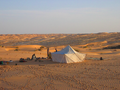 a bedouin tent in Mauretania, CC BY SMH 2008
 -
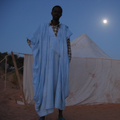 a bedouin tent in Mauretania at full moon, CC BY SMH 2008
 -
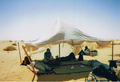 Khaima (2007, Mauretania).


Previous Idenfications, collated by Laffitte (2025)
[Northern] Tent (الخِباء الشّامیَة)
Name Variants:
- The Tent
- The Northern Tent
- The Syrian Tent
Kunitzsch (1959) and Laffitte (2012, 2025) identifies الخِباء الشّامیَة (The Northern Tent) with stars in Lynx and Auriga.
Ibn Qutayba
(last but one line ۱۵ ـ الغفر )
والهبا اسفل من الحوض، كواكب فؾ مثل هؾة الهبا اليمانية
wa-al-ḫibā’ asfal min al-ḥawḍ kawākib fī miṯl hay’at al-ḫibā’ al-yamāniyya
“al-ḫibā’ [“the Tent”] below al-ḥawḍ [“The Watering Hole”], stars that have the form of al-ḫibā’ al-yamāniyya [“the Austral Tent”]”.
Which give us Kunizsch before talking of al-Ṣūfī (Untersuchungen, 70):
Ibn Qutayba 67,3 (bei den unter Mondstation 14 mitbehandelten Sternen): wa-al-ḫibā’ asfal min al-ḥawḍ kawākib fī miṯl hay’at al-ḫibā’ al-yamāniyya „al-ḫib ā’„: Sterne unterhalb von al-ḥawḍ [= τ,h,υ,φ,θ,e,f Ursae Maioris], in Form der Südlisches Zeltes [cf. Den folgenden Artikel]”.
“Ibn Qutayba 67.3 (regarding the stars discussed under Moondstation 14): wa-al-ḫibā’ asfal min al-ḥawḍ kawākib fī miṯl hay’at al-ḫibā’ al-yamāniyya “al-ḫibā’”: Stars below al-ḥawḍ [= τ,h,υ,φ,θ,e,f Ursae Maioris], in the form of the Southern Tent [cf. The following article]”.
It is difficult to identify this figure exactly, but it is highly probable that it is from series 2, 15, 31 Lyn, 10 UMa, 38 & a Lyn are part of al-ḫibā’ which can be qualified of “[Northern] Tent”.
NB: Kunitzsch then cites al-Marzūqī who makes a mistake by putting al-ḍibā’ instead of al-ẓibā’ to locate al-ḥawḍ. We may therefore leave him out of it.
al-Ṣūfī:
(Schjellerup, 94) :
وفي وسط منها كواكب من القدر الخامس والسادس تسميها العرب الهبا الاها على صورة الهبا والإثنان اللذان على رأس.من هذه الصورة داخل في جملة الهبا
“And in its center are stars of the fifth and sixth magnitude, which the Arabs call because they present the figure of a tent, and the two that are at the head of this image [of Auriga] are included in the group of the Tent”.
These are the two stars that, in his Index, Schjellerup identifies as δ,ξ Aur, but for the other stars of the group that al-Ṣūfī speaks of, he gives: “Fl. 9 or 10” (Schjellerup, 360). Kunitzsch writes about this (Untersuchungen, 70) :
Ṣūfī 91, 16-17 rechnet zu diesen al-ḫibā’ genannten Sternen die schwachen von Ptolemäus nicht beschriebenen Sterne des modernen Bildes Giraffe sowie auch den 1. und 2. Des proleMïschen Bildes Fuhrnann = δξ Aur.
“Ṣūfī 91, 16-17 includes among these stars called al-ḫibā’ the faint stars of the modern constellation Giraffe not described by Ptolemy, as well as the 1st and 2nd stars of the ptolemäischen Bildes Fuhrnann = δ,ξ Aur”.
Schjellerup had added some stars in Camelopardalis, but Laffitte (2025)[1] argues that they are too far north:
Ibn Qutayba gives δ, ξ Aur. Based on al-Ṣūfī's description, Schjellerup adds 2 Lyn +α, β Cam. But, as Ibn Qutayba points out that the figure begins under Awlād al-Ẓibā’, this means that it includes α Lyn. One can reasonably remove from Schjellerup’s list α,β Cam, which are too far away, and add the brightest stars that connect 2 Lyn to α Lyn.
There is also confusion in Ibn Qutayba, who places this figure under the one that he places under Station XIV and which he calls al-Ḫibā’ al-Yamānī, “the Yemeni” or “the Southern”. The one we are talking about, which is northern, should reasonably be called al-Ḥibā’ al-Šāmiyya, “the Syrian,” i.e. “the Northern”.
Yemenite Tent (الخِباء الیمانی)
Name Variants:
- The Yemenite Tent
- The Southern Tent
The Yemenite Tent is mentioned by al-Qutayba and al-Sufi; the latter also calls it the "Southern Tent" as opposed to the Northern Tent in the Lynx area. It is located in Corvus. Laffitte (2025)[1] identifies: β, γ, δ, ε Crv and argues:
By Ibn Qutayba, this figure is located under Lunar Station XIV. The epithet al-Yamānī, given by al-Ṣūfī, must be interstood in relation to another al-Ḫibā’, located between Awlād al-Ẓibā’ and al-ᶜAyyūq, which is boreal, and which we have therefore named al-Šāmiyya, “the Syrian” or “the Northern”.
Laffitte (2025) also points out that the stars of Corvus form an Arabic Lunar Station and are also listed with other Arabic names:
| Native Name | Romanisation | Translation | Author |
|---|---|---|---|
| al-Maᶜlaf | the Manger | Qutayba | |
| al-Aḥmal | the Lambs | Ḥanīfa | |
| al-Ağmal | the Camels | Ṣūfī | |
| al-Ğimāl | idem | Fāris | |
| al-Buᶜūl | the Masters | Mammātī |
Lucky [star] of the Tent (سَعْدُ الخِبَاء)
al-Suʿūd, “the Lucky [stars]” are an Arabian asterism in Aquarius. Several modern star names resemble this historical asterism (e.g. Sadalsuud, Sadalmelik, Sadalbari...). Laffitte (2025) lists two names among the lucky stars that include tents:
| Native Name | Romanisation | Translation | Author | Identification |
|---|---|---|---|---|
| Saʿd al-Aḫbiyya | the Lucky [star] of the Burrows or the Tents | Mālik | Lunar Station XXV:
γ, ζ, π, η Aqr | |
| Saʿd al-Ḫiba’ | the Lucky [star] of he Tent | Miṣrī | γ, ζ, π, η Aqr |
Mythology
IAU Working Group on Star Names
The name was discussed and approved by the IAU WGSN in 202x. As this star is already named ..., the WGSN chose ... (not to apply/ to apply the name to a neighbouring star/ to ...) in the IAU-CSN.
Weblinks
Reference
- ↑ 1.0 1.1 1.2 Roland Laffitte (2025), Nommer les étoile: 500 noms hérités des Arabes - Apport de l'uranographie arabe, Orient des Mots
- ↑ Roland Laffitte (2012), Le ciel des Arabes
- ↑ 3.0 3.1 Ibn Qutaybah, Al-Dinawarī, Abū Muḥammad ʿAbd Allah b. Muslim (died ~ 889), Kitab al-Anwāʾ (Book of meteorolgy), (Arabic print of the original book, Daʾirat al-Maʿarif al-Osmania, Hydarabad, India, 1956)
- ↑ Al-Marzūqī, Abū ʿAli Aḥmad b. Muḥammad b. al-Ḥassan (died 1030), Al-Azminah wa al-amkinah (Times and Places), Edition by Dr. Mohammad Nayef al-Dulaymi, (Arabic print of the original book in 2002, World of Books, Beirut, Lebanon)





