Enduri Senggu: Difference between revisions
HaochengLyu (talk | contribs) Small Fixes |
HaochengLyu (talk | contribs) Small Fixes |
||
| Line 9: | Line 9: | ||
== Concordance, Etymology, History == | == Concordance, Etymology, History == | ||
''Enduri Senggu'' is one of the most representative goddesses in Manchu shamanic star worship. The constellation is composed of more than 10 bright stars in the Milky Way, appearing in the central sky around the end of October and shifting westward.<ref name="wang1993">Wang, Honggang王宏刚. (1993). On the Star Goddesses of Shamanism论萨满教的星辰女神. ''Journal of Changchun Normal College长春师范学院学报'', (2), 69–72.</ref><ref name="fu1995">Fu, Yuguang富育光, & Wang, Honggang王宏刚. (1995). ''Shamanic Goddesses萨满教女神''. Shenyang: Liaoning People's Publishing House.</ref> In Manchu folk tradition, it is commonly known as "Hedgehog Stars" (''Senggu Usiha'') or "House-Frame Stars" because of its role as guardian of human dwellings.<ref name="fu1995"/> | ''Enduri Senggu'' is one of the most representative goddesses in Manchu shamanic star worship. The constellation is composed of more than 10 bright stars in the Milky Way, appearing in the central sky around the end of October and shifting westward.<ref name="wang1993">Wang, Honggang王宏刚. (1993). On the Star Goddesses of Shamanism论萨满教的星辰女神. ''Journal of Changchun Normal College长春师范学院学报'', (2), 69–72.</ref><ref name="fu1995">Fu, Yuguang富育光, & Wang, Honggang王宏刚. (1995). ''Shamanic Goddesses萨满教女神''. Shenyang: Liaoning People's Publishing House.</ref> In Manchu folk tradition, it is commonly known as "Hedgehog Stars" (''Senggu Usiha'') or "House-Frame Stars" because of its role as guardian of human dwellings.<ref name="fu1995"/> | ||
As a directional deity, ''Enduri Senggu'' is said to point south with its head and north with its tail in winter, and reverse this orientation in summer, thereby guiding human beings. In Manchu creation mythology, ''Enduri Senggu'' was originally ''Ningge Mama'', a sun-near goddess attending the Woman of Heaven ''Abka Hehe'', tasked with patrolling the tremors of the earth. When winter snows arrive, she leads the Sun Goddess to appear in the cold sky and warm the earth.<ref name="wang1993"/><ref name="fu1995"/> Later, in order to defeat the evil deity ''Yeruri'', | As a directional deity, ''Enduri Senggu'' is said to point south with its head and north with its tail in winter, and reverse this orientation in summer, thereby guiding human beings. In Manchu creation mythology, ''Enduri Senggu'' was originally ''Ningge Mama'', a sun-near goddess attending the Woman of Heaven ''Abka Hehe'', tasked with patrolling the tremors of the earth. When winter snows arrive, she leads the Sun Goddess to appear in the cold sky and warm the earth.<ref name="wang1993"/><ref name="fu1995"/> Later, in order to defeat the evil deity ''Yeruri'', Abka Hehe adorned her body with numerous minor spirits; through their help, she turned defeat into victory. After this transformation, ''Ningge Mama'' assumed the form of a hedgehog and came to be called ''Enduri Senggu'', continuing to guard the sky for Abka Hehe for tens of thousands of years.<ref name="fu1995"/> | ||
== Functions and Symbolism == | |||
The hedgehog goddess's core function is that of ''guardian of the house'' — protecting human dwellings from plague and from destruction by wind and snow. In the fishing and hunting life of the ancient Manchus, hedgehogs often lived close to human settlements: when plague struck, hedgehogs were always the first to contract the disease and show obvious symptoms, effectively serving as an "alarm" for the safety of human settlements. Moreover, their cough sounds remarkably similar to that of humans. These interesting natural phenomena likely led early peoples to transform this ordinary small animal into a powerful goddess.<ref name="wang1993"/><ref name="fu1995"/> | The hedgehog goddess's core function is that of ''guardian of the house'' — protecting human dwellings from plague and from destruction by wind and snow. In the fishing and hunting life of the ancient Manchus, hedgehogs often lived close to human settlements: when plague struck, hedgehogs were always the first to contract the disease and show obvious symptoms, effectively serving as an "alarm" for the safety of human settlements. Moreover, their cough sounds remarkably similar to that of humans. These interesting natural phenomena likely led early peoples to transform this ordinary small animal into a powerful goddess.<ref name="wang1993"/><ref name="fu1995"/> | ||
In the broader cosmic order, the hedgehog goddess is also a ''guardian of life and souls''. According to Manchu mythology, the Jeguru goddess | In the broader cosmic order, the hedgehog goddess is also a ''guardian of life and souls''. According to Manchu mythology, the Jeguru goddess possesses a "garment of light-souls," woven from the light of the sun and the moon.<ref name="fu1995"/> This garment of light can both deter all demons and protect the souls of all living beings.<ref name="backer2000">Bäcker, J. (2000). The shaman's sky. Manchu mythology and starlore in the Amur Valley. ''Ad Seres et Tungusos. Festschrift für Martin Gimm zu seinem'', ''65'', 1–17.</ref> The hedgehog goddess also assisted the three primal goddesses in creating all beings, rearing them, and giving them souls.<ref name="backer2000"/> In Manchu star rituals, the hedgehog goddess is an indispensable star deity.<ref name="fu1995"/> The hedgehog goddess also rules over the course of the sun and moon.<ref name="backer2000"/> | ||
In another myth, the Jeguru goddess, in order to save Abka Hehe and protect heaven and earth, transformed into a white, fragrant, shimmering peony star (''Šodan Usiha''); when Yeruri and the demons fought over this divine flower, it suddenly turned into ten thousand arrows of light, shooting Yeruri in the eyes until he screamed and fled back to his underground lair. This also explains why Manchu women love to wear flowers — especially white peonies — as it is believed that flowers worn in the hair can ward off demons.<ref name="fu1995"/> | |||
Among the Manchu people, many legends circulate about the hedgehog goddess benefiting and saving humanity. One such legend tells that after the primal matrix ''Fehe'' was crushed under the sea by a demon king, the hedgehog dug a ventilation hole for her, allowing her to survive.<ref name="wang1993"/><ref name="fu1995"/> | Among the Manchu people, many legends circulate about the hedgehog goddess benefiting and saving humanity. One such legend tells that after the primal matrix ''Fehe'' was crushed under the sea by a demon king, the hedgehog dug a ventilation hole for her, allowing her to survive.<ref name="wang1993"/><ref name="fu1995"/> | ||
== Mythology == | |||
=== | === The Heavenly War === | ||
The | |||
In the Heavenly War myth, the hedgehog goddess is one of the most important helpers of Abka Hehe. According to Manchu creation mythology, Abka Hehe once fell into the traps of the insidious Yeruri and found herself in a fatal situation. It was the hedgehog goddesses who blinded Yeruri with their arrows of light — that is, their spines — forcing him to withdraw. Enduri Senggu is also referred to as Abka Hehe's "Eye-Protecting Goddess," a title that may derive from this very deed of blinding the demon. In the final duel between Abka Hehe and Yeruri, the hedgehog goddesses similarly dazzled and weakened him.<ref name="backer2000"/> | |||
In the Heavenly War myth, the hedgehog goddess is one of the most important helpers of Abka Hehe. According to Manchu creation mythology, Abka Hehe once fell into the traps of the insidious Yeruri and found herself in a fatal situation. It was the hedgehog goddesses who blinded Yeruri with their arrows of light — that is, their spines — forcing him to withdraw. Enduri Senggu is also referred to as Abka Hehe's "Eye-Protecting Goddess," a title that may derive from this very deed of blinding the demon. | |||
The hedgehog is praised as the most able of all animals. It is said that it is unsurpassed in both offensive and defensive situations: it can roll itself forward or use its feet, can extend or contract itself, and is therefore invincible. The authority of the hedgehog goddesses derives not only from the dazzling garment of light-spines bestowed upon them by Abka Hehe, but also from the fact that the authority and qualities of all goddesses are united in them.<ref name="backer2000"/> | The hedgehog is praised as the most able of all animals. It is said that it is unsurpassed in both offensive and defensive situations: it can roll itself forward or use its feet, can extend or contract itself, and is therefore invincible. The authority of the hedgehog goddesses derives not only from the dazzling garment of light-spines bestowed upon them by Abka Hehe, but also from the fact that the authority and qualities of all goddesses are united in them.<ref name="backer2000"/> | ||
=== Creation and the Making of Humanity === | |||
In the post-flood creation narrative, Abka Hehe, acting on her master's orders, patrolled the earth and found several beings that had survived the flood, including the hedgehog god ''Senggu Enduri'', the willow goddess ''Fodoho Mama'', and the elm goddess ''Hailan Mama'', and took them as her disciples. | |||
In the post-flood creation narrative, Abka Hehe, acting on her master's orders, patrolled the earth and found several beings that had survived the flood, including the hedgehog god ''Senggu Enduri'', the willow goddess ''Fodoho Mama'', and the elm goddess ''Hailan Mama'', and took them as her disciples. Fodoho Mama preserved many souls that had survived the flood on her leaves, and fed them with her two breasts. Later, when Abka Hehe created humans, she "selected from among the animals the intelligent kind that could walk upright, and asked Fodoho Mama to install souls in them, thus forming present-day humanity."<ref name="zhang2011">Zhang, Yahui张亚辉. (2011). A Study of Rituals and Myths in Qing Court Shamanic Sacrifices清宫萨满祭祀的仪式与神话研究. ''Qing History Journal清史研究'', (4), 35.</ref> In this process, the hedgehog god participated in the work of installing souls for humanity.<ref name="backer2000"/><ref name="zhang2011"/> | |||
== Rituals and Folk Customs == | |||
=== Rituals | === Folk Rituals === | ||
The hedgehog star goddess became the guardian deity of the Manchu house; therefore, in former times, when the Manchus built a new house, they would first sacrifice to her.<ref name="wang1993"/><ref name="fu1995"/> | The hedgehog star goddess became the guardian deity of the Manchu house; therefore, in former times, when the Manchus built a new house, they would first sacrifice to her.<ref name="wang1993"/><ref name="fu1995"/> | ||
In the star sacrifice, the shaman, when inviting this female star deity, would chant the following spirit song:<ref name="fu1995"/> | In the star sacrifice, the shaman, when inviting this female star deity, would chant the following spirit song:<ref name="fu1995"/> | ||
<blockquote> Hedgehog Stars!<br/>In the midst of heaven,<br/>Star of the settled house,<br/>Drive away demons, drive away demons. </blockquote> | <blockquote>Hedgehog Stars!<br/>In the midst of heaven,<br/>Star of the settled house,<br/>Drive away demons, drive away demons.</blockquote> | ||
When the hedgehog goddess descended, a star-deity lamp with her star chart would be raised, and ice lamps forming her star chart would be lit. The star sacrifice transmitted the shamanic star charts and primitive astronomical knowledge formed by the northern peoples over their long history, passing them down to the present day.<ref name="fu1995"/> | When the hedgehog goddess descended, a star-deity lamp with her star chart would be raised, and ice lamps forming her star chart would be lit. The star sacrifice transmitted the shamanic star charts and primitive astronomical knowledge formed by the northern peoples over their long history, passing them down to the present day.<ref name="fu1995"/> | ||
In the Manchu fire sacrifice, a deity effigy of the goddess | In the Manchu fire sacrifice, a deity effigy of the goddess ''Senggu'', made of hedgehog skin, was hung on the sacred tree.<ref name="fu1995"/> | ||
In the fire sacrifice ritual, during the invocation of the eagle goddess, a myth is chanted in which the hedgehog goddess appears as a protector: | In the fire sacrifice ritual, during the invocation of the eagle goddess, a myth is chanted in which the hedgehog goddess appears as a protector: | ||
<blockquote> Long ago, long ago,<br/>Below was water,<br/>Above was water,<br/>Everywhere was like a great sea,<br/>And in this disaster,<br/>No living thing could survive.<br/>...<br/>The Woman of Heaven sent the Eagle Goddess,<br/>Who carried away the daughter born to this man and woman,<br/>And raised her to become the first female shaman of humanity,<br/>And the primal mother goddess of humanity.<br/>'''When the Eagle Goddess was away,'''<br/>'''It was a group of Hedgehog Goddesses who sheltered her,'''<br/>'''Protecting her from harm by poisonous insects and fierce beasts.'''<ref name="fu1995"/> </blockquote> | <blockquote>Long ago, long ago,<br/>Below was water,<br/>Above was water,<br/>Everywhere was like a great sea,<br/>And in this disaster,<br/>No living thing could survive.<br/>...<br/>The Woman of Heaven sent the Eagle Goddess,<br/>Who carried away the daughter born to this man and woman,<br/>And raised her to become the first female shaman of humanity,<br/>And the primal mother goddess of humanity.<br/>'''When the Eagle Goddess was away,'''<br/>'''It was a group of Hedgehog Goddesses who sheltered her,'''<br/>'''Protecting her from harm by poisonous insects and fierce beasts.'''<ref name="fu1995"/></blockquote> | ||
=== Court Rituals (Qing Imperial Shrine) === | |||
The hedgehog goddess also held an exalted position in Qing court rituals. According to the ''Imperially Authorized Rituals for Sacrifices to Gods and Heaven by the Manchus'' (''Qinding Manzhou Jishen Jitian Dianli'', 钦定满洲祭神祭天典礼), the evening sacrifices of the Kunning Palace (坤宁宫) included "Enduri Senggu" among the deities worshipped.<ref name="fu1995"/><ref name="qinding">''Imperially Authorized Rituals for Sacrifices to Gods and Heaven by the Manchus钦定满洲祭神祭天典礼'' (Qianlong 12th year). In ''Liaohai Series辽海丛书''.</ref> The evening sacrifice deity list of the Qing Imperial Shrine (''Tangzi'', 清宫堂子) also included "Enduri Senggu," listed alongside deities such as ''Ahūn i Niyansi'', ''Ancun Ayara'', ''Muri Muriha'', ''Nadan Daihūn'', ''Narhūn Hiyancu'', and ''Katun Noyan''.<ref name="fu1988">Fu, Yuguang富育光. (1988). An Examination of the Qing Imperial Shrine Sacrifices清宫堂子祭祀辨考. ''Social Science Front社会科学战线'', (4), 209.</ref><ref name="bai1995">Bai, Hongxi白洪希. (1995). An Exploration of the Qing Imperial Shrine Sacrifices清宫堂子祭探赜. ''Manchu Studies满族研究'', (3), 61–63.</ref> | The hedgehog goddess also held an exalted position in Qing court rituals. According to the ''Imperially Authorized Rituals for Sacrifices to Gods and Heaven by the Manchus'' (''Qinding Manzhou Jishen Jitian Dianli'', 钦定满洲祭神祭天典礼), the evening sacrifices of the Kunning Palace (坤宁宫) included "Enduri Senggu" among the deities worshipped.<ref name="fu1995"/><ref name="qinding">''Imperially Authorized Rituals for Sacrifices to Gods and Heaven by the Manchus钦定满洲祭神祭天典礼'' (Qianlong 12th year). In ''Liaohai Series辽海丛书''.</ref> The evening sacrifice deity list of the Qing Imperial Shrine (''Tangzi'', 清宫堂子) also included "Enduri Senggu," listed alongside deities such as ''Ahūn i Niyansi'', ''Ancun Ayara'', ''Muri Muriha'', ''Nadan Daihūn'', ''Narhūn Hiyancu'', and ''Katun Noyan''.<ref name="fu1988">Fu, Yuguang富育光. (1988). An Examination of the Qing Imperial Shrine Sacrifices清宫堂子祭祀辨考. ''Social Science Front社会科学战线'', (4), 209.</ref><ref name="bai1995">Bai, Hongxi白洪希. (1995). An Exploration of the Qing Imperial Shrine Sacrifices清宫堂子祭探赜. ''Manchu Studies满族研究'', (3), 61–63.</ref> | ||
Fu Yuguang pointed out that the evening sacrifice deities of the Qing court and the deities of various Manchu clans can often be cross-referenced — the name "Enduri Senggu" listed in the evening sacrifice deities in Volume 92 of the ''Collected Statutes of the Great Qing'' (''Da Qing Huidian'', 大清会典) can | Fu Yuguang pointed out that the evening sacrifice deities of the Qing court and the deities of various Manchu clans can often be cross-referenced — the name "Enduri Senggu" listed in the evening sacrifice deities in Volume 92 of the ''Collected Statutes of the Great Qing'' (''Da Qing Huidian'', 大清会典) can be found in the more than forty handwritten shamanic oracles of various Manchu clans currently in our possession. This confirms that the evening sacrifice deities of the Qing court were not exclusively the ancestral deities of the Aisin Gioro clan, but rather many belonged to more ancient shared deities worshipped by the Jurchen tribes before their differentiation, which were still inherited in the Qing court rituals. Enduri Senggu and ''Nadan Daihūn'' were cosmic star deities highly venerated for generations by the ancient Jurchen tribes, maintaining houses and the tranquility of the years.<ref name="fu1988"/> | ||
The "Portrait Deity" (''huaxiang shen'', 画像神) in the Imperial Shrine sacrifices originated from the ancient Manchu custom of painting ancestral portraits; the painting features stars on the left and the moon on the right, representing the "Seven Maidens in Heaven" (seven goddesses).<ref name="bai1995"/> | The "Portrait Deity" (''huaxiang shen'', 画像神) in the Imperial Shrine sacrifices originated from the ancient Manchu custom of painting ancestral portraits; the painting features stars on the left and the moon on the right, representing the "Seven Maidens in Heaven" (seven goddesses).<ref name="bai1995"/> | ||
| Line 78: | Line 80: | ||
|səŋkə | |səŋkə | ||
|} | |} | ||
This distribution of cognates demonstrates the antiquity of the concept of "hedgehog" in the Manchu-Tungusic language family. | This distribution of cognates demonstrates the antiquity of the concept of "hedgehog" in the Manchu-Tungusic language family. | ||
==== Cross-Cultural Comparisons ==== | ==== Cross-Cultural Comparisons ==== | ||
Revision as of 11:54, 24 June 2026
Authors: Lyu Haocheng, Eric Mamajek, Susanne M Hoffmann, ASE Tech Team

Enduri Senggu (Hedgehog Goddess, the Divine Hedgehog), a Manchu shamanic constellation located in Cygnus. In Manchu, enduri means "god" or "goddess", and sengge (spelled as senggu in this star name) means "hedgehog". Another more common proper name for this goddess is Jeguru Enduri.
Jeguru Enduri does not refer to a single specific hedgehog, but rather to many Jeguru Enduri existing at the same time, much like hedgehogs living in groups in the real world. Each has the form of a hedgehog, so the name means "hedgehog-shaped goddesses", not "goddess of hedgehogs").
Concordance, Etymology, History
Enduri Senggu is one of the most representative goddesses in Manchu shamanic star worship. The constellation is composed of more than 10 bright stars in the Milky Way, appearing in the central sky around the end of October and shifting westward.[1][2] In Manchu folk tradition, it is commonly known as "Hedgehog Stars" (Senggu Usiha) or "House-Frame Stars" because of its role as guardian of human dwellings.[2]
As a directional deity, Enduri Senggu is said to point south with its head and north with its tail in winter, and reverse this orientation in summer, thereby guiding human beings. In Manchu creation mythology, Enduri Senggu was originally Ningge Mama, a sun-near goddess attending the Woman of Heaven Abka Hehe, tasked with patrolling the tremors of the earth. When winter snows arrive, she leads the Sun Goddess to appear in the cold sky and warm the earth.[1][2] Later, in order to defeat the evil deity Yeruri, Abka Hehe adorned her body with numerous minor spirits; through their help, she turned defeat into victory. After this transformation, Ningge Mama assumed the form of a hedgehog and came to be called Enduri Senggu, continuing to guard the sky for Abka Hehe for tens of thousands of years.[2]
Functions and Symbolism
The hedgehog goddess's core function is that of guardian of the house — protecting human dwellings from plague and from destruction by wind and snow. In the fishing and hunting life of the ancient Manchus, hedgehogs often lived close to human settlements: when plague struck, hedgehogs were always the first to contract the disease and show obvious symptoms, effectively serving as an "alarm" for the safety of human settlements. Moreover, their cough sounds remarkably similar to that of humans. These interesting natural phenomena likely led early peoples to transform this ordinary small animal into a powerful goddess.[1][2]
In the broader cosmic order, the hedgehog goddess is also a guardian of life and souls. According to Manchu mythology, the Jeguru goddess possesses a "garment of light-souls," woven from the light of the sun and the moon.[2] This garment of light can both deter all demons and protect the souls of all living beings.[3] The hedgehog goddess also assisted the three primal goddesses in creating all beings, rearing them, and giving them souls.[3] In Manchu star rituals, the hedgehog goddess is an indispensable star deity.[2] The hedgehog goddess also rules over the course of the sun and moon.[3]
In another myth, the Jeguru goddess, in order to save Abka Hehe and protect heaven and earth, transformed into a white, fragrant, shimmering peony star (Šodan Usiha); when Yeruri and the demons fought over this divine flower, it suddenly turned into ten thousand arrows of light, shooting Yeruri in the eyes until he screamed and fled back to his underground lair. This also explains why Manchu women love to wear flowers — especially white peonies — as it is believed that flowers worn in the hair can ward off demons.[2]
Among the Manchu people, many legends circulate about the hedgehog goddess benefiting and saving humanity. One such legend tells that after the primal matrix Fehe was crushed under the sea by a demon king, the hedgehog dug a ventilation hole for her, allowing her to survive.[1][2]
Mythology
The Heavenly War
In the Heavenly War myth, the hedgehog goddess is one of the most important helpers of Abka Hehe. According to Manchu creation mythology, Abka Hehe once fell into the traps of the insidious Yeruri and found herself in a fatal situation. It was the hedgehog goddesses who blinded Yeruri with their arrows of light — that is, their spines — forcing him to withdraw. Enduri Senggu is also referred to as Abka Hehe's "Eye-Protecting Goddess," a title that may derive from this very deed of blinding the demon. In the final duel between Abka Hehe and Yeruri, the hedgehog goddesses similarly dazzled and weakened him.[3]
The hedgehog is praised as the most able of all animals. It is said that it is unsurpassed in both offensive and defensive situations: it can roll itself forward or use its feet, can extend or contract itself, and is therefore invincible. The authority of the hedgehog goddesses derives not only from the dazzling garment of light-spines bestowed upon them by Abka Hehe, but also from the fact that the authority and qualities of all goddesses are united in them.[3]
Creation and the Making of Humanity
In the post-flood creation narrative, Abka Hehe, acting on her master's orders, patrolled the earth and found several beings that had survived the flood, including the hedgehog god Senggu Enduri, the willow goddess Fodoho Mama, and the elm goddess Hailan Mama, and took them as her disciples. Fodoho Mama preserved many souls that had survived the flood on her leaves, and fed them with her two breasts. Later, when Abka Hehe created humans, she "selected from among the animals the intelligent kind that could walk upright, and asked Fodoho Mama to install souls in them, thus forming present-day humanity."[4] In this process, the hedgehog god participated in the work of installing souls for humanity.[3][4]
Rituals and Folk Customs
Folk Rituals
The hedgehog star goddess became the guardian deity of the Manchu house; therefore, in former times, when the Manchus built a new house, they would first sacrifice to her.[1][2]
In the star sacrifice, the shaman, when inviting this female star deity, would chant the following spirit song:[2]
Hedgehog Stars!
In the midst of heaven,
Star of the settled house,
Drive away demons, drive away demons.
When the hedgehog goddess descended, a star-deity lamp with her star chart would be raised, and ice lamps forming her star chart would be lit. The star sacrifice transmitted the shamanic star charts and primitive astronomical knowledge formed by the northern peoples over their long history, passing them down to the present day.[2]
In the Manchu fire sacrifice, a deity effigy of the goddess Senggu, made of hedgehog skin, was hung on the sacred tree.[2]
In the fire sacrifice ritual, during the invocation of the eagle goddess, a myth is chanted in which the hedgehog goddess appears as a protector:
Long ago, long ago,
Below was water,
Above was water,
Everywhere was like a great sea,
And in this disaster,
No living thing could survive.
...
The Woman of Heaven sent the Eagle Goddess,
Who carried away the daughter born to this man and woman,
And raised her to become the first female shaman of humanity,
And the primal mother goddess of humanity.
When the Eagle Goddess was away,
It was a group of Hedgehog Goddesses who sheltered her,
Protecting her from harm by poisonous insects and fierce beasts.[2]
Court Rituals (Qing Imperial Shrine)
The hedgehog goddess also held an exalted position in Qing court rituals. According to the Imperially Authorized Rituals for Sacrifices to Gods and Heaven by the Manchus (Qinding Manzhou Jishen Jitian Dianli, 钦定满洲祭神祭天典礼), the evening sacrifices of the Kunning Palace (坤宁宫) included "Enduri Senggu" among the deities worshipped.[2][5] The evening sacrifice deity list of the Qing Imperial Shrine (Tangzi, 清宫堂子) also included "Enduri Senggu," listed alongside deities such as Ahūn i Niyansi, Ancun Ayara, Muri Muriha, Nadan Daihūn, Narhūn Hiyancu, and Katun Noyan.[6][7]
Fu Yuguang pointed out that the evening sacrifice deities of the Qing court and the deities of various Manchu clans can often be cross-referenced — the name "Enduri Senggu" listed in the evening sacrifice deities in Volume 92 of the Collected Statutes of the Great Qing (Da Qing Huidian, 大清会典) can be found in the more than forty handwritten shamanic oracles of various Manchu clans currently in our possession. This confirms that the evening sacrifice deities of the Qing court were not exclusively the ancestral deities of the Aisin Gioro clan, but rather many belonged to more ancient shared deities worshipped by the Jurchen tribes before their differentiation, which were still inherited in the Qing court rituals. Enduri Senggu and Nadan Daihūn were cosmic star deities highly venerated for generations by the ancient Jurchen tribes, maintaining houses and the tranquility of the years.[6]
The "Portrait Deity" (huaxiang shen, 画像神) in the Imperial Shrine sacrifices originated from the ancient Manchu custom of painting ancestral portraits; the painting features stars on the left and the moon on the right, representing the "Seven Maidens in Heaven" (seven goddesses).[7]
Linguistics and Cross-Cultural Comparisons
Etymology and Cognates
The Manchu word for "hedgehog" is /səŋgə/ (Romanized: sengge). In the Manchu-Tungusic languages, this word shows a high degree of consistency:[8]
| English | Manchu | Sibe | Evenki | Oroqen | Hezhe (Nanai) |
|---|---|---|---|---|---|
| Hedgehog | səŋgə | səŋgə/səŋə | səŋŋə/səŋəŋ | səŋŋə | səŋkə |
This distribution of cognates demonstrates the antiquity of the concept of "hedgehog" in the Manchu-Tungusic language family.
Cross-Cultural Comparisons
Similar ideas about the divine hedgehog are found not only among the Manchus but also widely in many traditions of Central, Western, and even Eastern Asia. According to Bäcker's research, the hedgehog as God's helper and counselor, and its eminent position among deities, appear in Rumanian, Bulgaro-Macedonian, Lithuanian, Estonian, Votyak, Cheremis, Chuvash, Kazan-Tatar, Kirghiz, and Buryat legends. In the Buryat and Kirghiz texts in particular, it is the wise, divine hedgehog that brings light back to the cosmos after it has disappeared through some catastrophe or at the devil's hand.[3]
Róheim believed that the hedgehog's light symbolism had to do with its spines, though he provided no evidence for this. This thesis is, however, fully corroborated by the Manchu text — the hedgehog goddess's "garment of light" and "arrows of light" are precisely transformations of their spines. The center from which these traditions radiated has been believed to be ancient Iran. In the tradition of the Cenggel-Tuvinians, the divine hedgehog is one of the three creator gods.[3]
Bäcker further notes: "Probably nowhere in the above-mentioned traditions we find such a complete picture of the divine hedgehog's characteristics as in our text."[3] This underscores the unique richness of the Manchu hedgehog goddess mythology within the broader Eurasian tradition of hedgehog veneration.
Identification of stars

Enduri Senggu was recorded by Fu Yuguang during his fieldwork. The shamanic tradition has its own star charts, but since photography was not permitted, Fu Yuguang had to hand‑copy the star charts of all 20 constellations. Based on his field findings, he identified Enduri Senggu with the constellation Cygnus.[9]
Maps (Gallery)
- Enduri Senggu
-
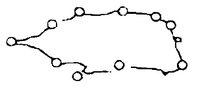 Star chart of Enduri Senggu, drawn by Fu Yuguang
 -
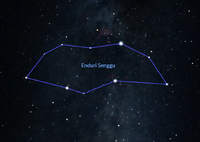 Enduri Senggu in Stellarium
 -
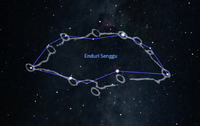 The superposition of traditional star chart and actual stars


IAU Working Group on Star Names
In 2026, the name of the historical constellation "Enduri Senggu" was suggested to be used for τ Cyg in this constellation. Enduri Senggu is also known as the "Eye-Protecting Goddess", and the star τ Cyg is situated near the position corresponding to the eye of the hedgehog in the traditional Manchu star chart.
Decision: ...
References
- ↑ 1.0 1.1 1.2 1.3 1.4 Wang, Honggang王宏刚. (1993). On the Star Goddesses of Shamanism论萨满教的星辰女神. Journal of Changchun Normal College长春师范学院学报, (2), 69–72.
- ↑ 2.00 2.01 2.02 2.03 2.04 2.05 2.06 2.07 2.08 2.09 2.10 2.11 2.12 2.13 2.14 Fu, Yuguang富育光, & Wang, Honggang王宏刚. (1995). Shamanic Goddesses萨满教女神. Shenyang: Liaoning People's Publishing House.
- ↑ 3.0 3.1 3.2 3.3 3.4 3.5 3.6 3.7 3.8 Bäcker, J. (2000). The shaman's sky. Manchu mythology and starlore in the Amur Valley. Ad Seres et Tungusos. Festschrift für Martin Gimm zu seinem, 65, 1–17.
- ↑ 4.0 4.1 Zhang, Yahui张亚辉. (2011). A Study of Rituals and Myths in Qing Court Shamanic Sacrifices清宫萨满祭祀的仪式与神话研究. Qing History Journal清史研究, (4), 35.
- ↑ Imperially Authorized Rituals for Sacrifices to Gods and Heaven by the Manchus钦定满洲祭神祭天典礼 (Qianlong 12th year). In Liaohai Series辽海丛书.
- ↑ 6.0 6.1 Fu, Yuguang富育光. (1988). An Examination of the Qing Imperial Shrine Sacrifices清宫堂子祭祀辨考. Social Science Front社会科学战线, (4), 209.
- ↑ 7.0 7.1 Bai, Hongxi白洪希. (1995). An Exploration of the Qing Imperial Shrine Sacrifices清宫堂子祭探赜. Manchu Studies满族研究, (3), 61–63.
- ↑ Chao, Ke朝克. Etymological Studies of Manchu-Tungusic Languages满通古斯语族语言词源研究 / Comparative Vocabulary of Manchu-Tungusic Languages满通古斯语族语言词汇比较.
- ↑ Fu, Yuguang富育光. (1988). A Study of Manchu Shamanic Star Rituals and Customs满族萨满教星祭俗考. Northern Ethnicities, (1).