Al-Miġzal: Difference between revisions
No edit summary |
|||
| Line 28: | Line 28: | ||
==IAU Working Group Star Names== | ==IAU Working Group Star Names== | ||
In 2026, the name al-Miġzal (or any spelling variant) was suggested as a star name in the area that is covered by the historical asterism. It is suggested to be used for η Cyg. | In 2026, the name al-Miġzal (or any spelling variant) was suggested as a star name in the area that is covered by the historical asterism. It is suggested to be used for η Cyg. | ||
== Weblinks == | == Weblinks == | ||
Revision as of 07:10, 19 July 2026
Authors: Khalid Al-Ajaji, Susanne M Hoffmann

al-Miġzal (Arabic: المِغْزَل), “the wool spindle” is an Arabic name for the stars forming a cross shape in Cygnus.
Provenance, Etymology, History
The name al-Miġzal is used regionally in central Saudi Arabia. It comes from an indigenous star knowledge of the ancient Arabs living in the Arabian Peninsula prior to the Greek astronomy influence in the ninth century. AlAjaji elaborates in Stellarium:[1]
The star knowledge of the ancient Arabs had been recorded and preserved in old poetry and in the old works of Arab philologists and lexicographers of the Islamic civilization. Many books were written on the subject of star knowledge and anwāʾ [Arabic الأنواء], the Arabic knowledge of meteorology. The editors of Ibn Qutaybah's Kitāb al-Anwāʾ (9th century) listed twenty-four books on this subject written mostly between early eighth and tenth century[2]. The only completely preserved text is that of Ibn Qutaybah, but later scholars had quoted many of the earlier texts. One of the most significant works that recorded the indigenous Arab star names is the Book of the stars written in ~ 964 AD by the prominent astronomer: al-Ṣūfī, where he identified the indigenous Arab star names with the respective Ptolemaic stars of the Greek constellations[3].

-
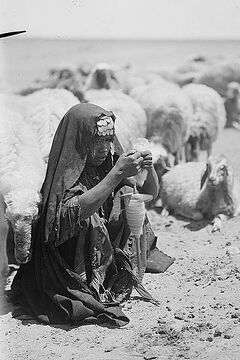 Bedouin shepherdess spinning. Source: Library of Congress, Prints and Photographs Division. Digital ID: matpc 03790 https://hdl.loc.gov/loc.pnp/matpc.03790 Original image on loc.gov

Etymology
al-Miġzal (Arabic: المِغْزَل)is derived from the Arabic root (غزل), referring to a wool spindle, and ultimately from the verb “أُغْزِلَ,” meaning “to be twisted and rotated”.
Sources and Identification
The name comes from local oral tradition, recorded by Khalid al-Ajaji in October 2016 during a star-gazing session in the dunes of Ṯuwayrāt in the al-Zulfī region, northwest of Riyadh, Saudi Arabia. The identification was made directly at the time, when the informant pointed to the cross-shaped stars of Cygnus, visible from shortly after sunset until after midnight.
The research is documented and published in Stellarium software,[4] available as a public dataset in the Stellarium GitHub Repository[5] and the description by Khalid AlAjaji is also published in paper form in the conference proceedings Hoffmann and Wolfschmidt (eds. 2022)[1]. In Stellarium it is written (by Khalid AlAjaji):
The Wool Spindle: The cross-shaped arrangement of α Cyg (Deneb), ε Cyg (Gienah), γ Cyg (Sadr), δ Cyg, and β1+β2 Cyg (Albireo). This comes from oral tradition in Zulfi, central Saudi Arabia [#1][6].
Stars Identification
The asterism of al-Miġzal is formed by the stars α, γ, β Cyg and ε, γ, δ Cyg.
The identification is considered secure, as the narrator of the name personally indicated these stars when describing al-Miġzal.
IAU Working Group Star Names
In 2026, the name al-Miġzal (or any spelling variant) was suggested as a star name in the area that is covered by the historical asterism. It is suggested to be used for η Cyg.
Weblinks
- Stellarium https://stellarium.org/
Reference
- ↑ 1.0 1.1 Khalid AlAjaji (2022). Stellarium Sky Culture "Arabian Peninsula", in Hoffmann, S. and Wolfschmidt, G. (eds.). Astronomy in Culture - Cultures of Astronomy, Featuring the Proceedings of a splinter meeting in the German Astronomical Society. tredition, Ahrensburg.
- ↑ Ibn Qutaybah, Al-Dinawarī, Abū Muḥammad ʿAbd Allah b. Muslim (died ~ 889), Kitab al-Anwāʾ (Book of meteorolgy), (Arabic print of the original book, Daʾirat al-Maʿarif al-Osmania, Hydarabad, India, 1956), أبو محمد عبد الله بن مسلم ابن قتيبة الدينوري (توفي 276 هـ)، كتاب الأنواء في مواسم العرب، دائرة المعارف العثمانية، حيدر أباد، الهند، 1375 هـ
- ↑ ">Book of the stars by al-Ṣūfī (died 986): Critical edition with commentary by Khalid al-Ajaji, digital edition, 2021, كتاب الكواكب لأبي الحسين عبد الرحمن بن عمر الرازي المعروف بالصوفي (291-376)، تحقيق خالد بن عبد الله العجاجي
- ↑ Zotti, G., Hoffmann, S. M., Wolf, A., Chéreau, F., & Chéreau, G. (2021). The Simulated Sky: Stellarium for Cultural Astronomy Research. Journal of Skyscape Archaeology, 6(2), 221–258. DOI: 10.1558/jsa.17822
- ↑ Stellarium Repo https://zenodo.org/records/20835040Stellarium's official Zenodo Digital Object Identifier (DOI) 10.5281/zenodo.20835040
- ↑ Reference [#1] in this case is "Oral Tradition" documented by the author of this sky culture, Khalid AlAjaji.