Kenemu: Difference between revisions
Ericmamajek (talk | contribs) |
No edit summary |
||
| Line 40: | Line 40: | ||
Previous Identification: Leitz (1995, 91)<ref>Leitz, Ch., 1995. Altägyptische Sternuhren. OLA, 62. Leuven: Peeters.</ref> reads ''knm'' and translates The Dark One, which he interprets as a reference to fainter stars. His identification with λ Aql is refuted by Belmonte and Lull (2023),<ref name=":1">Belmonte, Juan Antonio and Lull, José (2023). Astronomy of Ancient Egypt - A Cultural Perspective, Springer</ref> who also adopt another reading of the original hieroglyphs. | Previous Identification: Leitz (1995, 91)<ref>Leitz, Ch., 1995. Altägyptische Sternuhren. OLA, 62. Leuven: Peeters.</ref> reads ''knm'' and translates The Dark One, which he interprets as a reference to fainter stars. His identification with λ Aql is refuted by Belmonte and Lull (2023),<ref name=":1">Belmonte, Juan Antonio and Lull, José (2023). Astronomy of Ancient Egypt - A Cultural Perspective, Springer</ref> who also adopt another reading of the original hieroglyphs. | ||
==== Decan Star Clocks ==== | |||
Decan star clocks (also "diagonal star clocks") represent one of the earliest known systematic methods of stellar timekeeping, as they are preserved from the Middle Kingdom (2100-1800 BCE). During the night, the successive appearance of decans provided a way to divide the night into approximately twelve parts for the twelve hours of the night. These constellations shift successively, so that the Egyptian schema needs to be read diagonally: every ten days, another constellation is considered to rule the same hour, or in other words, each constellation (decan) rules a different hour depending on the time of the year. Hoffmann (2022)<ref>Hoffmann, S.M. (2022). Comparison of some General Concepts.,in Hoffmann and Wolfschmidt (eds.). Astronomy in Culture – Cultures of Astronomy, tredition Hamburg, 542-560</ref> writes: "The pattern of this systematic shift of constellations through the hours of the day within a year is depicted on Egyptian diagonal star clocks, when the sequence of decans was observed in culmination instead of in rising (Symons 2007<ref>Symons, Sarah (2007), A star's year: the annual cycle in the ancient egyptian sky, in J. M. Steele, ed., `Calendars and Years: Astronomy and Time in the Ancient World', Oxbow, Oxford (UK), pp. 1--33.</ref>), leading to a reduction of deviations throughout the year." | |||
=== Transfer and Transformation of the Constellation === | === Transfer and Transformation of the Constellation === | ||
Revision as of 11:12, 24 September 2026
Authors: Susanne M Hoffmann, Eric Mamajek, ASE Tech Team

| Asterism Info | |
| Native | Knmw |
|---|---|
| Translation | crew |
| Position (2000) | |
| Right ascension | 290.4181661 |
| Declination | -17.84719859 |
| Area | 0 sq. deg. |
| Stars | |
| Bright stars | 1 |
| Bayer/Flamsteed stars | 1 |
| Stars brighter than 3.00m | 0 |
| Brightest star | Kenemu (3.93m) |
| Taxonomy | |
| category of asterism | IAU-Star Name |
| IAU- constellations | Sgr |
Kenemu (knmw), Crew, is an Egyptian constellation of three stars ρ1 Sgr = 44 Sgr.[1][2] (Stars of) Kenmu, 17th decan in Egyptian astral science, has its heliacal rise in month Peret, represented by a small group of stars around ρ1 Sgr.
Concordance, Etymology, History

Origin of Constellation

Kenemu is the name of a decan (possibly form by several stars as its name indicate, the Crew) of the constellation Wia, The Boat, which is formed by several stars expanding from before the Red of the Prow (Antares) to the end of Sagittarius. It is sailing the Milky Way.

Lull (2018)[1] dedicates an entire research paper to the discussion, cultural embedding and astronomical identification of Wia, The Boat, with Knmw, The Crew. He concludes on the identification of Knmw with the area between the stars ρ1 Sgr (44 Sgr).
Previous Identification: Leitz (1995, 91)[3] reads knm and translates The Dark One, which he interprets as a reference to fainter stars. His identification with λ Aql is refuted by Belmonte and Lull (2023),[2] who also adopt another reading of the original hieroglyphs.
Decan Star Clocks
Decan star clocks (also "diagonal star clocks") represent one of the earliest known systematic methods of stellar timekeeping, as they are preserved from the Middle Kingdom (2100-1800 BCE). During the night, the successive appearance of decans provided a way to divide the night into approximately twelve parts for the twelve hours of the night. These constellations shift successively, so that the Egyptian schema needs to be read diagonally: every ten days, another constellation is considered to rule the same hour, or in other words, each constellation (decan) rules a different hour depending on the time of the year. Hoffmann (2022)[4] writes: "The pattern of this systematic shift of constellations through the hours of the day within a year is depicted on Egyptian diagonal star clocks, when the sequence of decans was observed in culmination instead of in rising (Symons 2007[5]), leading to a reduction of deviations throughout the year."
Transfer and Transformation of the Constellation

Religion/ Tales/ Mythology
In ancient Egyptian cosmology, boats carried the sun god Ra, and the deceased pharaoh's soul on its journey through the afterlife. The WjA constellation symbolized these vital spiritual and solar voyages.
Therefore constellation is also engraved on the granite sarcophagus lid of Djehapimu, the Royal Audit Officer and a relative of King Nectanebo II (Nakhthorheb, Nḫt-Ḥr-Ḥbt), c. 346-332 BCE, granite, displayed in the exhibition of the Neues Museum Berlin, Germany.
IAU WGSN star name discussion
The name was proposed to WGSN in 2025. As Kenemu means something as "crew", we are not sure if it would be appropriate for a single star. Juan Belmonte suggests to look for any pair of closing stars or a star which is multiple (not to the naked eye) in the area east of Kaus Australis, as in that case, it may suit. Yet, Belmonte and Lull (2023) and Lull (2018) both identify ρ1 Sgr at 3.93 mag in V.
In 2026, the name "Kenemu" was proposed for the star ρ1 Sgr (Rho1 Sagittarii, 44 Sgr, HR 7340, HD 181577, HIP 95168), a spectral type A9IV star with apparent magnitude V=3.92 that lies 40 parsecs away. The star is a Delta Scuti variable star that varies at the ~0.04 magnitude level on a timescale of ~1.2 hours. The star has a mass approximately 1.9x that of the Sun, and a luminosity of approximately 31x the Sun, placing it about ~1.5 magnitudes brighter than the main sequence, and making it a post-main sequence star.
-
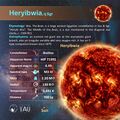 Heryibwia profile card (CC BY M.Sadegh Faghanpour for IAU-WGSN).
 -
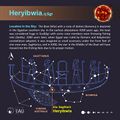 Heryibwia stick figure (CC BY M.Sadegh Faghanpour for IAU-WGSN).
 -
 Babylonian "River Boat" constellation: see Magur.
 -
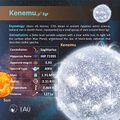 Kenemu profile card (CC BY M.Sadegh Faghanpour for IAU-WGSN).
 -
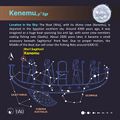 Kenemu stick figure (CC BY M.Sadegh Faghanpour for IAU-WGSN).
 -
 Qedty profile card (CC BY M.Sadegh Faghanpour for IAU-WGSN).
 -
 Qedty stick figure (CC BY M.Sadegh Faghanpour for IAU-WGSN).
Weblinks
References
- References (general)
- ↑ 1.0 1.1 Lull, José (2018). Ancient Egyptian constellation of WjA (Boat) and its link to Sagittarius in the Ptolemaic and Roman era. Aula Orientalis 36/2, 257-277
- ↑ 2.0 2.1 Belmonte, Juan Antonio and Lull, José (2023). Astronomy of Ancient Egypt - A Cultural Perspective, Springer
- ↑ Leitz, Ch., 1995. Altägyptische Sternuhren. OLA, 62. Leuven: Peeters.
- ↑ Hoffmann, S.M. (2022). Comparison of some General Concepts.,in Hoffmann and Wolfschmidt (eds.). Astronomy in Culture – Cultures of Astronomy, tredition Hamburg, 542-560
- ↑ Symons, Sarah (2007), A star's year: the annual cycle in the ancient egyptian sky, in J. M. Steele, ed., `Calendars and Years: Astronomy and Time in the Ancient World', Oxbow, Oxford (UK), pp. 1--33.





