Bawy: Difference between revisions
| Line 28: | Line 28: | ||
</gallery>Leitz (1995,<ref name=":0" /> 78) describes a graphical identification method for the decan constellations and says that he basically follows the identifications of Neugebauer and Parker (Astronomische Texte I, 97-100). Yet, on the following pages, Leitz (1995) gives his own arguments, always citing NP but occasionally giving alternatives. | </gallery>Leitz (1995,<ref name=":0" /> 78) describes a graphical identification method for the decan constellations and says that he basically follows the identifications of Neugebauer and Parker (Astronomische Texte I, 97-100). Yet, on the following pages, Leitz (1995) gives his own arguments, always citing NP but occasionally giving alternatives. | ||
Bawy is the 21st decan (Leitz 1995, 92) reads: <blockquote>Für diesen Dekan lassen sich immerhin Vorschläge machen. In etwa den richtigen Horizontabstand weisen Algenib (γ Persei, m = 2.8-2.9, Höhe rund 2.2°) und θ Ceti (m=3.6, Höhe rund 2.6°) auf. Nimmt man dagegen an, dass die Emendierung von Neugebauer und Parker (''ȝḫwy'' zu ''bȝwy'') richtig ist und sucht nach einem Sternpaar vor dem 21. Untergangshorizont, so wäre die wahrscheindlichste Lösung ζ und χ Ceti. Der erste Stern (ζ Ceti = Baten Kaitos) besitzt eine Helligkeit con m =3.7, der zweite, dicht danebenliegende von m = 4.7, ihr Abstand vom Horizont (6.°5-7°) ist um rund 2° zu groß, wäre also vielleicht noch zu akzeptieren. </blockquote><blockquote>'''English:''' Suggestions can at least be made for this decan. Algenib (γ Persei, m = 2.8–2.9, altitude around 2.2°) and θ Ceti (m = 3.6, altitude around 2.6°) have roughly the correct horizontal distance. If, on the other hand, one assumes that Neugebauer and Parker’s emendation (''ȝḫw''y to ''bȝwy'') is correct and searches for a pair of stars before the 21st horizon, the most likely solution would be ζ and χ Ceti. The first star (ζ Ceti = [[Baten Kaitos]]) has a magnitude of m = 3.7, whilst the second, lying close by, has a magnitude of m = 4.7; their distance from the horizon (6.5–7°) is about 2° too great, but might still be acceptable.</blockquote> | Bawy is the 21st decan (Leitz 1995, 92) reads:<blockquote>Für diesen Dekan lassen sich immerhin Vorschläge machen. In etwa den richtigen Horizontabstand weisen Algenib (γ Persei, m = 2.8-2.9, Höhe rund 2.2°) und θ Ceti (m=3.6, Höhe rund 2.6°) auf. Nimmt man dagegen an, dass die Emendierung von Neugebauer und Parker (''ȝḫwy'' zu ''bȝwy'') richtig ist und sucht nach einem Sternpaar vor dem 21. Untergangshorizont, so wäre die wahrscheindlichste Lösung ζ und χ Ceti. Der erste Stern (ζ Ceti = Baten Kaitos) besitzt eine Helligkeit con m =3.7, der zweite, dicht danebenliegende von m = 4.7, ihr Abstand vom Horizont (6.°5-7°) ist um rund 2° zu groß, wäre also vielleicht noch zu akzeptieren. </blockquote><blockquote>'''English:''' Suggestions can at least be made for this decan. Algenib (γ Persei, m = 2.8–2.9, altitude around 2.2°) and θ Ceti (m = 3.6, altitude around 2.6°) have roughly the correct horizontal distance. If, on the other hand, one assumes that Neugebauer and Parker’s emendation (''ȝḫw''y to ''bȝwy'') is correct and searches for a pair of stars before the 21st horizon, the most likely solution would be ζ and χ Ceti. The first star (ζ Ceti = [[Baten Kaitos]]) has a magnitude of m = 3.7, whilst the second, lying close by, has a magnitude of m = 4.7; their distance from the horizon (6.5–7°) is about 2° too great, but might still be acceptable.</blockquote> | ||
=== Transfer and Transformation of the Constellation === | === Transfer and Transformation of the Constellation === | ||
Revision as of 18:07, 24 September 2026
Authors: Susanne M Hoffmann, Juan Antonio Belmonte Avilés


Bawy, bȝwy, the dual form of Ba (the Soul), i.e. Two Souls, is an Egyptian name, used in decanal star clocks.
This asterism, possibly formed by two stars appears for the first time in the coffin-lids of the First Intermediate Period (FIP) and early Middle Kingdom. It appeaared along Egyptian history in celestial diagrams, including the circular zodiac of Dendera wwhere it is present in the decan belt just below Pisces. This may give an aapproximate idea of its RA location..
Concordance, Etymology, History
Variants
- Bawy
- Bau
- Ba+Ka
Origin of the Constellation
The Two Souls could be a couple of stars in Peg or Cet according to Belmonte and Lull (2023) but it is extremely difficult to precise which stars formed this decan.
Bawy can be considered as a syncretism of Set and Heru. Then, the name Harwyfy can also refer to them, it translates to "He with the Two Faces".
Decan Star Clocks
Decan star clocks (also "diagonal star clocks")[1] represent one of the earliest known systematic methods of stellar timekeeping, as they are preserved from the Middle Kingdom (2100-1800 BCE). During the night, the successive appearance of decans provided a way to divide the night into approximately twelve parts for the twelve hours of the night. These constellations shift successively, so that the Egyptian schema needs to be read diagonally: every ten days, another constellation is considered to rule the same hour, or in other words, each constellation (decan) rules a different hour depending on the time of the year. Hoffmann (2022)[2] writes: "The pattern of this systematic shift of constellations through the hours of the day within a year is depicted on Egyptian diagonal star clocks, when the sequence of decans was observed in culmination instead of in rising (Symons 2007[3]), leading to a reduction of deviations throughout the year."
-
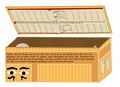 Schema of Egyptian star clock in a coffin lid (CC BY Bettina Hoffmann).
-
 Schema of Egyptian star clock: how it works (CC BY Bettina Hoffmann).
-
 Diagonal star clock in coffins from the Middle Kingdom of Ancient Egypt (Coffin of Nacht, probably from Asyut, 11th/12th Dynasty): Hildesheim, Römer und Pelicäusmuseum.


Leitz (1995,[1] 78) describes a graphical identification method for the decan constellations and says that he basically follows the identifications of Neugebauer and Parker (Astronomische Texte I, 97-100). Yet, on the following pages, Leitz (1995) gives his own arguments, always citing NP but occasionally giving alternatives. Bawy is the 21st decan (Leitz 1995, 92) reads:
Für diesen Dekan lassen sich immerhin Vorschläge machen. In etwa den richtigen Horizontabstand weisen Algenib (γ Persei, m = 2.8-2.9, Höhe rund 2.2°) und θ Ceti (m=3.6, Höhe rund 2.6°) auf. Nimmt man dagegen an, dass die Emendierung von Neugebauer und Parker (ȝḫwy zu bȝwy) richtig ist und sucht nach einem Sternpaar vor dem 21. Untergangshorizont, so wäre die wahrscheindlichste Lösung ζ und χ Ceti. Der erste Stern (ζ Ceti = Baten Kaitos) besitzt eine Helligkeit con m =3.7, der zweite, dicht danebenliegende von m = 4.7, ihr Abstand vom Horizont (6.°5-7°) ist um rund 2° zu groß, wäre also vielleicht noch zu akzeptieren.
English: Suggestions can at least be made for this decan. Algenib (γ Persei, m = 2.8–2.9, altitude around 2.2°) and θ Ceti (m = 3.6, altitude around 2.6°) have roughly the correct horizontal distance. If, on the other hand, one assumes that Neugebauer and Parker’s emendation (ȝḫwy to bȝwy) is correct and searches for a pair of stars before the 21st horizon, the most likely solution would be ζ and χ Ceti. The first star (ζ Ceti = Baten Kaitos) has a magnitude of m = 3.7, whilst the second, lying close by, has a magnitude of m = 4.7; their distance from the horizon (6.5–7°) is about 2° too great, but might still be acceptable.
Transfer and Transformation of the Constellation
-
 ancient manuscript 1
-
modern mapping by author XY
-
ancient manuscript 2
-
modern mapping by author AB
-
something else ...
Note: On the circular Dendera zodiac, there is an unexplained couple of deities in Cetus. They carry planet symbols but are south of the region where planets orbit. These unexplained deities are unlikely to be related to Bawy.
Religion/ Tales/ Mythology
mnemonic tales and cultural significance
IAU Working Group on Star Names
In 2023, it was suggested to WGSN to use a star in Cetus to commemorate this obsolete constellation.
Weblinks
References
- References (general)
- ↑ 1.0 1.1 Leitz, Ch., 1995. Altägyptische Sternuhren. OLA, 62. Leuven: Peeters.
- ↑ Hoffmann, S.M. (2022). Comparison of some General Concepts.,in Hoffmann and Wolfschmidt (eds.). Astronomy in Culture – Cultures of Astronomy, tredition Hamburg, 542-560
- ↑ Symons, Sarah (2007), A star's year: the annual cycle in the ancient egyptian sky, in J. M. Steele, ed., `Calendars and Years: Astronomy and Time in the Ancient World', Oxbow, Oxford (UK), pp. 1--33.