Sah: Difference between revisions
| Line 2: | Line 2: | ||
Authors: {{PAGEAUTHORS}} | Authors: {{PAGEAUTHORS}} | ||
---- | ---- | ||
[[File:Sah (god).svg|thumb|egyptian god Sah based of a panting at the temple at Dendera (CC0)]] | |||
[[File: | [[File:ORION SAH RL.jpg|thumb|Sah and Sopdet in Ori+Lep and CMa (CC BY Roland E. Laffitte)]] | ||
[[File: | Sah (''sꜣḥ''), [translation] is an ancient Egyptian god who was considered to be located in the stars. He is represented by a constellation in the area of modern [[Orion]] and [[Lepus]], and attested since the middle of the 3rd millennium in Pyramide Texts. | ||
==Concordance, Etymology, History== | ==Concordance, Etymology, History== | ||
| Line 13: | Line 10: | ||
=== Origin of Constellation === | === Origin of Constellation === | ||
Sah was frequently mentioned as "the Father of Gods" in Pyramid Texts of the Old Kingdom (roughly 2686 – 2181 BCE). According to Egyptian belief, the pharaoh was considered god-like, which is why his soul was thought to travel to the constellation of Sah in Orion after the pharaoh's death.<ref name="Wilkinson" /> | |||
Sah's consort was considered the goddess Isis, represented by the Sopdet constellation with its main star [[Sirius]]. | |||
==== Pyramide Texts ==== | |||
The Pyramid Texts<ref>Allen, James P. (2015). The Ancient Egyptian Pyramid Texts. 2nd ed. Society of Biblical Literature, Writings from the Ancient World 23. [https://www.jstor.org/stable/j.ctt14jxv34?utm_source=chatgpt.com JSTOR]</ref> are the oldest substantial corpus of religious writings from ancient Egypt and among the earliest surviving religious texts in the world.<ref>Sethe, Kurt (1908–1922). Die altägyptischen Pyramidentexte. 4 vols. Leipzig.</ref><ref>Faulkner, Raymond O. (1969). The Ancient Egyptian Pyramid Texts. Oxford: Clarendon Press.</ref> They were inscribed in hieroglyphs on the interior walls of royal pyramids, beginning with the pyramid of King Unas (Wenis), the last ruler of the Fifth Dynasty, at Saqqara, around 2350 BCE. They subsequently appeared in the pyramids of several Sixth-Dynasty kings and queens. There is no uniform collection;<ref>Allen, James P. (2017). A Grammar of the Ancient Egyptian Pyramid Texts, Vol. I: Unis. Eisenbrauns.</ref> the presented information differs from one pyramid to the other, but several texts were subsequently adapted and transmitted in the Coffin Texts of the Middle Kingdom and, later, in the Book of the Dead. | |||
The texts also contain important references to astronomical and celestial concepts, including stars, constellations and the cyclical movements of celestial bodies. The deceased king's association with the imperishable stars and his identification with Orion (Sah), associated with Osiris, form part of this elaborate conception of the celestial afterlife. | |||
==== Decan Star Clocks ==== | |||
Decan star clocks (also "diagonal star clocks")<ref name=":0">Leitz, Ch., 1995. Altägyptische Sternuhren. OLA, 62. Leuven: Peeters.</ref> represent one of the earliest known systematic methods of stellar timekeeping, as they are preserved from the Middle Kingdom (2100-1800 BCE). During the night, the successive appearance of decans provided a way to divide the night into approximately twelve parts for the twelve hours of the night. These constellations shift successively, so that the Egyptian schema needs to be read diagonally: every ten days, another constellation is considered to rule the same hour, or in other words, each constellation (decan) rules a different hour depending on the time of the year. Hoffmann (2022)<ref>Hoffmann, S.M. (2022). Comparison of some General Concepts.,in Hoffmann and Wolfschmidt (eds.). Astronomy in Culture – Cultures of Astronomy, tredition Hamburg, 542-560</ref> writes: "The pattern of this systematic shift of constellations through the hours of the day within a year is depicted on Egyptian diagonal star clocks, when the sequence of decans was observed in culmination instead of in rising (Symons 2007<ref>Symons, Sarah (2007), A star's year: the annual cycle in the ancient egyptian sky, in J. M. Steele, ed., `Calendars and Years: Astronomy and Time in the Ancient World', Oxbow, Oxford (UK), pp. 1--33.</ref>), leading to a reduction of deviations throughout the year."<gallery> | |||
File:EgStarClockSarg_BettinaHoffmann.jpeg|Schema of Egyptian star clock in a coffin lid (CC BY Bettina Hoffmann). | |||
File:EgStarClockSchema_BettinaHoffmann.jpeg|Schema of Egyptian star clock: how it works (CC BY Bettina Hoffmann). | |||
File:Digaonalsternuhr.jpg|Diagonal star clock in coffins from the Middle Kingdom of Ancient Egypt (Coffin of Nacht, probably from Asyut, 11th/12th Dynasty): Hildesheim, Römer und Pelicäusmuseum. | |||
</gallery><gallery> | |||
</gallery> | |||
==== Ramesside Star Clock ==== | ==== Ramesside Star Clock ==== | ||
| Line 18: | Line 31: | ||
==== Individual Stars ==== | ==== Individual Stars ==== | ||
* Msḏr-Sꜣḥ, | * Msḏr-Sꜣḥ,, the ear of sah, '''Sigma Ori,''' present in Sethy I celestial diagram | ||
* | * Remen Hery sah, Upper Arm of Sah, '''Pi5 Ori''' (Remenherysah), another decan of the constellation Sah. | ||
=== Transfer and Transformation of the Constellation === | === Transfer and Transformation of the Constellation === | ||
<gallery> | <gallery> | ||
File: | File:SAH & SOPDET ORION SIRIUS RL.png|Sah and Sopdet on a Diagonal Star Clock (CC BY Roland Laffitte) | ||
File:Ori-sah dendera orig +sirius+canopus.png|Sah and neighboring constellations on the circular Zodiac of Dendera (CC BY [https://collections.louvre.fr/en/ark:/53355/cl010028871 Musée du Louvre, Département des Antiquités égyptiennes]) | File:Ori-sah dendera orig +sirius+canopus.png|Sah and neighboring constellations on the circular Zodiac of Dendera (CC BY [https://collections.louvre.fr/en/ark:/53355/cl010028871 Musée du Louvre, Département des Antiquités égyptiennes]) | ||
File:Ori dendera black inv.jpg|Constellation of Sah in the area of [[Orion]] on the circular Zodiac of Dendera, Egypt (drawing by SMH for Stellarium 2026). | File:Ori dendera black inv.jpg|Constellation of Sah in the area of [[Orion]] on the circular Zodiac of Dendera, Egypt (drawing by SMH for Stellarium 2026). | ||
| Line 37: | Line 49: | ||
== Weblinks == | == Weblinks == | ||
* | * UCL [https://www.ucl.ac.uk/museums-static/digitalegypt/literature/religious/pyramid.html Digital Collection]: Pyramid Texts | ||
== References == | == References == | ||
Revision as of 11:41, 10 November 2026
Authors: Susanne M Hoffmann


Sah (sꜣḥ), [translation] is an ancient Egyptian god who was considered to be located in the stars. He is represented by a constellation in the area of modern Orion and Lepus, and attested since the middle of the 3rd millennium in Pyramide Texts.
Concordance, Etymology, History
What does the term mean, does it always have the same meaning - was it changed over time.
Origin of Constellation
Sah was frequently mentioned as "the Father of Gods" in Pyramid Texts of the Old Kingdom (roughly 2686 – 2181 BCE). According to Egyptian belief, the pharaoh was considered god-like, which is why his soul was thought to travel to the constellation of Sah in Orion after the pharaoh's death.[1]
Sah's consort was considered the goddess Isis, represented by the Sopdet constellation with its main star Sirius.
Pyramide Texts
The Pyramid Texts[2] are the oldest substantial corpus of religious writings from ancient Egypt and among the earliest surviving religious texts in the world.[3][4] They were inscribed in hieroglyphs on the interior walls of royal pyramids, beginning with the pyramid of King Unas (Wenis), the last ruler of the Fifth Dynasty, at Saqqara, around 2350 BCE. They subsequently appeared in the pyramids of several Sixth-Dynasty kings and queens. There is no uniform collection;[5] the presented information differs from one pyramid to the other, but several texts were subsequently adapted and transmitted in the Coffin Texts of the Middle Kingdom and, later, in the Book of the Dead.
The texts also contain important references to astronomical and celestial concepts, including stars, constellations and the cyclical movements of celestial bodies. The deceased king's association with the imperishable stars and his identification with Orion (Sah), associated with Osiris, form part of this elaborate conception of the celestial afterlife.
Decan Star Clocks
Decan star clocks (also "diagonal star clocks")[6] represent one of the earliest known systematic methods of stellar timekeeping, as they are preserved from the Middle Kingdom (2100-1800 BCE). During the night, the successive appearance of decans provided a way to divide the night into approximately twelve parts for the twelve hours of the night. These constellations shift successively, so that the Egyptian schema needs to be read diagonally: every ten days, another constellation is considered to rule the same hour, or in other words, each constellation (decan) rules a different hour depending on the time of the year. Hoffmann (2022)[7] writes: "The pattern of this systematic shift of constellations through the hours of the day within a year is depicted on Egyptian diagonal star clocks, when the sequence of decans was observed in culmination instead of in rising (Symons 2007[8]), leading to a reduction of deviations throughout the year."
-
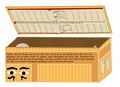 Schema of Egyptian star clock in a coffin lid (CC BY Bettina Hoffmann).
-
 Schema of Egyptian star clock: how it works (CC BY Bettina Hoffmann).
-
 Diagonal star clock in coffins from the Middle Kingdom of Ancient Egypt (Coffin of Nacht, probably from Asyut, 11th/12th Dynasty): Hildesheim, Römer und Pelicäusmuseum.


Ramesside Star Clock
Individual Stars
- Msḏr-Sꜣḥ,, the ear of sah, Sigma Ori, present in Sethy I celestial diagram
- Remen Hery sah, Upper Arm of Sah, Pi5 Ori (Remenherysah), another decan of the constellation Sah.
Transfer and Transformation of the Constellation
-
 Sah and Sopdet on a Diagonal Star Clock (CC BY Roland Laffitte)
-
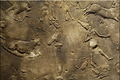 Sah and neighboring constellations on the circular Zodiac of Dendera (CC BY Musée du Louvre, Département des Antiquités égyptiennes)
-
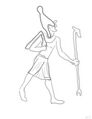 Constellation of Sah in the area of Orion on the circular Zodiac of Dendera, Egypt (drawing by SMH for Stellarium 2026).


Religion/ Tales/ Mythology
mnemonic tales and cultural significance
IAU Working Group on Star Names
Weblinks
- UCL Digital Collection: Pyramid Texts
References
- References (general)
- ↑ Cite error: Invalid
<ref>tag; no text was provided for refs namedWilkinson - ↑ Allen, James P. (2015). The Ancient Egyptian Pyramid Texts. 2nd ed. Society of Biblical Literature, Writings from the Ancient World 23. JSTOR
- ↑ Sethe, Kurt (1908–1922). Die altägyptischen Pyramidentexte. 4 vols. Leipzig.
- ↑ Faulkner, Raymond O. (1969). The Ancient Egyptian Pyramid Texts. Oxford: Clarendon Press.
- ↑ Allen, James P. (2017). A Grammar of the Ancient Egyptian Pyramid Texts, Vol. I: Unis. Eisenbrauns.
- ↑ Leitz, Ch., 1995. Altägyptische Sternuhren. OLA, 62. Leuven: Peeters.
- ↑ Hoffmann, S.M. (2022). Comparison of some General Concepts.,in Hoffmann and Wolfschmidt (eds.). Astronomy in Culture – Cultures of Astronomy, tredition Hamburg, 542-560
- ↑ Symons, Sarah (2007), A star's year: the annual cycle in the ancient egyptian sky, in J. M. Steele, ed., `Calendars and Years: Astronomy and Time in the Ancient World', Oxbow, Oxford (UK), pp. 1--33.