IR.BI4.IL: Difference between revisions
From All Skies Encyclopaedia
IR.BI4.IL
No edit summary |
No edit summary |
||
| Line 1: | Line 1: | ||
{{DISPLAYTITLE:IR.BI<sub>4</sub>.IL}} | {{DISPLAYTITLE:IR.BI<sub>4</sub>.IL}} | ||
<sup>mul</sup>IR.BI<sub>4</sub>.IL (𒀯𒅕𒁁𒅋) is an ancient Mesopotamian asterism, referring to the planet Mars. | <sup>mul</sup>IR.BI<sub>4</sub>.IL (𒀯𒅕𒁁𒅋) is an ancient Mesopotamian asterism, referring to the planet Mars. | ||
==Concordance, Etymology, History | ==Concordance, Etymology, History<ref>[[Mesopotamian (All Terms)|Planetarium Babylonicum 2.0]], All Skies Encyclopaedia.</ref>== | ||
[G. 201]; apparently one of the epithets of Mars; only in prediction: DIŠ <sup>mul</sup>IR.BI<sub>4</sub>.IL<sup>(?)</sup> ANŠE.KUR.RA.MEŠ UŠ<sub>2</sub>.MEŠ <sup>d</sup>''Ṣal-bat-a-nu u''<sub>2</sub>-''tan-na''-[''at''] "When Irbil<sup>?</sup> (observed): horses die; (this happens when) the brilliance of Mars wanes" [ACh Ištar, 30:44]. Could this be a reference to Mars being Ishtar of the Assyrian city Irbil = Erbella - if yes why Mars and not Venus? '''<nowiki>[[need to collate?? - check in cdli for tablet??? ??]]</nowiki>''' | [G. 201]; apparently one of the epithets of Mars; only in prediction: DIŠ <sup>mul</sup>IR.BI<sub>4</sub>.IL<sup>(?)</sup> ANŠE.KUR.RA.MEŠ UŠ<sub>2</sub>.MEŠ <sup>d</sup>''Ṣal-bat-a-nu u''<sub>2</sub>-''tan-na''-[''at''] "When Irbil<sup>?</sup> (observed): horses die; (this happens when) the brilliance of Mars wanes" [ACh Ištar, 30:44]. Could this be a reference to Mars being Ishtar of the Assyrian city Irbil = Erbella - if yes why Mars and not Venus? '''<nowiki>[[need to collate?? - check in cdli for tablet??? ??]]</nowiki>''' | ||
Revision as of 15:45, 17 December 2025
mulIR.BI4.IL (𒀯𒅕𒁁𒅋) is an ancient Mesopotamian asterism, referring to the planet Mars.
Concordance, Etymology, History[1]
[G. 201]; apparently one of the epithets of Mars; only in prediction: DIŠ mulIR.BI4.IL(?) ANŠE.KUR.RA.MEŠ UŠ2.MEŠ dṢal-bat-a-nu u2-tan-na-[at] "When Irbil? (observed): horses die; (this happens when) the brilliance of Mars wanes" [ACh Ištar, 30:44]. Could this be a reference to Mars being Ishtar of the Assyrian city Irbil = Erbella - if yes why Mars and not Venus? [[need to collate?? - check in cdli for tablet??? ??]]
Images of Mars
-
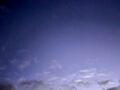 Close Conjunction of Jupiter (brighter) and Mars (reddish) under Orion (upper right), seen from Cape Town (SMH 2024)
 -
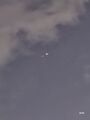 Closest Conjunction of Jupiter and Mars in 2024 (Cape Town, SMH).
 -
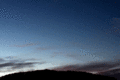 Jupiter, Mars and Pleiades at Dawn (SMH 2024).
 -
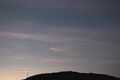 Jupiter, Mars, Pleiaden in a slightly cloudy morning twilight (SMH 2024).
 -
 Mars in the constellation Gemini, The Twins (SMH January 2025).
 -
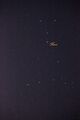 Mars in the constellation Gemini, The Twins (SMH February 2025).
 -
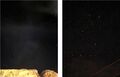 Mars extremly close to epsilon Geminorum (14 April 2023), seen from Petra, Jordan (SMH).
 -
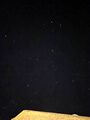 One day after the close conjunction of Mars with epsilon Geminorum; seen from Petra, Jordan (SMH 2023). The planet then had a visible separation from the star.
 -
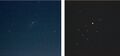 Mars in the Open Star Cluster Praesepe (M44) in Cancer (2023)
 -
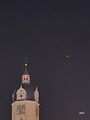 Mars next to a tower in Central Europe: its reddish colour is extraordinarily obvious (SMH 2025).
 -
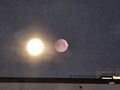 Mars two moon widths next to the Moon, photograph at full moon taken through a window in order to produce a dimmer image of the full moon next to Mars: the planet is at the right edge of the Moon. (SMH January 2025).


Historical Dictionaries
| Kurtik (2022, i14) | Gössmann (1950) |
|---|---|
| [G. 201]; по-видимому, один из эпитетов Марса; только в предсказании: DIŠ mulIR.BI4.IL(?) ANŠE.KUR.RA.MEŠ UŠ2.MEŠ dṢal-bat-a-nu u2-tan-na-[at] «Когда Ирбил? (наблюдается): лошади умирают; (это происходит, когда) блеск Марса ослабевает» [ACh Ištar, 30:44]. | Example |
References
- ↑ Planetarium Babylonicum 2.0, All Skies Encyclopaedia.