Auriga: Difference between revisions
| Line 41: | Line 41: | ||
|- | |- | ||
| | | | ||
| | |Psc 10 1/2 | ||
| | |Tau 15 1/2 | ||
| | |Sgr 20 | ||
| | |Cap 29 | ||
|- | |- | ||
| | | | ||
| Line 53: | Line 53: | ||
|- | |- | ||
|star | |star | ||
| | |those in the head | ||
| | |the in the foot | ||
| | | | ||
| | | | ||
|- | |- | ||
|duration | |duration | ||
| colspan="4" | | | colspan="4" |3 hours = 180 min = 45 degree | ||
|} | |} | ||
Revision as of 16:33, 23 February 2026
Authors: Susanne M Hoffmann, Doris Vickers, Youla Azkarrula, Ian Ridpath

One of the 88 IAU constellations.
Etymology and History
The Greek constellation ...
Origin of Constellation
Babylonian

Greco-Roman
Aratos
If you are minded to observe the Charioteer and the Charioteer’s stars, and rumour has reached you of the Goat herself and the Kids, who have often looked down on men being tossed upon the heaving sea, [160] you will find the Charioteer lying large to the left of the Twins, while opposite Helice circles his head at that extremity. Fastened to his left shoulder is the sacred Goat, who is said to have tendered her breast to Zeus: the interpreters of Zeus call her the Olenian Goat. [165] Now he is large and brilliant, but her Kids there on the Charioteer’s wrist shine faintly.
Near the feet of the Charioteer look for the horned Bull crouching. This constellation is very recognisable, so clearly defined is its head: one needs no other [170] sign to identify the ox’s head, so well do the stars themselves model both sides of it as they go round. Their name is also very popular: the Hyades are not just nameless. They are set out all along the Bull’s face; the point of its left horn [175] and the right foot o f the adjacent Charioteer are occupied by a single star, and they are pinned together as they go. But the Bull is always ahead o f the Charioteer in sinking to the horizon, though it rises simultaneously.
(Kidd 1997)
Eratosthenes
Hipparchus
Rising (Lib II Cap V §10)
The Rising of ...
| east | south | |||
|---|---|---|---|---|
| lam1 | lam2 | lam1 | lam2 | |
| Psc 10 1/2 | Tau 15 1/2 | Sgr 20 | Cap 29 | |
| star | those in the head | the in the foot | ||
| duration | 3 hours = 180 min = 45 degree | |||
Setting (Lib II Cap VI §10)
| west | south | |||
|---|---|---|---|---|
| lam1 | lam2 | lam1 | lam2 | |
| star | ||||
| duration | 2 2/3 hours = 160 min = 40° | |||
Stars Mentioned
| Greek | German | English | ident. | src | lam_culm | ||
|---|---|---|---|---|---|---|---|
| Lib II Cap V §10 | rising, east, first | ||||||
| Lib II Cap V §10 | rising, east, last | ||||||
| Lib II Cap VI §2 | setting CrB, south, last | Psc 13.5 | |||||
| Lib II Cap VI §13 | setting Aql, south, first | Ari 2 | |||||
| Lib III Cap I §9 | rising Ori, south, last | Psc 13 |
Hyginus, Astronomica
In Latin we call him "auriga" — Erichthonius by name, as Eratosthenes shows. Jupiter seeing that he first among men yoked horses in four-horse chariots, admired the genius of a man who could rival the invention of Sol, who first among the gods made use of the quadriga. Erichthonius first invented the four-horse chariot, as we said before, and also first established sacrifices to Minerva, and a temple on the citadel of the Athenians. Euripides gives the following account of his birth. Vulcan, inflamed by Minerva's beauty, begged her to marry him, but was refused. She hid herself in the place called Hephaestius, on account of the love of Vulcan. They say that Vulcan, following her there, tried to force her, and when, full of passion he tried to embrace her, he was repulsed, and some of his seed fell to the ground. Minerva overcome by shame, with her foot spread dust over it. From this the snake Erichthonius was born, who derives his name from the earth and their struggle. Minerva is said to have hidden him, like a cult-object, in a chest. She brought the chest to the daughters of Erechtheus and gave it to them to guard, forbidding them to open it. But man is by nature so curious, that the oftener he is forbidden to do something, the more he desired to do it. So the girls opened the chest and saw the snake. As a result they were driven mad by Minerva, and threw themselves from the Acropolis. But the snake fled to the shield of Minerva, and was reared by her.
Others have said that Erichthonius merely had snake-legs, and in his youth established the Panathenaic Games for Minerva, himself competing in the four-horse chariot race. In return for these deeds he was placed among the constellations.
Some too, who have written about the stars, have said that the Charioteer was an Argive by birth, named Orsilochus, who first invented the four-horse chariot, and for his invention gained a place among the stars.
Others identified him as the son of Mercury and Clytie, Myrtilus by name, the charioteer of Oinomaus. After his death, the manner of which is common knowledge, his father is said to have put his form in the sky.
On his left shoulder (the goat) Capra stands, and in his left hand the Kids seem to be placed. They tell this story about him. A certain Olenus, son of Vulcan, had two daughters, the nymphs Aex and Helice, who were nurses of Jove. Others have said that certain cities were named from them — Olenus in Aulis, Helice in the Peloponnesus, and Aex in Haemonia — about which Homer writes in the second book of the Iliad. But Parmeniscus say that a certain Melisseus was king in Crete, and to his daughters Jove was brought to nurse. Since they did not have milk, they furnished him a she-goat, Amalthea by name, who is said to have reared him. She often bore twin kids, and at the very time that Jove was brought to her to nurse, had borne a pair. And so because of the kindness of the mother, the kids, too were placed among the constellations. Cleostratus of Tenedos is said to have first pointed out these kids among the stars.
But Musaeus says Jove was nursed by Themis and the nymph Amalthea, to whom he was given by Ops, his mother. Now Amalthea had as a pet a certain goat which is said to have nursed Jove.
Some have called Aex the daughter of Sol, who surpassed many in beauty of body, but in contrast to this beauty, had a most horrible face. Terrified by it, the Titans begged Terra to hide her body, and Terra is said to have hidden her in a cave in the island of Crete. Later she became nurse of Jove, as we have said before. But when Jupiter, confident in his youth, was preparing for war against the Titans, oracular reply was given to him that if he wished to win, he should carry on the war protected with the skin of a goat, aigos, and the head of the Gorgon. The Greeks call this the aegis. When this was done, as we have shown above, Jupiter, overcoming the Titans, gained possession of the kingdom. Covering the remaining bones of the goat with a skin, he gave life to them and memorialised them, picturing them with stars. Afterwards he gave to Minerva the aegis with which he had been protected when he won.
Euhemerus says that a certain Aex was the wife of Pan. When she was embraced by Jove she bore a son whom she called son of Pan. So the child was called Aegipan, and Jove, Aegiochus. Since he was very fond of him, he placed in memory the form of a goat among the stars. (Mary Ward 1960)
Geminos
Almagest Ἠνίοχος.
| id | Greek
(Heiberg 1898) |
English
(Toomer 1984) |
ident. |
|---|---|---|---|
| Ἡνιόχου ἀστερισμός | Constellation of Auriga | ||
| 1 | ὁ τῶν ἐπὶ τῆς κεφαλῆς δύο ὁ νοτιώτερος. | The southernmost of the two on the head | del Aur |
| 2 | ὁ βορειότερος καὶ ὑπὲρ τὴν κεφαλήν | The northernmost [ of these], over the head | xi Aur |
| 3 | ὁ ἐπὶ τοῦ ἀριστεροῦ ὤμου καλούμευος Αἵξ. | The star on the left shoulder, called Capella | alf Aur |
| 4 | ὁ ἐπὶ τοῦ δεξιοῦ ὥμου | The star on the right shoulder | bet Aur |
| 5 | ὁ ἐπὶ τοῦ δεξιοῦ ἀγκῶνος. | The star on the right elbow | nu Aur |
| 6 | ὁ ἐπὶ τοῦ δεξιοῦ καρποῦ. | The star on the. right wrist | tet Aur |
| ὁ ἐπὶ τοῦ ἀριστεροῦ ἀγκῶνος. | The star on the left elbow | eps Aur | |
| τῶν ἐπὶ τοῦ ἀριστεροῦ καρποῦ β καλουμένων Ἑρίφων ὁ ἐπόμενος | The rearmost of the two stars on the left wrist, which are called 'Haedi' | eta Aur | |
| ὁ προηγούμενος αὐτῶν. | The more ad;,anced of these | zet Aur | |
| ὁ ἐπὶ τοῦ ἀριστεροῦ σφυροῦ. | The star on the left ankle | iot Aur | |
| ὁ ἐπὶ τοῦ δεξιοῦ σφυροῦ κοινὸς κέρατος. | The star on the right ankle, which is [ applied in] common to the horn [ of Taurus] | bet Tau | |
| ὁ τούτου ἀπ’ ἄρκτων ἐν τῷ περιποδύῳ. | The one to the north of the latter, in the lower hem [ of the garment] | chi Aur | |
| ὁ ἔτι τούτου βορειότερος ἐπὶ τοῦ γλουτοῦ. | The one north aga,in of this, on the buttock | phi Aur | |
| ὁ ὑπὲρ τὸν ἀριστερὸν πόδα μικρός | The small star over the left foot | 14 Aur | |
| ἀστέρες ἰδ, ὥν α μεγέθουςα, β’ ἂ, γ’ β, δ’ὁ, ε β, ς ἂ. | 14 stars, I of the first magnitude, l of the second, 2 of the third, 7 of the fourth, 2 of the fifth, I of the sixth} |

Stars within the Constellation Area
| id | Label | IAU design. | description | Vmag |
|---|---|---|---|---|
| 1 | Capella | HIP 24608 | Constellation lines | 0.08 |
| 2 | Elnath | HIP 25428 | Constellation lines (Vertex) | 1.65 |
| 3 | Menkalinan | HIP 28360 | Constellation lines | 1.9 |
| 4 | Mahasim | HIP 28380 | Constellation lines (Vertex) | 2.62 |
| 5 | Hassaleh | HIP 23015 | Constellation lines (Vertex) | 2.69 |
| 6 | Almaaz | HIP 23416 | Constellation lines (Vertex) | 2.99 |
| 7 | Haedus | HIP 23767 | Constellation lines | 3.18 |
| 8 | Bagu | HIP 28358 | Constellation lines (Vertex) | 3.72 |
| 9 | Saclateni | HIP 23453 | Constellation lines | 3.75 |
| 10 | ν Aurigae | HIP 27673 | Constellation lines | 3.95 |
| 11 | C 0519+409 | C 0519+409 | Inside the hull | 4.2 |
| 12 | τ Aurigae | HIP 27483 | Inside the hull | 4.5 |
| 13 | λ Aurigae | HIP 24813 | Inside the hull | 4.71 |
| 14 | υ Aurigae | HIP 27639 | Inside the hull | 4.74 |
| 15 | 2 Aur | HIP 22678 | Inside the hull | 4.779 |
| 16 | χ Aurigae | HIP 25984 | Constellation lines | 4.79 |
| 17 | μ Aurigae | HIP 24340 | Inside the hull | 4.821 |
| 18 | 1 Aur | HIP 22453 | Constellation lines (Vertex) | 4.867 |
| 19 | σ Aurigae | HIP 25292 | Constellation lines | 4.996 |
| 20 | ω Aurigae | HIP 23179 | Inside the hull | 5 |
| 21 | KW Aur | HIP 24504 | Inside the hull | 5 |
| 22 | 19 Aur | HIP 24879 | Inside the hull | 5.03 |
| 23 | ϕ Aurigae | HIP 25541 | Inside the hull | 5.059 |
| 24 | ρ Aurigae | HIP 25048 | Inside the hull | 5.207 |
| 25 | IQ Aur | HIP 24799 | Inside the hull | 5.371 |
| 26 | - | HIP 24902 | Inside the hull | 5.456 |
| 27 | ο Aurigae | HIP 27196 | Constellation lines | 5.46 |
| 28 | - | HIP 25143 | Inside the hull | 5.542 |
| 29 | PU Aur | HIP 24738 | Inside the hull | 5.65 |
| 30 | - | HIP 25001 | Inside the hull | 5.67 |
| 31 | - | HIP 25492 | Inside the hull | 5.72 |
| 32 | - | HIP 25471 | Inside the hull | 5.905 |
| 33 | - | HIP 28343 | Inside the hull | 5.907 |
| 34 | - | HIP 25291 | Inside the hull | 5.925 |
| 35 | AE Aur | HIP 24575 | Inside the hull | 5.96 |
| 36 | 5 Aur | HIP 23261 | Inside the hull | 5.97 |
| 37 | - | HIP 25816 | Inside the hull | 5.991 |
| 38 | M 36 | M 36 | Inside the hull | 6 |
| 39 | - | HIP 26363 | Inside the hull | 6.082 |
| 40 | - | HIP 22955 | Inside the hull | 6.089 |
| 41 | - | HIP 26315 | Inside the hull | 6.095 |
| 42 | - | HIP 23511 | Inside the hull | 6.111 |
| 43 | AR Aur | HIP 24740 | Inside the hull | 6.144 |
| 44 | - | HIP 25476 | Inside the hull | 6.151 |
| 45 | - | HIP 25475 | Inside the hull | 6.158 |
| 46 | NGC 1912 562 | NGC 1912 562 | Inside the hull | 6.17 |
| 47 | - | HIP 24771 | Inside the hull | 6.199 |
| 48 | - | HIP 23799 | Inside the hull | 6.207 |
| 49 | - | HIP 26071 | Inside the hull | 6.261 |
| 50 | - | HIP 25290 | Inside the hull | 6.29 |
| 51 | - | HIP 27319 | Inside the hull | 6.292 |
| 52 | - | HIP 26463 | Inside the hull | 6.355 |
| 53 | - | HIP 25810 | Inside the hull | 6.377 |
| 54 | - | HIP 27777 | Inside the hull | 6.39 |
| 55 | M 38 | M 38 | Inside the hull | 6.4 |
| 56 | - | HIP 25580 | Inside the hull | 6.4 |
| 57 | - | HIP 26592 | Inside the hull | 6.44 |
| 58 | - | HIP 25301 | Inside the hull | 6.46 |
| 59 | - | HIP 27293 | Inside the hull | 6.46 |
| 60 | - | HIP 24332 | Inside the hull | 6.47 |
| 61 | - | HIP 26054 | Inside the hull | 6.474 |
| 62 | 6 Aur | HIP 23268 | Inside the hull | 6.48 |
| 63 | - | HIP 24881 | Inside the hull | 6.48 |
| 64 | 18 Aur | HIP 24832 | Inside the hull | 6.489 |
| 65 | - | HIP 23724 | Inside the hull | 6.5 |
Transfer and Transformation of the Constellation
-
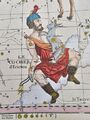 Auriga as Erichtonius in Fortin's Atlas Céleste, 3rd edition (1795).






