The Lizard is a modern constellation: Polish astronomer and brewer Johannes Hevelius formed a constellation in a gap between [[Cassiopeia]], the Summer Triangle and the Autumn Square. The region, which only contains third-magnitude stars, had no name in ancient times. It is irrelevant for observing planets and the Moon, and until now there had been no need to name it. However, with the constant improvement of telescopes and the beginning of surveys to search for comets and ‘nebulae’ (galaxies, star clusters, etc.), observers felt the need to systematically cover the sky with constellations.
Hevelius was one of the masters of large telescopes. He was an entrepreneur in Danzig, temporarily also mayor, but in any case also a gifted astronomer. From 1641 onwards, he built large telescopes and used them to observe the sky from Danzig. His wife Elisabetha Koopman Hevelius was involved in his work and published several important works after his death, including a star catalogue and a celestial atlas.
It is no longer possible to determine which of the two came up with the lizard and why. The jagged pattern of stars of roughly equal brightness is somehow reminiscent of a lizard seen from above.
=== Source ===
Hevelius's description: <blockquote>[[File:Stellio in Hevelius.jpg|alt=star catalogue|thumb|Hevelius' star catalogue for the newly invented constellation squeezed into the empty space between Andromeda and Lacerta. ]]Secundò, Lacertam sive Stellionenm , quam inter Andromedam, & Cygnum reposui, eam ob causam elegi, quòd ibidem in tali angusto loco magnum aliquod animal consistere minimè posset, etiamsi decem lucidissimis Stellulis, Spatium istud esset resertum: adhrec, ut Autores volunt, sit animalculum versicolor , quasi plurimis Stellulis exornatum; id quod Nostro animalculo Coelestis omnium optimé convenit.
Hevelius's description: <blockquote>[[File:Stellio in Hevelius.jpg|alt=star catalogue|thumb|Hevelius' star catalogue for the newly invented constellation squeezed into the empty space between Andromeda and Lacerta. ]]Secundò, Lacertam sive Stellionenm , quam inter Andromedam, & Cygnum reposui, eam ob causam elegi, quòd ibidem in tali angusto loco magnum aliquod animal consistere minimè posset, etiamsi decem lucidissimis Stellulis, Spatium istud esset resertum: adhrec, ut Autores volunt, sit animalculum versicolor , quasi plurimis Stellulis exornatum; id quod Nostro animalculo Coelestis omnium optimé convenit.
Revision as of 19:41, 26 February 2026
Johannes Hevelius - Lacerta sive Stellio
An early modern constellation invented by Jan and Elizabeta Hevelius during their observations in the 1680s. It was introduced in their star catalogue of 1687 and depicted on the star atlas 1690, both published under the name of Johannes Hevelius, the latter posthumously by his wife. Lacerta is now one of the 88 official IAU constellations.
The Lizard is a modern constellation: Polish astronomer and brewer Johannes Hevelius formed a constellation in a gap between Cassiopeia, the Summer Triangle and the Autumn Square. The region, which only contains third-magnitude stars, had no name in ancient times. It is irrelevant for observing planets and the Moon, and until now there had been no need to name it. However, with the constant improvement of telescopes and the beginning of surveys to search for comets and ‘nebulae’ (galaxies, star clusters, etc.), observers felt the need to systematically cover the sky with constellations.
Hevelius was one of the masters of large telescopes. He was an entrepreneur in Danzig, temporarily also mayor, but in any case also a gifted astronomer. From 1641 onwards, he built large telescopes and used them to observe the sky from Danzig. His wife Elisabetha Koopman Hevelius was involved in his work and published several important works after his death, including a star catalogue and a celestial atlas.
It is no longer possible to determine which of the two came up with the lizard and why. The jagged pattern of stars of roughly equal brightness is somehow reminiscent of a lizard seen from above.
Source
Hevelius's description:
Hevelius' star catalogue for the newly invented constellation squeezed into the empty space between Andromeda and Lacerta.
Secundò, Lacertam sive Stellionenm , quam inter Andromedam, & Cygnum reposui, eam ob causam elegi, quòd ibidem in tali angusto loco magnum aliquod animal consistere minimè posset, etiamsi decem lucidissimis Stellulis, Spatium istud esset resertum: adhrec, ut Autores volunt, sit animalculum versicolor , quasi plurimis Stellulis exornatum; id quod Nostro animalculo Coelestis omnium optimé convenit.
English:
"Secondly, I placed the Lizard or the Stellion between Andromeda and Cygnus; I chose it for this reason, that in such a narrow space a large animal could not possibly exist, even if that space were occupied by ten very bright stars: furthermore, as the authors say, it is a multicoloured little animal, as if adorned with many stars; this suits our little celestial animal best."
Description of Lacerta in Hevelius (1687)
The area was left empty in Greco-Roman antiquity, as there are only a few bright stars. α Lacertae is with 3.75 mag the only one brighter than 4 mag. Ptolemy's star catalogue is only complete until 4.2 mag, and it became relevant to close this gap between Andromeda and Cygnus only since astronomers surveyed the stars systematically with telescopes — the other stars in Lacerta between 4 and 5 mag form a zigzag pattern.
Transfer and Transformation
Lacerta sive Stellio in Hevelius (1687).
Le Lezard in Fortin (1795)
Mythology
?
IAU Working Group Star Names
Following the Almagest-tradition of using alternative names for the constellation given by its creator to the brightest star in the group, the name "Stellio" was suggested for the brightest star in Lacerta, α Lac (alpha Lacertae). It was discussed and approved by the IAU WGSN in 2024.
On August 29th 2024, the IAU WGSN decided to adopt the name "Stellio" for α Lac, a high proper motion star of 3.77 mag in V.


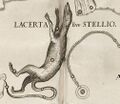 Lacerta sive Stellio in Hevelius (1687).
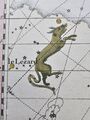 Le Lezard in Fortin (1795)