Red Rectangle: Difference between revisions
| Line 25: | Line 25: | ||
==IAU Working Group on Star Names== | ==IAU Working Group on Star Names== | ||
The name was approved by the IAU WGSN in 2026, following a SIMBAD adoption. The term "Red Rectangle" first appeared in the article Cohen et al. 1975 and since then,in at least 173 papers prior to IAU consideration. It is a common name in lterature, registered in SIMBAD and the AAVSO Variable Star Index (VSX). | The name was approved by the IAU WGSN in May 2026, following a SIMBAD adoption. The term "Red Rectangle" first appeared in the article Cohen et al. 1975 and since then,in at least 173 papers prior to IAU consideration. It is a common name in lterature, registered in SIMBAD and the AAVSO Variable Star Index (VSX). | ||
== Weblinks == | == Weblinks == | ||
Revision as of 10:42, 9 May 2026
Authors: Susanne M Hoffmann, Youla Azkarrula
_(433794740).jpg)
"Red Rectangle" is a modern star name adopted by the International Astronomical Union in the IAU-Catalog of Star Names (IAU-CSN). Its origin is modern astrophysics language (English). It is the name of the star V777 Mon = HD 44179 (9.02 mag) in constellation Monoceros.
Concordance, Etymology, History

Red Rectangle is a metal-poor post-AGB central star of a bipolar protoplanetary nebula (VSX). The photometric variation with the orbital period is caused by scattering of dust in the upper layers of an optically thick circumbinary disk. The binary consists of an A-type and a G-type component with emission lines. The star is at V=9.0, plx=2.27mas.
The name originates from the visual appearance of the star in early IR-surveys with which it was discovered in 1973 (a rocket flight associated with the AFCRL Infrared Sky Survey called Hi Star).[1]
The peculiar object HD 44179 ("The red rectangle").
A strong infrared source detected in the AFCRL sky survey is confirmed, and is identified with the binary star HD 44179, embedded in a peculiar nebula. UBVRI and broad-band photometry between 2.2 and 27 microns are combined with blue, red, and near-infrared spectra, polarimetry and spectrophotometry of the star, and a range of direct and image-tube photographs of the nebula, to suggest a composite model of the system. In this model, the infrared radiation derives from thermal emission by dust grains contained in a disklike geometry about the central object, which appears to be of spectral type B9-A0 III and which may be in pre-main-sequence evolution. Two infrared emission features are found, peaking at 8.7 and 11.3 microns, the latter corresponding to the feature seen in the spectrum of the planetary nebula NGC 7027. The complex nebular structure is discussed on the basis of photographs through narrow-band continuum and emission-line filters. The polarization data support the suggestion of a disk containing some large particles. No radio continuum emission is detected.
Images
-
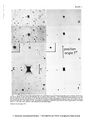 Red Rectangle in first publication: Cohen et al. 1975 - Plate 3
 -
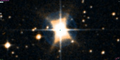 Red Rectangle in the DSS
 -
 Released to Public Hubble Red Rectangle Nebula (NASA) (433794740)
 -
 This schematic illustrates the wide range of unique structures observed in this remarkable nebula. A thick dust disc obscures the starlight from the central binary star system. Constrained starlight passes into the bipolar nebula lobes, seen almost face-on. Multiple episodes of mass-loss have created a series of nested paraboloids in which the gas surfaces are seen edge-on as ”ladder rungs” with bright vortex-like features at their lateral edges. In infrared wavelengths, the nebula does not shine by reflected starlight but emits broad and narrow unidentified molecular bands. (NASA and A. Feild (STScI))


.jpg)
Mythology
no mythology
IAU Working Group on Star Names
The name was approved by the IAU WGSN in May 2026, following a SIMBAD adoption. The term "Red Rectangle" first appeared in the article Cohen et al. 1975 and since then,in at least 173 papers prior to IAU consideration. It is a common name in lterature, registered in SIMBAD and the AAVSO Variable Star Index (VSX).
Weblinks
Reference
- References (general)
- References (early modern)
- Ian Ridpath's website (Star Tales )