Pegasus: Difference between revisions
No edit summary |
|||
| Line 62: | Line 62: | ||
(Pamias and Zucker 2013)<ref>Ératosthènes de Cyrène: Catastérrismes, translated by Pamìas, Jordi und Zucker, Arnaud, Les Belles Lettres, Paris 2013</ref></blockquote> | (Pamias and Zucker 2013)<ref>Ératosthènes de Cyrène: Catastérrismes, translated by Pamìas, Jordi und Zucker, Arnaud, Les Belles Lettres, Paris 2013</ref></blockquote> | ||
{|class="wikitable" | |||
|+ | |||
!erat.Cat.ID | |||
!constStarID | |||
!starName | |||
!ident.Bayer | |||
!ident.HIP | |||
!certainty | |||
|- | |||
|285 | |||
|1 | |||
|two dim stars on the mouth | |||
|9 Peg | |||
|107348 | |||
|1 | |||
|- | |||
|286 | |||
|2 | |||
|two dim stars on the mouth | |||
|13 Peg | |||
|107788 | |||
|1 | |||
|- | |||
|287 | |||
|3 | |||
|one on the head | |||
|eps Peg | |||
|107315 | |||
|1 | |||
|- | |||
|288 | |||
|4 | |||
|one on the jaw | |||
|17 Peg | |||
|108339 | |||
|4 | |||
|- | |||
|289 | |||
|5 | |||
|one dim one on each ear | |||
|4 Peg | |||
|106856 | |||
|2 | |||
|- | |||
|290 | |||
|6 | |||
|one dim one on each ear | |||
|7 Peg | |||
|107151 | |||
|2 | |||
|- | |||
|291 | |||
|7 | |||
|four on the neck (of which the one nearest the head is the brightest) | |||
|theta Peg | |||
|109427 | |||
|1 | |||
|- | |||
|292 | |||
|8 | |||
|four on the neck | |||
|nu Peg | |||
|109068 | |||
|2 | |||
|- | |||
|293 | |||
|9 | |||
|four on the neck | |||
|35 Peg | |||
|110882 | |||
|3 | |||
|- | |||
|294 | |||
|10 | |||
|four on the neck | |||
|31 Peg | |||
|110386 | |||
|3 | |||
|- | |||
|295 | |||
|11 | |||
|one on each shoulder | |||
|alpha Peg | |||
|113963 | |||
|1 | |||
|- | |||
|296 | |||
|12 | |||
|one on each shoulder | |||
|55 Peg | |||
|114144 | |||
|3 | |||
|- | |||
|297 | |||
|13 | |||
|one on the chest | |||
|beta Peg | |||
|113881 | |||
|1 | |||
|- | |||
|298 | |||
|14 | |||
|two on the front knees | |||
|lambda Peg | |||
|112440 | |||
|1 | |||
|- | |||
|299 | |||
|15 | |||
|two on the front knees | |||
|mu Peg | |||
|112748 | |||
|1 | |||
|- | |||
|300 | |||
|16 | |||
|one on the back | |||
|gam Peg | |||
|1067 | |||
|1 | |||
|- | |||
|301 | |||
|17 | |||
|one bright one on the navel as the outermost star | |||
|alpha And | |||
|677 | |||
|1 | |||
|- | |||
|302 | |||
|18 | |||
|one on each hoof | |||
|pi Peg | |||
|109410 | |||
|2 | |||
|- | |||
|303 | |||
|19 | |||
|one on each hoof | |||
|iota Peg | |||
|109176 | |||
|1 | |||
|} | |||
===== Three Ancient Globes ===== | ===== Three Ancient Globes ===== | ||
Revision as of 20:26, 24 August 2026
Authors: Youla Azkarrula, Susanne M Hoffmann, Doris Vickers, Ian Ridpath

| Asterism Info | |
| Native | ʿˊΙππος |
|---|---|
| Romanisation | Hippos |
| Translation | Horse |
| Position (2000) | |
| Right ascension | 355.8431615 to 2.09691619 |
| Declination | 5.058530164 to 33.17822233 |
| Area | 813.48 sq. deg. |
| Stars | |
| Bright stars | 131 |
| Bayer/Flamsteed stars | 74 |
| Stars brighter than 3.00m | 6 |
| Brightest star | Alpheratz (2.06m) |
| Taxonomy | |
| category of asterism | Almagest constellation |
| IAU- constellations | Peg, And |
One of the 88 IAU constellations. The ancient Greek constellation has always been called The Horse (without wings). However, the mythology associated with it has simultaneously always left Pegasus, the winged horse, as one of several options. Scholars suspect that the constellation has Phoenician origin[1] or originated from a pun or misunderstanding of a Babylonian term in the Mycaenian[2] culture, or influence of any cultural exchange with India due to the Aśvini (अश्विनी) nakșatra.[3]
Etymology and History
The poet Hesiod (8th century BCE) presents a folk etymology of the name Pegasus as derived from πηγή pēgē 'spring, well', referring to "the pegai of Okeanos, where he was born".
Origin of Constellation
[4]In Greek, this constellation is simply called ‘horse,’ and authors disagree about which horse it is and what it is doing in the sky. Aratus states that the hoofprints of this horse created Hippocrene, the horse spring below the eastern peak of Mount Helicon north of Corinth. He thus implies that it could be Pegasus, but Eratosthenes also quotes unnamed ‘other’ authors who do not believe this because the horse in the sky has no wings.
Euripides, on the other hand, identifies the horse with Hippe, the daughter of the wise centaur Cheiron, who wanted to hide her pregnancy from her father. Even after she was transformed into a horse, she hides her lower body, which is why only the upper body of the horse is visible. Moreover, she is never in the sky at the same time as the centaur because she hides from him.
For mathematical astronomy, the constellation was always called ‘the horse’; this is beyond question for Eratosthenes, Hipparchus and Ptolemy. For Eratosthenes, it is wingless, Ptolemy records a star below the wing, and for Hipparchus this cannot be determined because his star catalogue has not been preserved. Aratus' didactic poem was part of basic education in ancient times, i.e. it was much better known than the scholarly texts of mathematical astronomy. The memorable hexameters could be useful as farmers' rules, and even though the weather in Central Europe differs from that in the Mediterranean region, some observations about the seasons can also be applied there. The interpretation of the winged horse survived both in the Arab Middle Ages with as-Sufi and in the Latin Middle Ages with the Carolingians – not only because of the popularity of the poem, but also because ancient illustrations still existed at that time, which are no longer preserved today. This is evidenced by manuscripts such as the Leiden Aratea from the Carolingian period and the impressive illustrations by as-Sufi in Iran.
The Babylonian constellation at this point was the quadrangle, which is called the Autumn Square in the northern hemisphere. The Babylonian quadrangle has the technical name IKU (the field), a unit of area for farmland similar to our hectare. It is also considered the seat of the god Ea, a god of wisdom and magic.
In this case, too, the Greek constellation, which dates back to archaic times, could be based on the Babylonian model: the Sumerian loanword ‘IKU’ sounds very similar to the word for horse in the Mycenaean dialect of Greek: ‘Iqo’. Coupled with the ambiguity of the obsolete Mesopotamian vocabulary, this may easily have led to a (deliberate or accidental) reinterpretation. It's as if I were to say ‘look, there's a morning’ and mean a piece of land. But because the unit of measurement ‘morning’ is completely obsolete for areas of land, most people would misunderstand me and think of an early hour of the day.
Babylonian
see
Ancient Greco-Roman Ίππος Horse
In Greek,[5] this constellation is simply called a Horse, and the authors argue about which horse it is and what it does in the sky. Aratos states that the hoofbeat of this horse created the Hippocrene, the source of the horse below the eastern peak of Mount Helicon, north of Corinth. He implies that it could be Pegasus, but Eratosthenes also quotes nameless ‘other’ authors who do not believe this because the horse has no wings in the sky.
Euripides, on the other hand, identifies the horse with Hippe, the daughter of the wise centaur Cheiron, who wanted to hide her pregnancy from her father. Even after being transformed into a horse, she hides her abdomen, which is why only the horse's upper body is visible. Moreover, she is never in the sky at the same time as the centaur because she is hiding from him.
Aratus
[205] Now the monster Horse is actually pinned to her head by its lower belly: there shines a star that is common to its navel and the head at her extremity. The three other stars mark off lines of equal length upon the flanks and shoulders of the Horse; [210] they are beautiful and bright. Its head is not at all comparable, nor its neck, though it is long. But the end star on its shining mouth could well rival the former four, which outline it so very conspicuously. But it is no quadruped; at its navel edge [215] the sacred Horse is halved in the middle as it goes round. This was the Horse, they say, that from the heights of Helicon produced the good water of fertilising Hippocrene. The summit of Helicon was not then flowing with streams, but the Horse struck it, and from that very spot a flood of water [220] gushed out at the stroke of its forefoot; the shepherds were the first to call that draught the Horse’s Spring. So the water wells out of a rock, and you can see it never far from the men of Thespiae; but the Horse revolves in the realm of Zeus and you may view it there. (Kidd 1997)
Eratosthenes
Pamias and Zucker (2013,[6] 56-59)
Var. 1 (Περὶ τοῦ Ἲππου): Only half of it is visible; just the front section, down to the navel, can be seen. According to Aratus, this is the horse of Helicon, which, with a single kick of its hoof, caused the spring known as the ‘Horse’s Spring’ (Hippocrene) to gush forth. However, according to others, it is Pegasus, the horse that flew up to the stars after Bellerophon’s fall; nevertheless, some find this interpretation implausible, as the figure has no wings. As for Euripides, he states in his *Melanippe* that among the stars it is Hippe, the daughter of Chiron. It is said that she was raised on Mount Pelion, practised hunting, and devoted herself to the observation and study of nature. Aeolus abused her and raped her, but she was able, for a time, to conceal the matter; yet when it became evident, due to the roundness of her belly, she fled into the mountains. She was about to give birth when her father set out to search for her in the mountains; just as she was about to be discovered, she prayed to the gods to be transformed into a horse so that she might not be recognised. She was therefore transformed into a horse and gave birth to a foal. Moreover, because of her piety and that of her father, she was placed by Artemis amongst the constellations, and this is why it is impossible for the Centaur to see her; indeed, it is said that the Centaur is none other than Chiron. The hindquarters of Hippe are invisible, precisely so that no one may know she is female.
The Horse has two stars on its nostrils, one on its head, one on its jaw, one dim star on each ear, four on its neck, one on its shoulder, one on its chest, one on its back, one bright star at the edge of the image on its navel, two on its front knees, and one on each hoof. Eighteen in all.
Var. 2 (Ἲππου): All that can be seen of it is the front part, down to the navel. According to Aratus, this is the horse of Helicon, which, with a single kick of its hoof, caused the spring known as the ‘Hippocrene’ (Horse’s Spring) to gush forth. But according to others, it is Pegasus, the horse that flew up to the stars after Bellerophon’s fall; nevertheless, some find this interpretation implausible, insofar as the figure has no wings. As for Euripides, he states in his *Melanippe* that it is Hippè, the daughter of Chiron whom Aeolus abused and raped, and who had to flee to the mountains because of the roundness of her belly. She was about to give birth when her father set out to search for her in the mountains; just as she was about to be discovered, she prayed to the gods to be transformed into a horse so that she might not be recognised. Thus, because of her piety and that of her father, she was placed by Artemis amongst the constellations, and this is why it is impossible for the Centaur to see her; it is said, in fact, that the Centaur is none other than Chiron. The hindquarters of Hippè are invisible, so that no one may know she is female.
The Horse has two dim stars on its nostrils, one on its head, one on its jaw, one dim star on each ear, four on the neck—the one near the head being the brightest—, one on the shoulder, one on the chest, one on the back, one bright star at the edge of the constellation, on the navel, two on the front knees, and one on each hoof. Eighteen in all.
(Pamias and Zucker 2013)[7]
| erat.Cat.ID | constStarID | starName | ident.Bayer | ident.HIP | certainty |
|---|---|---|---|---|---|
| 285 | 1 | two dim stars on the mouth | 9 Peg | 107348 | 1 |
| 286 | 2 | two dim stars on the mouth | 13 Peg | 107788 | 1 |
| 287 | 3 | one on the head | eps Peg | 107315 | 1 |
| 288 | 4 | one on the jaw | 17 Peg | 108339 | 4 |
| 289 | 5 | one dim one on each ear | 4 Peg | 106856 | 2 |
| 290 | 6 | one dim one on each ear | 7 Peg | 107151 | 2 |
| 291 | 7 | four on the neck (of which the one nearest the head is the brightest) | theta Peg | 109427 | 1 |
| 292 | 8 | four on the neck | nu Peg | 109068 | 2 |
| 293 | 9 | four on the neck | 35 Peg | 110882 | 3 |
| 294 | 10 | four on the neck | 31 Peg | 110386 | 3 |
| 295 | 11 | one on each shoulder | alpha Peg | 113963 | 1 |
| 296 | 12 | one on each shoulder | 55 Peg | 114144 | 3 |
| 297 | 13 | one on the chest | beta Peg | 113881 | 1 |
| 298 | 14 | two on the front knees | lambda Peg | 112440 | 1 |
| 299 | 15 | two on the front knees | mu Peg | 112748 | 1 |
| 300 | 16 | one on the back | gam Peg | 1067 | 1 |
| 301 | 17 | one bright one on the navel as the outermost star | alpha And | 677 | 1 |
| 302 | 18 | one on each hoof | pi Peg | 109410 | 2 |
| 303 | 19 | one on each hoof | iota Peg | 109176 | 1 |
Three Ancient Globes
-
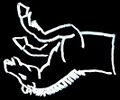 Horse (without wings) on the Kugel Globe; 1st century BCE
 -
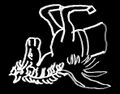 Winged Horse on Mainz Globe (2nd century CE).
 -
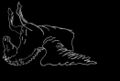 winged Horse on Farnese Globe (2nd century CE based on Hellenistic template)


Terminology
For mathematical astronomy, the constellation was always called ‘The Horse’; this is beyond question for Eratosthenes, Hipparchus and Ptolemy. For Eratosthenes, it is wingless, Ptolemy records a star below the wing; for Hipparchus, this cannot be decided because his star catalogue has not survived. The didactic poem by Aratos was part of basic education in antiquity (for everybody, not only scholars), i.e. it was much better known than the scholarly texts on mathematical astronomy. The memorable hexameters could be useful as farming rules, and even if the weather in Central Europe differed from that in the Mediterranean region, some statements about the seasons could also be utilised there.
The interpretation of the winged horse survives both in the Arabic Middle Ages with aṣ-Ṣūfī and in Latin with the Carolingians, not only because of the popularity of the poem, but also because there were still ancient illustrations at the time that no longer exist today. Manuscripts such as the Leiden Aratea from the Carolingian period and the impressive illustrations in aṣ-Ṣūfī in Iran bear witness to this.
Hipparchus
Rising (Lib II Cap V §10)
The Rising of ...
| east | south | |||
|---|---|---|---|---|
| lam1 | lam2 | lam1 | lam2 | |
| Cap 1 | Aqr 21 | Lib 20 1/2 | Sgr 5 1/2 | |
| star | the southern front foot | the bright one at the hip | ||
| duration | 3 hours = 180 min = 45 degree | |||
Setting (Lib II Cap VI §10)
| west | south | |||
|---|---|---|---|---|
| lam1 | lam2 | lam1 | lam2 | |
| Aqr 12 1/2 | Psc 13 | Tau 3 1/2 | Gem 10 1/2 | |
| star | the bright one mouth (eps) | the bright one at the hip (gam) | ||
| duration | 2 1/2 hours = 150 min = 37 1/2° | |||
Stars Mentioned
| Greek | German | English | ident. | src | lam_culm | ||
|---|---|---|---|---|---|---|---|
| Lib II Cap V §10 | rising, east, first | ||||||
| Lib II Cap V §10 | rising, east, last | ||||||
| Lib II Cap VI §2 | setting CrB, south, last | Psc 13.5 | |||||
| Lib II Cap VI §13 | setting Aql, south, first | Ari 2 | |||||
| Lib III Cap I §9 | rising Ori, south, last | Psc 13 |
Hyginus, Astronomica
This sign Aratus and many others have called Pegasus, offspring of Neptune and the Gorgon Medusa, who on Helicon, a mountain of Boeotia, opened up a spring by striking the rock with his hoof. From him the spring is called Hippocrene. Others say that at the time Bellerophon came to visit Proetus, son of Abas and king of the Argives, Antia, the king's wife, smitten with love for the guest, begged to visit him, promising him her husband's kingdom. When she couldn't obtain this request, out of fear that he would accuse her to the king, she anticipated him by telling Proetus that he had offered violence to her. Proetus, who had been fond of Bellerophon, was reluctant to inflict punishment himself, but knowing that he had the horse Pegasus, sent him to the father of Antia (some call her Sthenoboea), for him to defend his daughter's chastity and send the youth against the Chimera, which at that time was laying waste with flames the country of the Lycians.
Bellerophon was victor, and escaped, but after the creation of the spring, as he was attempting to fly to heaven, and had almost reached it, he became terrified looking down at the earth, and fell off and was killed. But the horse is said to have flown up and to have been put among the constellations by Jove. Others have said that Bellerophon fled from Argos not because of Antia's accusations, but so as not to hear any more proposals which were distasteful to him, or to be distressed by her entreaties.
Euripides in his Melanippe, says that Melanippe, daughter of Chiron the Centaur, was once called Thetis. Brought up on Mount Helicon, a girl especially fond of hunting, she was wooed by Aeolus, son of Hellen, and grandson of Jove, and conceived a child be him. When her time drew near, she fled into the forest, so that her father, who supposed her a virgin, might not see that she had given birth to a grandchild. And so when her father was looking for her, she is said to have begged the power of the gods not to let her father see her in childbirth. After the child was born, by the will of the gods she was changed into a mare which was placed among the stars.
Some say that she was a prophetess, and because she used to reveal the plans of the gods to men, she was changed into a mare. Callimachus says that because she ceased hunting and worshipping Diana, Diana changed her into the shape we have mentioned. For the reason above, too, she is said to be out of sight of the Centaur, who come say is Chiron, and to show only half her body, since she didn't want her sex to be known. (Mary Ward 1960)
Ptolemy's Almagest
| Greek
(Heiberg 1898) |
English
(Toomer 1984) |
ident. | |
|---|---|---|---|
| 1 | ὁ έπὶ τοῦ ὀμφαλοῦ κοινὸς τῆς κεφαλῆς τῆς ᾿Αvδρομέδας | The star on the navel, which is [applied in] common to the head of Andromeda | α And |
| 2 | ὁ έπὶ τῆς ὀσφύος καὶ ἄκροv τού πτεροῦ. | The star on the rump and the wing-tip | γ Peg |
| 3 | ὁ ἐπὶ τού δεξιού ὤμου καὶ τῆς του ποδος ἐκφύσεως | The star on the right shoulder and the place where the leg joins [it] | β Peg |
| 4 | ὁ ἐπί τού μεταφρένου καὶ τού ὤμοv τῆς πτέρvγος | The star on the place between the shoulders and the shoulder-part of the wing | α Peg |
| 5 | τῶν ἐν τῷ σώματι ὑπὸ τὴν πτέρυγα δύο ὁ βορειότερος | The northernmost of the two stars in the body under the wing | τ Peg |
| 6 | ὁ νοτιώτερος αὐτῶν | The southernmost of them | υ Peg |
| 7 | τῶν ἐν τῷ δεξιῷ γόνατι δύο ὁ βορειότερος | The northernmost of the two stars in the right knee | η Peg |
| 8 | ὁ νοτιώτερος αὐτῶν | The southernmost of them | ο Peg |
| 9 | των έν τφ στήθει δύο σύνεγγυς ὁ προηγούμενος | The more advanced of the two stars close together in the chest | λ Peg |
| 10 | ὁ ἐπόμενος αὐτῶν | The rearmost of them | μ Peg |
| 11 | τῶν ἐν τῷ τραχήλῳ β σύνεγγυς ὁ προηγούμενος | The more advanced of the 2 stars close together in the neck | ζ Peg |
| 12 | ὁ ἐπόμενος αὐτῶν | The rearmost of them | ξ Peg |
| 13 | τῶν ἐπὶ τῆς χαίτης δύο ὁ νοτιώτερος | The southernmost of the two stars on the mane | ρ Peg |
| 14 | ὁ βορειότερος αὐτῶv | The northernmost of them | σ Peg |
| 15 | τῶν ἐπὶ τῆς κεφαλῆς β σύνεγγυς ὁ βορειότερος | The northernmost of the two stars close together on the head | θ Peg |
| 16 | ὁ νοτιώτερος αὐ τῶν | The southernmost of them | ν Peg |
| 17 | ὁ ἐν τῷ ρύγχει | The star in the muzzle | ε Peg |
| 18 | ὁ ἐν τῷ δεξιῷ σφυρῷ | The star in the right hock | π Peg |
| 19 | ὁ ἐπι τοῦ ἀριστεροῦ γόνατος | The star on the left knee | ι Peg |
| 20 | ὁ ἐν τῷ ἀριστερῷ σφvρῷ | The star in the left hock | κ Peg |
{20 stars, 4 of the second magnitude, 4 of the third, 9 of the fourth, 3 of the fifth}

Stars within the Constellation Area
| id | Label | IAU design. | description | Vmag |
|---|---|---|---|---|
| 1 | Alpheratz | HIP 677 | Constellation lines (Vertex) | 2.06 |
| 2 | Enif | HIP 107315 | Constellation lines (Vertex) | 2.39 |
| 3 | Scheat | HIP 113881 | Constellation lines | 2.42 |
| 4 | Markab | HIP 113963 | Constellation lines | 2.48 |
| 5 | Algenib | HIP 1067 | Constellation lines (Vertex) | 2.84 |
| 6 | Matar | HIP 112158 | Constellation lines | 2.95 |
| 7 | Homam | HIP 112029 | Constellation lines | 3.41 |
| 8 | Sadalbari | HIP 112748 | Constellation lines | 3.48 |
| 9 | Biham | HIP 109427 | Constellation lines (Vertex) | 3.55 |
| 10 | ι Pegasi | HIP 109176 | Constellation lines | 3.77 |
| 11 | λ Pegasi | HIP 112440 | Constellation lines | 3.93 |
| 12 | κ Pegasi | HIP 107354 | Constellation lines (Vertex) | 4.135 |
| 13 | ξ Pegasi | HIP 112447 | Constellation lines | 4.2 |
| 14 | π 2 Pegasi | HIP 109410 | Constellation lines (Vertex) | 4.29 |
| 15 | 9 Peg | HIP 107348 | Inside the hull | 4.35 |
| 16 | Alkarab | HIP 115623 | Inside the hull | 4.4 |
| 17 | 55 Peg | HIP 114144 | Inside the hull | 4.52 |
| 18 | 70 Peg | HIP 115919 | Constellation lines | 4.56 |
| 19 | Salm | HIP 115250 | Inside the hull | 4.58 |
| 20 | ψ Pegasi | HIP 118131 | Inside the hull | 4.66 |
| 21 | 56 Peg | HIP 114155 | Inside the hull | 4.74 |
| 22 | ο Pegasi | HIP 112051 | Inside the hull | 4.79 |
| 23 | 32 Peg | HIP 110371 | Inside the hull | 4.81 |
| 24 | ν Pegasi | HIP 109068 | Constellation lines (Vertex) | 4.84 |
| 25 | ρ Pegasi | HIP 113186 | Inside the hull | 4.9 |
| 26 | 78 Peg | HIP 117073 | Inside the hull | 4.96 |
| 27 | 31 Peg | HIP 110386 | Inside the hull | 4.99 |
| 28 | 77 Peg | HIP 117020 | Constellation lines (Vertex) | 5.071 |
| 29 | ϕ Pegasi | HIP 117718 | Inside the hull | 5.08 |
| 30 | 16 Peg | HIP 108022 | Inside the hull | 5.081 |
| 31 | 66 Peg | HIP 115444 | Inside the hull | 5.081 |
| 32 | 57 Peg | HIP 114347 | Inside the hull | 5.14 |
| 33 | 59 Peg | HIP 114520 | Inside the hull | 5.154 |
| 34 | σ Peg | HIP 112935 | Constellation lines (Vertex) | 5.16 |
| 35 | 12 Peg | HIP 107472 | Inside the hull | 5.266 |
| 36 | 13 Peg | HIP 107788 | Inside the hull | 5.336 |
| 37 | 58 Peg | HIP 114389 | Inside the hull | 5.386 |
| 38 | 71 Peg | HIP 116264 | Inside the hull | 5.42 |
| 39 | Helvetios | HIP 113357 | Inside the hull | 5.46 |
| 40 | 75 Peg | HIP 116611 | Inside the hull | 5.482 |
| 41 | 17 Peg | HIP 108339 | Inside the hull | 5.533 |
| 42 | 87 Peg | HIP 729 | Inside the hull | 5.555 |
| 43 | 63 Peg | HIP 115271 | Inside the hull | 5.557 |
| 44 | 36 Peg | HIP 110986 | Inside the hull | 5.574 |
| 45 | 20 Peg | HIP 108693 | Inside the hull | 5.599 |
| 46 | 19 Peg | HIP 108699 | Inside the hull | 5.633 |
| 47 | - | HIP 114096 | Inside the hull | 5.66 |
| 48 | - | HIP 114449 | Inside the hull | 5.661 |
| 49 | - | HIP 108060 | Inside the hull | 5.676 |
| 50 | 23 Peg | HIP 109056 | Inside the hull | 5.7 |
| 51 | - | HIP 109209 | Inside the hull | 5.74 |
| 52 | - | HIP 109023 | Inside the hull | 5.744 |
| 53 | 85 Peg | HIP 171 | Inside the hull | 5.75 |
| 54 | - | HIP 107887 | Inside the hull | 5.768 |
| 55 | - | HIP 109471 | Inside the hull | 5.774 |
| 56 | - | HIP 110992 | Inside the hull | 5.778 |
| 57 | 25 Peg | HIP 109240 | Inside the hull | 5.78 |
| 58 | 40 Peg | HIP 111810 | Inside the hull | 5.82 |
| 59 | 21 Peg | HIP 108875 | Inside the hull | 5.822 |
| 60 | - | HIP 114641 | Inside the hull | 5.852 |
| 61 | - | HIP 109730 | Inside the hull | 5.867 |
| 62 | IM Peg | HIP 112997 | Inside the hull | 5.89 |
| 63 | - | HIP 112067 | Inside the hull | 5.921 |
| 64 | - | HIP 109602 | Inside the hull | 5.923 |
| 65 | - | HIP 109577 | Inside the hull | 5.93 |
| 66 | - | HIP 114189 | Inside the hull | 5.953 |
| 67 | 79 Peg | HIP 117500 | Inside the hull | 5.96 |
| 68 | 69 Peg | HIP 115806 | Inside the hull | 5.979 |
| 69 | - | HIP 110873 | Inside the hull | 5.986 |
| 70 | 18 Peg | HIP 108612 | Inside the hull | 6 |
| 71 | - | HIP 111974 | Inside the hull | 6.05 |
| 72 | V439 And | HIP 544 | Inside the hull | 6.07 |
| 73 | - | HIP 109276 | Inside the hull | 6.072 |
| 74 | * 52 Peg A | HIP 113503 | Inside the hull | 6.08 |
| 75 | - | HIP 116307 | Inside the hull | 6.111 |
| 76 | 23 Psc | HIP 117710 | Inside the hull | 6.113 |
| 77 | - | HIP 114081 | Inside the hull | 6.15 |
| 78 | 31 G. Peg | HIP 110341 | Inside the hull | 6.163 |
| 79 | - | HIP 118048 | Inside the hull | 6.166 |
| 80 | V372 Peg | HIP 107558 | Inside the hull | 6.174 |
| 81 | - | HIP 109439 | Inside the hull | 6.179 |
| 82 | 29 G. Peg | HIP 109939 | Inside the hull | 6.192 |
| 83 | - | HIP 114526 | Inside the hull | 6.21 |
| 84 | - | HIP 716 | Inside the hull | 6.246 |
| 85 | 74 Peg | HIP 116592 | Inside the hull | 6.249 |
| 86 | - | HIP 399 | Inside the hull | 6.25 |
| 87 | - | HIP 110696 | Inside the hull | 6.264 |
| 88 | - | HIP 107734 | Inside the hull | 6.267 |
| 89 | 65 Peg | HIP 115407 | Inside the hull | 6.267 |
| 90 | 45 Peg | HIP 112358 | Inside the hull | 6.269 |
| 91 | - | HIP 110548 | Inside the hull | 6.27 |
| 92 | - | HIP 111649 | Inside the hull | 6.28 |
| 93 | 76 Peg | HIP 116972 | Inside the hull | 6.293 |
| 94 | - | HIP 109493 | Inside the hull | 6.32 |
| 95 | 41 Peg | HIP 111884 | Inside the hull | 6.324 |
| 96 | HO Peg | HIP 107956 | Inside the hull | 6.33 |
| 97 | GX Peg | HIP 111191 | Inside the hull | 6.33 |
| 98 | - | HIP 111296 | Inside the hull | 6.33 |
| 99 | - | HIP 114607 | Inside the hull | 6.331 |
| 100 | - | HIP 114742 | Inside the hull | 6.34 |
| 101 | - | HIP 108119 | Inside the hull | 6.341 |
| 102 | OY Peg | HIP 109212 | Inside the hull | 6.35 |
| 103 | - | HIP 115389 | Inside the hull | 6.354 |
| 104 | - | HIP 109445 | Inside the hull | 6.359 |
| 105 | - | HIP 112032 | Inside the hull | 6.36 |
| 106 | - | HIP 113131 | Inside the hull | 6.36 |
| 107 | - | HIP 108766 | Inside the hull | 6.367 |
| 108 | - | HIP 108296 | Inside the hull | 6.37 |
| 109 | - | HIP 109977 | Inside the hull | 6.37 |
| 110 | V354 Peg | HIP 116119 | Inside the hull | 6.388 |
| 111 | - | HIP 114725 | Inside the hull | 6.395 |
| 112 | - | HIP 116187 | Inside the hull | 6.4 |
| 113 | 39 Peg | HIP 111278 | Inside the hull | 6.41 |
| 114 | - | HIP 111601 | Inside the hull | 6.419 |
| 115 | - | HIP 109009 | Inside the hull | 6.42 |
| 116 | - | HIP 34 | Inside the hull | 6.434 |
| 117 | 28 Peg | HIP 109458 | Inside the hull | 6.438 |
| 118 | 41 G. Peg | HIP 113445 | Inside the hull | 6.44 |
| 119 | - | HIP 115915 | Inside the hull | 6.44 |
| 120 | - | HIP 113994 | Inside the hull | 6.44 |
| 121 | - | HIP 410 | Inside the hull | 6.462 |
| 122 | - | HIP 114686 | Inside the hull | 6.47 |
| 123 | - | HIP 116465 | Inside the hull | 6.47 |
| 124 | PT Peg | HIP 110346 | Inside the hull | 6.48 |
| 125 | - | HIP 109691 | Inside the hull | 6.488 |
| 126 | - | HIP 109788 | Inside the hull | 6.49 |
| 127 | - | HIP 110907 | Inside the hull | 6.49 |
| 128 | - | HIP 112803 | Inside the hull | 6.49 |
| 129 | - | HIP 114844 | Inside the hull | 6.5 |
| 130 | - | HIP 117939 | Inside the hull | 6.5 |
| 131 | - | HIP 112222 | Inside the hull | 6.5 |
Babylonian Predecessor

The Babylonian constellation[5] in this area of the sky was the quadrilateral (the one that is now called the 'autumn square' among amateur astronomers of Europe and North America). The Babylonian quadrilateral has the technical name mulIKU ("One Field"), an area measure for arable land similar to our hectare. It is also considered the seat of Ea, a god of wisdom and magic (he is depicted in the constellation Aquarius, Mesopotamian GU.LA, The Giant).
In this case, too, the Greek constellation, which dates back to archaic times, could go back to the Babylonian model: The Sumerian loanword ‘IKU’ sounds very similar (almost homophonous) to the word for horse in the Mycenaean dialect of Greek: ‘Iqo’.[2][9][10] Coupled with the ambiguity of the obsolete Mesopotamian vocabulary, this could easily have led to a (deliberate or inadvertent) reinterpretation.
Transfer and Transformation of the Constellation
Medieval Latin manuscript below:
The oldest scientific manuscript in the National Library the volume contains various Latin texts on astronomy. The volume, written in Caroline minuscule, consists of two sections, the first (ff. 1-26) copied c. 1000, in the Limoges area of France, probably in the milieu of Adémar de Chabannes (989-1034), whilst the second (ff. 27-50), from a scriptorium in the same region, may be dated c. 1150.
al-Sufi's representation below:
The constellation Pegasus ("The Winged or Flying Horse") as depicted in the influential star atlas of the Persian astronomer Abd al-Rahman al-Sufi (10th cent.). In this beautifully illustrated copy, made around 1435 for the Samarkand astronomer-ruler Ulugh Beg, the constellation is shown as depicted on a celestial globe (i.e. mirrored as seen in the night sky).The brighter stars are labelled in Arabic which accurately translate the Greek names listed in the star catalogue of Claudius Ptolemy's Almagest (2nd cent.). The four brightest stars, forming the easily recognisable "Square of Pegasus" visible in the autumn and the winter night skies, are labelled Matn al-Faras ("The Horse's Back" = Alpha Pegasi), Mankib al-Faras ("The Horse's Shoulder" = Beta Pegasi), Surrat al-Faras ("The Horse's Navel" = Alpha Andromedae) and Jinah al-Faras ("The Horse's Wing" = Gamma Pegasi). The modern constellation Pegasus also contains the star designated 51 Pegasi, which hosts the first exoplanet discovered (in 1995) around a solar-type star. As a result of the NameExoWorld contest organized by the IAU, the star is now named Helvetios (and the exoplanet, designated 51 Pegasi b, is named Dimidium). The compass directions are labelled in red, i.e. the top is west, bottom is east, left is south and right is north.Image details: BnF ms. Arabe 5036, fol. 93r.
-
 Pegasus in a manuscript dated 1150 CE.
 -
 Detail; Constellation of Pegasus (horse) from Persian Manuscript 373
 -
 The constellation Pegasus in a copy of al-Sufi (10th cent.), made around 1435 for the Samarkand astronomer-ruler Ulugh Beg. Image details: BnF ms. Arabe 5036, fol. 93r.
 -
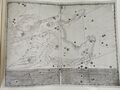 Pegasus in Bayer (1603).
 -
 Pegasus in Hevelius (1687)
 -
 Pegasus in Flamsteed (1776)
 -
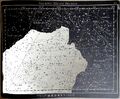 Pegasus in Goldbach (1799)
 -
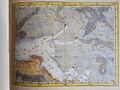 Pegasus in the third edition of Bode's 1782 German atlas (1805).
 -
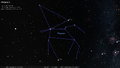 (1952) H.A. Rey's stick figure of Pegasus
 -
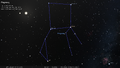 (1988) O. Hlad's stick figure of Pegasus


.jpg)


Mythology
See Ian Ridpath, Star Tales Pegasus[11]
The myth of Hippe and Cheiron is reported for the horse without wings. The myth of Bellerophon applies to the horse with wings.
Cheiron's daughter Hippe was seduced and impregnated by Aiolos. At first she was able to hide this from her father, but when her belly grew too large, she fled to the mountains of Pelion, where she had been brought up. She was a very clever woman who had studied hunting and nature observation, so she was able to survive on her own. However, her father was looking for her. Normally she could hide from him, but when she was in labor and she noticed him nearby, she begged the gods for help. In her distress, she asked that her form would change. She was transformed into a horse. This is why her baby is also a horse.
The other legend tells of the winged horse Pegasos, a mythological creature that was created when Perseus defeated Medusa.
Bellerophon came from Corinth and was banished for a crime he had committed in self-defence or by mistake. He found shelter with a neighbouring king and established himself at his court. Due to slander, however, the king was forced to remove him from the world. As he considered him a friend, he sent him to his father-in-law in the neighbouring kingdom. The latter also fraternized with him and did not have the heart to harm him. He gave him the - supposedly deadly - task of killing the Chimaera, a fire-breathing hybrid of a lion and a goat with two heads. However, Bellerophon defeated the Chimaera because Pegasus helped him. Pegasus had either been tamed by Bellerophon, the horse stealer, or the gods had sent him directly to help him. Bellerophon rode the winged horse, which accompanied him for the rest of his life and returned to Olympus after his death.
Weblinks
References
- ↑ Condos, T. (1997), Star Myths ofthe Greeks and Romans: A Sourcebook, Phanes Press, Grand Rapids, page 154.
- ↑ 2.0 2.1 Aratus & Kidd, D. (1997), Aratus: Phaenomena, Cambridge University Press, Cambridge (UK), page 258.
- ↑ Susanne M. Hoffmann,* Khalid AlAjaji, B.S. Shylaja, Yang Boshun, Danielle Adams, Eric Mamajek, Ian Ridpath, Paul Baki, Juan Antonio Belmonte Avilés, Sze-Leung Cheung, Daniel Cunnama, Jörg Matthias Determann, M. Sadegh Faghanpour, Steven Gullberg, Duane Hamacher, Roland Laffitte, Alejandro M. López, Javier Mejuto, Thierry Montmerle, Clive Ruggles, Shi Yunli, Doris Vickers, Sun Xiaochun, and Hitoshi Yamaoka (2025). The IAU Working Group on Star Names (WGSN): Research Finds in 2025. Journal of Astronomical History and Heritage, 28(4), 1026–1038 (2025).
- ↑ Hoffmann, Susanne M. Wie der Löwe an den Himmel kam. Franckh Kosmos Verlag, Stuttgart 2021
- ↑ 5.0 5.1 Hoffmann, Susanne M. Wie der Löwe an den Himmel kam. Franckh Kosmos Verlag, Stuttgart 2021
- ↑ Pamìas, Jordi und Zucker, Arnaud (2013). Ératosthènes de Cyrène: Catastérrismes, Belles Lettres, Paris
- ↑ Ératosthènes de Cyrène: Catastérrismes, translated by Pamìas, Jordi und Zucker, Arnaud, Les Belles Lettres, Paris 2013
- ↑ Hoffmann, S.M. (2021). Das babylonische Kompendium MUL.APIN: Messung von Zeit und Raum, in: Meller H., Reichenberger A. und Risch R. (Hrsg.), Zeit ist Macht: Wer macht Zeit? Time is power. Who makes Time? Tagungsband 13. Mitteldeutscher Archäologentag, in: Tagungen des Landesmuseums für Vorgeschichte, Bd. 24, Halle 251-275
- ↑ McHugh, J. (2016), `How Cuneiform Puns Inspired Some of the Bizarre Greek Constellations and Asterisms', Archaeoastronomy and Ancient Technologies 4/2, 69--100.
- ↑ Kechagias, A.-E. and Hoffmann, S.M. (2022). Intercultural Misunderstandings as possible source of ancient constellations. in: Hoffmann and Wolfschmidt (eds.). Astronomy in Culture – Cultures of Astronomy, tredition Hamburg/ OpenScienceTechnology Berlin, 205-235
- ↑ Ian Ridpath, Star Tales – Pegasus





