Crater: Difference between revisions
| Line 193: | Line 193: | ||
|} | |} | ||
====== | ====== Hipparchus's "lost" star Catalogue ====== | ||
{| class="wikitable" | |||
|+ | The star catalogue of Hipparchus is not preserved. Yet, several scholars have reconstructed it in the past century: Vogt (1925)<ref>Vogt, H., “Versuch einer Wiederherstellung von Hipparchs Fixsternver zeichnis”, <nowiki><i>Astronomische Nachrichten</i></nowiki>, vol. 224, no. 2, Wiley, p. 17, 1925. doi:10.1002/asna.19252240202.</ref>, Grasshoff (1990)<ref>Graßhoff, G., <nowiki><i>The History of Ptolemy's Star Catalogue</i></nowiki>, Springer, New York, 1990 </ref>, Hoffmann (2017)<ref>Hoffmann, S. M., <nowiki><i>Hipparchs Himmelsglobus</i></nowiki>. Springer Wiesbaden/ New York, 2017. doi:10.1007/978-3-658-18683-8.</ref> and Glover (2026)<ref>Glover, E. (2026). ''The Astronomy of Hipparchus'', Cambridge University Press</ref>. Grasshoff's catalogue and computations are not published digitally, Hoffmann published three versions of the Manitius+Hoffmann<ref>Hipparchus's Lost Star Catalogue (1/2 reconstructed) (Hoffmann, 2017) in VizieR</ref> star lists in the CDS [https://vizier.unistra.fr/ VizieR] "catalog of catalogs", and Glover printed the star lists constellationwise in his book. | ||
{|class="wikitable" | |||
! | |+ Hipparchus's star in Aquarius (Glover 2026) | ||
! | |||
! | !hipp.Cat.ID | ||
!ident. | !constStarID | ||
! | !starName | ||
!ident.Bayer | |||
! | !ident.HIP | ||
!concordance | |||
|- | |- | ||
| | |229 | ||
| | |1 | ||
| | | | ||
| | |α Crt | ||
| | |53740 | ||
| | |CPAE | ||
|- | |- | ||
| | |230 | ||
| | |2 | ||
| | | | ||
| | |β Crt | ||
| | |54682 | ||
| | |CPAE | ||
|- | |- | ||
| | |231 | ||
| | |3 | ||
| | | | ||
| | |γ Crt | ||
| | |55705 | ||
| | |CPAE | ||
|- | |- | ||
| | |232 | ||
| | |4 | ||
| | | | ||
| | |δ Crt | ||
| | |55282 | ||
| | |CPAE | ||
|- | |- | ||
| | |233 | ||
| | |5 | ||
| | | | ||
| | |ε Crt | ||
| | |55687 | ||
| | |CPAE | ||
| | |- | ||
| | |234 | ||
|6 | |||
| | |||
|ζ Crt | |||
|57283 | |||
|CPAE | |||
|- | |||
|235 | |||
|7 | |||
| | |||
|η Crt | |||
|58188 | |||
|CPAE | |||
|- | |||
|236 | |||
|8 | |||
| | |||
|θ Crt | |||
|56633 | |||
|CPAE | |||
|} | |} | ||
Revision as of 13:14, 26 August 2026
Authors: Susanne M Hoffmann, Youla Azkarrula, Ian Ridpath, Doris Vickers

| Asterism Info | |
| Native | Κρατήρ |
|---|---|
| Romanisation | Krater |
| Translation | Vessel |
| Position (2000) | |
| Right ascension | 164.9436048 to 179.00397550000002 |
| Declination | -18.35067637 to -9.802222702 |
| Area | 69.2 sq. deg. |
| Stars | |
| Bright stars | 13 |
| Bayer/Flamsteed stars | 10 |
| Stars brighter than 3.00m | 0 |
| Brightest star | δ Crateris (3.56m) |
| Taxonomy | |
| category of asterism | Almagest constellation |
| IAU- constellations | Cra |
The constellation crater was created in antiquity, probably due to wordplay. It is unknown whether it happened intentionally or unintentionally. The constellation forms part of the ancient Greek super-constellation of Hydra-Corvus-Crater. As such it is mentioned by Aratus, Eratosthenes, Hipparchus and Ptolemy (and all Greek authors from Hellenistic time on). Greek mythology connects it to the adjacent constellations Hydra and Corvus, more details on mythology in Ian Ridpath's Star Tales.
Etymology & History
Etymology
An ancient 'crater' or 'krater' is a specific jar or vessel.[1] Unlike an amphora, which has a narrow upper opening, a krater has a wide opening. The difference is similar to that between a water bottle and a fruit bowl. For obvious reasons, the word for a volcanic crater is derived from this ancient Greek word.
Origin of the Constellation
The constellation is Greek and has no known Babylonian precursors; it probably originated during the transfer of Babylonian star knowledge to Greece and was then given a legend. Mythologically, it is therefore linked to a legend about the constellations Raven and Water Snake, because this group had already existed for thousands of years in Sumer, Assyria, and Babylonia. Raven and Snake are Babylonian figures and are considered a double constellation in Hellenism.
In Greek, only the fact that a crater can be seen next to the stars of the Raven is established – and a large chalice can easily be recognized from an arc of faint stars. However, Greek astronomers interpret its exact shape differently: for Hipparchus, it is a bowl on a stately pedestal of four stars and without a handle, while for Ptolemy, the crater has two handles and stands on a single point, i.e., it has no distinct pedestal.
No Babylonian Predecessor
The pun which created the constellation
McHugh (2016)[2] uses the term MUŠ stating that this Sumerian word has the Akkadian counterpart "ṣēru" (also meaning the snake). However, the Akkadian word "ṣēru" is a homonym, i. e. it has two meanings: it can denote a snake or a ceramic jug for wine. This way, astronomers from other cultures (e.g. the Mediterranean ones) could have confused the ṣēru (snake) with the ṣēru (crater) and thus put a crater on the back of Hydra. Compellingly, there is also a preposition ṣēru which means "on top of, upon". McHugh (2016, 87-88) therefore, produces the phrase "wine-bowl on top of the water-snake" from the term MUŠ.
Kechagias and Hoffmann (2022)[3] agree with the first idea concerning the homophony but reject the latter part: "the intercultural misunderstandings of a Sumerian word to transform a special deity to a usual Water-Snake and of a homophonous Akkadian term to change a snake into a wine-bowl, are rather convincing. In contrast, deriving the presence of a raven at the snake's tail from cuneiform wordplays is considered unnecessary."
The Sumerian cuneiform character MUŠ for this constellation can be expressed in Akkadian with the word Muschhuschu for the snake god. However, it can also stand for “the snake” in general, i.e., it can be rewritten with the word ṣēru. The word ṣēru is itself ambiguous in Akkadian: it can mean “snake,” but also “vessel.” In written language, this is clearly distinguished by a determinative, a defining particle, but these words sound the same when pronounced. It is therefore easy to imagine that in an international environment, e.g., among traders or in international cities where cultures mixed (Babylon or any port city), one person said to another, “Look, there is the constellation ṣēru.” Although the speaker meant a snake, the listener may have thought of a vessel and also identified this by seeing shapes in the stars. So perhaps a Babylonian teacher said, “This constellation is called Muschhuschu, a ṣēru,” and his Greek exchange student, who knew that Muschhuschu was the name of the snake god, thought that a snake and a vessel should be seen there.

Depiction of Crater in Antiquity

The snake-like constellation called Hydra in Greek uranology used to be considered a straight line of stars at the celestial equator in the Sumerian and early Babylonian culture. It is depicted as a straight snake-body until the Seleucid period, particularly on the microzodiac clay tablets VAT 7847 and AO 6448. This traditional view is also represented on the preserved Greek silver globe (Galérie Kugel, Paris).
The super-constellation "Hydra+Corvus+Crater" is depicted on the other two globes preserved from Greco-Roman antiquity. On the marble Farnese Globe dated to Hellenistic times, the Hydra snake has a dip towards the south, forming a vessel for the smaller sub-constellations of Crater and Corvus. This depiction is reproduced in Roman and mediaeval images, possibly originally depicting the pun that the "snake" simultaneously "is" the jar it contains.
Greco-Roman Texts
Aratos
[448?] Midway on its coiling form is set the Crater, and at the tip the figure of a Raven [Corvus] that seems to peck at the coil.
[520?] the dim-lit Crater and the Crow
[600?] The Hydra rises higher as far as Crater,
(Kidd 1997)
Pseudo-Eratosthenes
see Hydra
| erat.Cat.ID | constStarID | starName | ident.Bayer | ident.HIP | certainty |
|---|---|---|---|---|---|
| 689 | 1 | the Cup [at a considerable distance from the first coil of the Hydra, inclined toward the knees of Virgo] has two dim stars on the rim | eps Crt | 55687 | 2 |
| 690 | 2 | the Cup has two dim stars on the rim | zeta Crt | 57283 | 2 |
| 691 | 3 | two in the middle [of the Cup] | delta Crt | 55282 | 1 |
| 692 | 4 | two in the middle [of the Cup] | gam Crt | 55705 | 1 |
| 693 | 5 | two near the bottom [of the Cup] | beta Crt | 54682 | 2 |
| 694 | 6 | two near the bottom [of the Cup] | alpha Crt | 53740 | 2 |
Hipparchus
Rising (Lib III Cap I §2)
The Rising of ...
| east | south | |||
|---|---|---|---|---|
| lam1 | lam2 | lam1 | lam2 | |
| Leo 26 1/2 | Vir 10 1/2 | Tau 20 1/2 | Gem 7 1/2 | |
| star | the northern one of the four at the foot (nu) | the southern one of the six stars at the vascular bulge | ||
| duration | 1 1/4 hours = 75 min = 18 3/4 degree | |||
Setting (Lib III Cap II §2)
| west | south | |||
|---|---|---|---|---|
| lam1 | lam2 | lam1 | lam2 | |
| Cnc 21 | Leo 12 1/2 | Sco 11 1/2 | Sgr 1 | |
| star | the northern one of those in the feet (nu Hya) | the southern and the northern one of those in the vascular bulge | ||
| duration | 1 1/3 hours = 80 min = 20° | |||
Hipparchus's "lost" star Catalogue
The star catalogue of Hipparchus is not preserved. Yet, several scholars have reconstructed it in the past century: Vogt (1925)[4], Grasshoff (1990)[5], Hoffmann (2017)[6] and Glover (2026)[7]. Grasshoff's catalogue and computations are not published digitally, Hoffmann published three versions of the Manitius+Hoffmann[8] star lists in the CDS VizieR "catalog of catalogs", and Glover printed the star lists constellationwise in his book.
| hipp.Cat.ID | constStarID | starName | ident.Bayer | ident.HIP | concordance |
|---|---|---|---|---|---|
| 229 | 1 | α Crt | 53740 | CPAE | |
| 230 | 2 | β Crt | 54682 | CPAE | |
| 231 | 3 | γ Crt | 55705 | CPAE | |
| 232 | 4 | δ Crt | 55282 | CPAE | |
| 233 | 5 | ε Crt | 55687 | CPAE | |
| 234 | 6 | ζ Crt | 57283 | CPAE | |
| 235 | 7 | η Crt | 58188 | CPAE | |
| 236 | 8 | θ Crt | 56633 | CPAE |
Geminos
Ptolemy's Almagest Κρατήρ
| Greek
(Heiberg 1898) |
English
(Toomer 1984) |
ident. | |
|---|---|---|---|
| Κρατῆρος ἀστερισμός | Constellation of Crater | ||
| ὁ ἐκ τῇ βάσει τοῦ Κρατῆρος κοινὸς τοῦ Ὕδρου. | The star in the base of bowl, which is [applied in] common to Hydra | alf Crt | |
| τῶν ἐν μέσῳ τῷ Κρατῆρι β ὁ νοτιώτερος | The southernmost of the 2 stars in the middle of the bowl | gam Crt | |
| ὁ βορειότερος αὐτῶν | The northernmost of them | del Crt | |
| ὁ ἐπὶ τῆς φοτίου περιφερείας τοῦ στόματος. | The star on the southern rim of the mouth | zet Crt | |
| ὁ ἐπὶ τῆς βορείου περιφερείας. | The star on the northern rim | eps Crt | |
| ὁ ἐπὶ τοῦ φοτίου ὡτίου | The star on the southern handle | eta Crt | |
| ὁ ἐπὶ τοῦ βορείου ὠτίου | The star on the northern handle | tet Crt | |
| ἀστέρες ξ μεγέθους δ΄. | {7 stars of the fourth magnitude} |

Stars within the Constellation Area
| id | Label | IAU design. | description | Vmag |
|---|---|---|---|---|
| 1 | δ Crateris | HIP 55282 | Constellation lines | 3.56 |
| 2 | γ Crateris | HIP 55705 | Constellation lines | 4.06 |
| 3 | Alkes | HIP 53740 | Constellation lines (Vertex) | 4.07 |
| 4 | θ Crateris | HIP 56633 | Constellation lines (Vertex) | 4.673 |
| 5 | ζ Crateris | HIP 57283 | Constellation lines (Vertex) | 4.706 |
| 6 | ϵ Crateris | HIP 55687 | Constellation lines (Vertex) | 4.802 |
| 7 | η Crateris | HIP 58188 | Constellation lines (Vertex) | 5.16 |
| 8 | ι Crateris | HIP 56802 | Inside the hull | 5.48 |
| 9 | κ Crateris | HIP 55874 | Inside the hull | 5.923 |
| 10 | - | HIP 56364 | Inside the hull | 6.044 |
| 11 | - | HIP 57732 | Inside the hull | 6.122 |
| 12 | VX Crt | HIP 56899 | Inside the hull | 6.19 |
| 13 | - | HIP 56901 | Inside the hull | 6.198 |
Transfer and Transformation
-
 Crater on Hydra: Kugel Globe (1st c. BCE), drawing by SMH 2024.
 -
 Crater and Corvus on Hydra: Farnese Globe (2nd c. CE, drawing and mapping by SMH 2021)
 -
 Hydra, Crater and Corvus on Mercator Globe (1551)
 -
 Crater and Corvus in Hevelius (1690)
 -
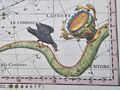 Corvus and Crater in Fortin's Atlas Céleste, 3rd edition (1795).
 -
 Crater in Hall (1825)
 -
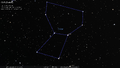 (1952) H.A. Rey's stick figure of Crater
 -
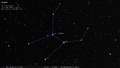 (1988) O. Hlad's stick figure of Crater


Mythology
[1]In the Greek legend, the god Apollo gives a raven a crater to fetch water (see Hydra). This crater is depicted here next to the raven.
Weblinks
- Ridpath, Ian, Star Tales – Crater
- IAU WGSN: List of ancient images of the IAU-constellations: https://exopla.net
- Warburg Institute Iconographic Database – Crater
References
- ↑ 1.0 1.1 Hoffmann, Susanne M. Wie der Löwe an den Himmel kam. Franckh Kosmos Verlag, Stuttgart 2021
- ↑ John McHugh (2016), How Cuneiform Puns Inspired Some of the Bizarre Greek Constellations and Asterisms, Archaeoastronomy and Ancient Technologies, 4(2), 69-100
- ↑ Kechagias and Hoffmann (2022). Intercultural Misunderstandings as a possible Source of Ancient Constellations, in Hoffmann and Wolfschmidt (eds.), Astronomy in Culture - Cultures of Astronomy, tredition, Ahrensburg, 205-234
- ↑ Vogt, H., “Versuch einer Wiederherstellung von Hipparchs Fixsternver zeichnis”, <i>Astronomische Nachrichten</i>, vol. 224, no. 2, Wiley, p. 17, 1925. doi:10.1002/asna.19252240202.
- ↑ Graßhoff, G., <i>The History of Ptolemy's Star Catalogue</i>, Springer, New York, 1990
- ↑ Hoffmann, S. M., <i>Hipparchs Himmelsglobus</i>. Springer Wiesbaden/ New York, 2017. doi:10.1007/978-3-658-18683-8.
- ↑ Glover, E. (2026). The Astronomy of Hipparchus, Cambridge University Press
- ↑ Hipparchus's Lost Star Catalogue (1/2 reconstructed) (Hoffmann, 2017) in VizieR





