Magur: Difference between revisions
Ericmamajek (talk | contribs) added update on adoption and nature of star |
Ericmamajek (talk | contribs) mNo edit summary |
||
| Line 3: | Line 3: | ||
---- | ---- | ||
[[File:Magur profileCard SadeghFaghanpour-IAU-WGSN.jpg|thumb|Magur profile card (CC BY M.Sadegh Faghanpour for IAU-WGSN).]] | [[File:Magur profileCard SadeghFaghanpour-IAU-WGSN.jpg|thumb|Magur profile card (CC BY M.Sadegh Faghanpour for IAU-WGSN).]] | ||
'''Magur''' is a modern star name adopted by the International Astronomical Union in the IAU-Catalog of Star Names (IAU-CSN) for the 5th magnitude star HR 6862 (HIP 90037, HD 168592) in constellation [[Corona Australis]]. | '''Magur''' is a modern star name adopted by the International Astronomical Union in the IAU-Catalog of Star Names (IAU-CSN) for the 5th magnitude star HR 6862 (HIP 90037, HD 168592) in constellation [[Corona Australis]]. The origin of the name is Sumerian. | ||
==Concordance, Etymology, History== | ==Concordance, Etymology, History== | ||
Revision as of 15:44, 20 September 2026
Authors: Susanne M Hoffmann, Eric Mamajek

Magur is a modern star name adopted by the International Astronomical Union in the IAU-Catalog of Star Names (IAU-CSN) for the 5th magnitude star HR 6862 (HIP 90037, HD 168592) in constellation Corona Australis. The origin of the name is Sumerian.
Concordance, Etymology, History
For details see MA2.GUR8.
Mythology
IAU Working Group on Star Names
The name was discussed and adopted by the IAU WGSN in 2026.
-
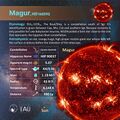 Magur profile card (CC BY M.Sadegh Faghanpour for IAU-WGSN).
 -
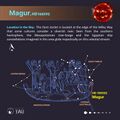 Magur stick figure (CC BY M.Sadegh Faghanpour for IAU-WGSN).
 -
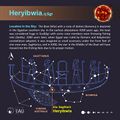


In August 2026, the name Magur was proposed and adopted by the IAU WGSN for the star HR 6862 (HIP 90037, HD 168592) , a star with apparent V magnitude 5.09 in the constellation Corona Borealis. Magur is a red giant star with spectral type K4/5III (Houk 1982) about 148 parsecs away, based on its Gaia DR3 parallax (Bailer-Jones et al. 2021, Gaia Collaboration 2023).Fetherolf et al. (2023) reports the light curve of the star measured by the NASA TESS mission revealed a periodicity of 4.9851 days with an amplitude of about 1 millimagnitude. Thus far, no companions have been reported for this star.





