Khepdenreret
Authors: Susanne M Hoffmann, Youla Azkarrula
| Asterism Info | |
| Translation | Buttocks of Reret |
|---|---|
| Position (2000) | |
| Right ascension | 255.072389 |
| Declination | 30.92640423 |
| Area | 0 sq. deg. |
| Stars | |
| Bright stars | 1 |
| Bayer/Flamsteed stars | 1 |
| Stars brighter than 3.00m | 0 |
| Brightest star | Khepdenreret (3.92m) |
| exoplanets | 0 |
| Taxonomy | |
| category of asterism | IAU-Star Name |
| IAU- constellations | Boo |
Khepdenreret is a modern star name adopted by the International Astronomical Union in the IAU-Catalog of Star Names (IAU-CSN). Its origin is ancient Egyptian. It is the name of the star ϵ Her in constellation Hercules.
Provenance, Etymology, History

The name means "Buttocks of Reret" and Reret is a hippopotamus goddess in ancient Egypt who is represented by a constellation that is in charge of guaranteeing the stability of the celestial (north) pole.
Reret (also spelled Reret-Weret, “the Great Sow”) is a protective goddess in ancient Egyptian religion. She is best understood as one of the names or manifestations of Taweret, the famous hippopotamus goddess associated with pregnancy, childbirth, and the protection of mothers and infants.
-
 Reret depicted on a sarkophagus (Staatliche Museen zu Berlin – Ägyptisches Museum und Papyrussammlung, ÄM 7.)
 -
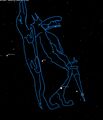 Reret and Menit (Berlin) mapped to Stellarium (small version: Bootes only, CC BY SMH for WGSN)


Mythology/Religion
Reret is a protective hippopotamus goddess, usually treated as a form of Taweret. She safeguarded pregnancy, childbirth, and infants, while also serving as a celestial guardian associated with the stars in the constellations Draco, Hercules, and Bootes, and the ever-visible stars of the northern sky. Though less famous than Taweret, she represents one of ancient Egypt’s most vivid symbols of fierce maternal protection and cosmic stability.
IAU Working Group on Star Names
The name "Reret" was discussed and approved by the IAU WGSN in 2026, and due to its significance in the Egyptian culture, it was decided to use a specific name mentioned in the Ramesside Star Clocks for the adoption in the IAU-CSN.
ϵ Her is a multiple system, easily visible a one dot of light in the keystone-asterism central in constellation Hercules. Both components are A-type stars (A0, A2) but the exact classification is still an open research topic.