Corvus
Authors: Susanne M Hoffmann, Youla Azkarrula, Ian Ridpath, Doris Vickers

| Asterism Info | |
| Native | Κóραξ |
|---|---|
| Romanisation | Korax |
| Translation | Raven |
| Position (2000) | |
| Right ascension | 182.1034053 to 188.59681219999996 |
| Declination | -24.7288756 to -16.19600517 |
| Area | 37.54 sq. deg. |
| Stars | |
| Bright stars | 12 |
| Bayer/Flamsteed stars | 8 |
| Stars brighter than 3.00m | 4 |
| Brightest star | Gienah (2.58m) |
| Taxonomy | |
| category of asterism | Almagest constellation |
| IAU- constellations | Crv |
One of the 88 IAU constellations. Since ancient times, it forms a super-constellation with Hydra and (later) Crater.
Etymology and History

Origin of Constellation
The constellation is first found as a standalone constellation in the Greek literature. However, in Babylonian uranography it had existed already for a millennium (at least) at that time.[1]
Babylonian
see

Greco-Roman
Egyptian
In Ptolemaic times (1st century BCE), when Egypt was ruled by the Romans, new Egyptian temples were built: a Chnum temple in Esna and a Hathor temple Dendera (south and north of Thebes/ Luxor). They display a cultural mixture of Babylonian and Egyptian constellations.
-
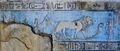 Leo, Com, Hya - Crv broken; rectangular zodiac of Dendera
 -
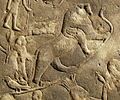 Leo with Com, Hya, Crv, circular zodiac of Dendera (CC BY Musée du Louvre, Département des Antiquités égyptiennes)


Aratos
[448?] Midway on its coiling form is set the Crater, and at the tip the figure of a Raven [Corvus] that seems to peck at the coil.
[520?] the dim-lit Crater and the Crow
(Kidd 1997)
Eratosthenes
see Hydra
Eratosthenes's star catalogue can be reconstructed from the list of stars he mentions in the last section of each of the constelllation descriptions. Hoffmann (2017)[2] made such a catalogue and used it for computational comparison with Hipparchus's, Ptolemy's and Babylonian data; it is based on the edition and translation by Pamias and Geus (2007)[3] and presented here in English translation.
| erat.Cat.ID | constStarID | starName | ident.Bayer | ident.HIP | certainty |
|---|---|---|---|---|---|
| 682 | 1 | the Raven on its tail [of the Water Serpent] has a dim star on its beak [facing west] | alpha Crv | 59199 | 2 |
| 683 | 2 | the Raven[…] two on the wing | eps Crv | 59316 | 2 |
| 684 | 3 | the Raven[…] two on the wing | gam Crv | 59803 | 2 |
| 685 | 4 | the Raven[…] two on the tail | delta Crv | 60965 | 2 |
| 686 | 5 | the Raven[…] two on the tail | eta Crv | 61174 | 2 |
| 687 | 6 | the Raven[…] one on each tip of the foot | beta Crv | 61359 | 2 |
| 688 | 7 | the Raven[…] one on each tip of the foot | 6 Crv | 60425 | 2 |
Hipparchus
Rising (Lib III Cap I §3)
The Rising of ...
| east | south | |||
|---|---|---|---|---|
| lam1 | lam2 | lam1 | lam2 | |
| Vir 16 | Vir 23 | Gem 14 | Gem 22 | |
| star | the one at the hip (gam) | the one in the feet (beta) | ||
| duration | 3/5 hours = 36 min = 9 degree | |||
Setting (Lib II Cap VI §10)
| west | south | |||
|---|---|---|---|---|
| lam1 | lam2 | lam1 | lam2 | |
| missing in the text (only the first ten words of the paragrph preserved) | ||||
| star | ||||
| duration | ||||
Hipparchus's "lost" star Catalogue
The star catalogue of Hipparchus is not preserved. Yet, several scholars have reconstructed it in the past century: Vogt (1925)[4], Grasshoff (1990)[5], Hoffmann (2017)[6] and Glover (2026)[7]. Grasshoff's catalogue and computations are not published digitally, Hoffmann published three versions of the Manitius+Hoffmann[8] star lists in the CDS VizieR "catalog of catalogs", and Glover printed the star lists constellationwise in his book.
| hipp.Cat.ID | constStarID | starName | ident.Bayer | ident.HIP | concordance |
|---|---|---|---|---|---|
| 223 | 1 | α Crv | 59199 | CPAE | |
| 224 | 2 | β Crv | 61359 | CPAE | |
| 225 | 3 | γ Crv | 59803 | CPAE | |
| 226 | 4 | δ Crv | 60965 | CPAE | |
| 227 | 5 | ε Crv | 59316 | CPAE | |
| 228 | 6 | ζ Crv | 60189 | CPAE |
Geminos
Almagest Κόραξ.
| id | Greek
(Heiberg 1898) |
English
(Toomer 1984) |
ident. |
|---|---|---|---|
| Κόρακος ἀστερισμός | Constellation of Corvus | ||
| 1 | ὁ ἐν τῷ ῥάμφει καὶ κοιφὸς τοῦ Ὕδρου. | The star in the beak, which is [applied in] common to Hydra | alf Crv |
| 2 | ὁ ἐν τῷ τραχήλῳ πρὸς τῇ κεφαλῇἡ | The star in the neck, by the head | eps Crv |
| 3 | ὁ ἐν τῷ στήθει. | The star in the breast | zet Crv |
| 4 | ὁ ἐν τῇ προηγουμένῃ καὶ δεξιᾷ πτέρυγι. | The star in the advance, right wing | gam Crv |
| 5 | τῶν ἐν τῇ ἐπομένῃ πτέρογι β’ ὁ ἠγούμενος; | The more advanced of the 2 stars in the rear wing | del Crv |
| 6 | ὁ ἐπόμενος αὐτῶ | The rearmost of them | eta Crv |
| 7 | ὁ ἐπ’ ἄκρου τοῦ ποδὸς κοιφὸς τοῦ Ὕδρου | The star on the end of the leg, which is [applied in] common to Hydra | bet Crv |
| all | ὁ ἀστέρες ξ, ὧν γ’ μεγέθους ἔ, δ’ ἂ, ε’ ἄ | {17 stars, 5 of the third magnitude, 1 of the fourth, 1 of the fifth} |

Stars within the Constellation Area
| id | Label | IAU design. | description | Vmag |
|---|---|---|---|---|
| 1 | Gienah | HIP 59803 | Constellation lines (Vertex) | 2.58 |
| 2 | Kraz | HIP 61359 | Constellation lines (Vertex) | 2.64 |
| 3 | Algorab | HIP 60965 | Constellation lines | 2.94 |
| 4 | ϵ Corvi | HIP 59316 | Constellation lines (Vertex) | 2.98 |
| 5 | Alchiba | HIP 59199 | Constellation lines (Vertex) | 4.01 |
| 6 | η Corvi | HIP 61174 | Constellation lines (Vertex) | 4.294 |
| 7 | ζ Corvi | HIP 60189 | Constellation lines | 5.21 |
| 8 | 3 Crv | HIP 59394 | Inside the hull | 5.47 |
| 9 | - | HIP 59728 | Inside the hull | 5.807 |
| 10 | - | HIP 60157 | Inside the hull | 5.97 |
| 11 | - | HIP 60809 | Inside the hull | 6.294 |
| 12 | - | HIP 61208 | Inside the hull | 6.39 |
Transfer and Transformation of the Constellation
-
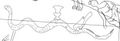 Hydra with Crater and Corvus on the Kugel Globe (-1st c., drawing by SMH)
 -
 Hydra with Corvus and Crater on the Mercator Globe (1551)
 -
 Hydra in the Uranometria (1603), Corvus not drawn but in map
 -
 Corvus in Flamsteed (1776)
 -
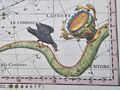 Corvus and Crater in Fortin's Atlas Céleste, 3rd edition (1795).
 -
 Corvus in Hall (1825)
 -
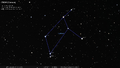 (1952) H.A. Rey's stick figure of Corvus
 -
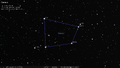 (1988) O. Hlad's stick figure of Corvus


.jpg)


Mythology
Weblinks
- Warburg Institute Iconographic Database – Corvus
- Ian Ridpath's Star Tales – Corvus
References
- ↑ Hoffmann, Susanne M. Wie der Löwe an den Himmel kam. Franckh Kosmos Verlag, Stuttgart 2021
- ↑ Hoffmann, S. M., <i>Hipparchs Himmelsglobus</i>. Springer Wiesbaden/ New York, 2017. doi:10.1007/978-3-658-18683-8.
- ↑ Eratosthenes: Sternsagen, übersetzt von Pamìas, Jordi und Geus, Klaus, Verlag Utopica, Oberhaid 2007
- ↑ Vogt, H., “Versuch einer Wiederherstellung von Hipparchs Fixsternver zeichnis”, <i>Astronomische Nachrichten</i>, vol. 224, no. 2, Wiley, p. 17, 1925. doi:10.1002/asna.19252240202.
- ↑ Graßhoff, G., <i>The History of Ptolemy's Star Catalogue</i>, Springer, New York, 1990
- ↑ Hoffmann, S. M., <i>Hipparchs Himmelsglobus</i>. Springer Wiesbaden/ New York, 2017. doi:10.1007/978-3-658-18683-8.
- ↑ Glover, E. (2026). The Astronomy of Hipparchus, Cambridge University Press
- ↑ Hipparchus's Lost Star Catalogue (1/2 reconstructed) (Hoffmann, 2017) in VizieR





