Meskhetyu
Authors: Susanne M Hoffmann


Meskhetyu (... ), The Foreleg [of a Bull, Seth] is an ancient Egyptian constellation.
Concordance, Etymology, History
Variants
- ...
Origin of Constellation
This constellation is documented from earliest times on and well identified with the seven stars of the Big Dipper in Ursa Major.
Decan Star Clocks
Decan star clocks (also "diagonal star clocks") represent one of the earliest known systematic methods of stellar timekeeping, as they are preserved from the Middle Kingdom (2100-1800 BCE). During the night, the successive appearance of decans provided a way to divide the night into approximately twelve parts for the twelve hours of the night. These constellations shift successively, so that the Egyptian schema needs to be read diagonally: every ten days, another constellation is considered to rule the same hour, or in other words, each constellation (decan) rules a different hour depending on the time of the year. Hoffmann (2022)[1] writes: "The pattern of this systematic shift of constellations through the hours of the day within a year is depicted on Egyptian diagonal star clocks, when the sequence of decans was observed in culmination instead of in rising (Symons 2007[2]), leading to a reduction of deviations throughout the year."
-
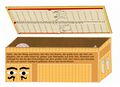 Schema of Egyptian star clock in a coffin lid (CC BY Bettina Hoffmann).
 -
 Schema of Egyptian star clock: how it works (CC BY Bettina Hoffmann).
 -
 Diagonal star clock in coffins from the Middle Kingdom of Ancient Egypt (Coffin of Nacht, probably from Asyut, 11th/12th Dynasty): Hildesheim, Römer und Pelicäusmuseum.


Ramesside Star Clocks
Tombs
Dendera Zodiacs
Transfer and Transformation of the Constellation
-
Meskhetyu in the middle left of a Decan Star Clock
-
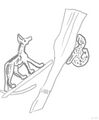 Meskhetyu with the (Babylonian-borrowed) asterisms of a Fox and a Ewe on the circular Zodiac of Dendera, Egypt.

Religion/ Tales/ Mythology
mnemonic tales and cultural significance
IAU Working Group on Star Names
Weblinks
References
- References (general)
- ↑ Hoffmann, S.M. (2022). Comparison of some General Concepts.,in Hoffmann and Wolfschmidt (eds.). Astronomy in Culture – Cultures of Astronomy, tredition Hamburg, 542-560
- ↑ Symons, Sarah (2007), A star's year: the annual cycle in the ancient egyptian sky, in J. M. Steele, ed., `Calendars and Years: Astronomy and Time in the Ancient World', Oxbow, Oxford (UK), pp. 1--33.