Tobo Usiha (ᡨᠣᠪᠣ ᡠᠰᡳᡥᠠ)
Tobo Usiha
Authors: Lyu Haocheng, Susanne M Hoffmann

| Asterism Info | |
| Native | ᡨᠣᠪᠣ ᡠᠰᡳᡥᠠ |
|---|---|
| Romanisation | tobo usiha |
| IPA | /tʰɔ.pɔ u.ɕi.χä/ |
| Translation | the Hut Stars |
| Position (2000) | |
| Right ascension | 42.64329167 to 59.45879167 |
| Declination | 38.31608333 to 53.50297222 |
| Stars | |
| Bright stars | 9 |
| Bayer/Flamsteed stars | 9 |
| Stars brighter than 3.00m | 5 |
| Brightest star | α Per (Mirfak) (1.79m) |
| Taxonomy | |
| category of asterism | constellation |
| IAU- constellations | Per |
Tobo Usiha (Manchu: ᡨᠣᠪᠣ ᡠᠰᡳᡥᠠ, "the Hut Stars"), a Manchu shamanic asterism identified with the bright stars of Perseus.[1][2] It is described as ten to twelve bright stars "shaped like a hut", lying beside the W-shaped star goddess Taci Mama (ᡨᠠᠴᡳ ᠮᠠᠮᠠ) (Cassiopeia).[2] Its place in Manchu religion is functional rather than narrative: it is the halt — the "resting hut" — at which the shaman's soul pauses on its way up to the sky.[1][3]
Concordance, Etymology, History
Name and spelling
The name is tobo (hut) plus usiha (star).[4] Tobo denotes a simple shelter built of willow branches or similar light material; the spelling Toboo Usiha also occurs in the literature and is a legitimate variant.[4][3] Unlike most Manchu star-names, which are formed from an animal or a deity plus usiha, this one is built on a common noun naming a building. It therefore belongs to a small group of Manchu asterisms taken directly from dwellings and implements — the hut, the terrace, the ladder, the drum — in which the material culture of camp life is projected onto the sky.[5] A second, narrower sense of tobo — "mourning hut" — is given in the Manchu-German dictionary, but it has no support in the star material: no source links this asterism with funerary practice.[6]
The hut in the landscape
Tobo is one member of a larger set of Manchu shelter terms. One comparative Tungusic word-list renders it "villa", while the plain "shack" is carried by a different word, tatan.[7][4]
The Manchu lexicon binds shelter to travel. Tatan means both "a small, temporary, wooden, tent-shaped structure" and "a camp, a stopping place"; its verb tatanambi means "to stop on a journey", and tatara boo is an inn.[4] In this vocabulary a shelter and a place to halt are one notion.
The setting is the forest-and-river economy of the Manchu homeland, in which shelters were raised for the duration of a hunt or a fishing season and abandoned after it. A survey of the lower Sungari (Songhua River) made in 1934 quotes an earlier traveller's list of six kinds of temporary shelter among the Tungusic population there, distinguished by material and purpose: birch bark for hunting, grass thatch for fishing, cloth or bark for a night on the road — in each case a light structure with no claim to permanence.[8] The sky hut belongs to this world of movable shelter. What is placed in the sky is not only a house but a halt.
Myth and ritual
No independent narrative survives for this asterism: there is no origin story, no adversary and no transformation. Its deity — grammatically female — is defined entirely by her function, the shelter offered to the ascending soul.[2] The same table assigns three asterisms to successive stages of the shaman's ascent: the ladder star (Terkin Usiha Mama), the hut (Tobo Usiha) and the vessel-store (Wadan).[1][5] The three lie far apart in the sky — Virgo, Perseus and Corvus — and cannot be joined into a continuous road.
Identification of stars

The asterism is identified with Perseus.[1] The asterism is said to lie beside Taci Mama (ᡨᠠᠴᡳ ᠮᠠᠮᠠ) (Cassiopeia), whose border Perseus touches; it is said to appear at the beginning of winter, when α Per rises at dusk; and the hand-copied chart draws a sloping line of five stars with a prop dropping from the fourth, the outline of a hut.
Maps (Gallery)
- Tobo Usiha
-
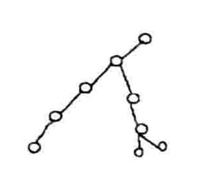 Star chart of Tobo Usiha, drawn by Fu Yuguang
-
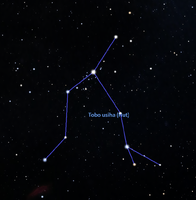 Tobo Usiha in Stellarium
-
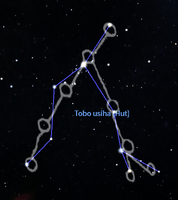 The superposition of traditional star chart and actual stars


IAU Working Group on Star Names
In 2026, the name "Tobo" was suggested to be used for 16 Per in this constellation. Tobo Usiha is depicted as a triangular hut image, with 16 Per being a star branching off from its southwest end and clearly drawn in hand drawn star maps.
Decision: ...
References
- ↑ 1.0 1.1 1.2 1.3 Fu, Yuguang富育光. (1988). A Study of Manchu Shamanic Star Rituals and Customs满族萨满教星祭俗考. Northern Ethnicities北方民族, (1), 98–108. — star table and chart pp.103–105 (reprinted in Fu 1990 pp.107–109; Fu & Meng 1991 pp.232–235).
- ↑ 2.0 2.1 2.2 Editorial Board编辑委员会. (1993). Dictionary of the Religions and Myths of China's Ethnic Groups中国各民族宗教与神话大词典. Beijing: Xueyuan Publishing House. — p.402 (Tobo Usiha).
- ↑ 3.0 3.1 Bäcker, J. (2000). The shaman's sky: Manchu mythology and starlore in the Amur Valley. Ad Seres et Tungusos. Festschrift für Martin Gimm, 1–17. — §11 and n.28.
- ↑ 4.0 4.1 4.2 4.3 Norman, J. (1978). A Concise Manchu-English Lexicon. Seattle: University of Washington Press. — tobo / toboo / tob / tatan / tatanambi / tatara boo / usiha.
- ↑ 5.0 5.1 Fu, Yuguang富育光, & Meng, Huiying孟慧英. (1991). A Study of Manchu Shamanism满族萨满教研究. Beijing: Beijing University Press. — traditional star-name table, pp.232–235.
- ↑ Hauer, E. (1952–55). Handwörterbuch der Mandschusprache. Wiesbaden: Harrassowitz. — sub tobo: "aus Zweigen errichtete primitive Hütte, Trauerhütte" (second sense quoted here after Bäcker 2000, n.28; the original has not been collated).
- ↑ Chog, Dular Osor朝克. (2014). A Comparative Vocabulary of the Manchu-Tungusic Languages满通古斯语族语言词汇比较. Beijing: China Social Sciences Press. — p.192 (窝棚 tatan; 别墅 tobo), p.193 (villa).
- ↑ Ling, Chunsheng凌纯声. (1934). The Hezhe People of the Lower Sungari松花江下游的赫哲族. Nanjing: Academia Sinica. — p.88, quoting Cao Tingjie曹廷杰, A Brief Account of Eastern Siberia西伯利东偏纪要, p.50.