Tigris
Authors: Susanne M Hoffmann, Doris Vickers
Tigris or River Tigris is an obsolete constellation. It was invented twice in different times and places: First in Southern Mesopotamia in the first millennium BCE and second (independently) in Europe in the early 17th century.
Concordance, Etymology, History
Spelling Variants
- Tigris
- Tygris Fluvius
- Tÿgris Fluvi
Origin of Constellation
Today's name of the river is Greek, with uncertain etymology.
There are two independent inventions of this constellation:
Ancient Mesopotamia

mul ídIDIGNA (𒀯𒀀𒇉𒈦𒄘𒃼), the Tigris-river asterism, is a constellation that is mentioned in late cuneiform texts in the area of northeastern Pisces and western Andromeda. Together with the Euphrates' asterism (BURANUN) it formed a super-constellation that corresponds to the ribbons of classical Pisces and ZIBme in cuneiform, a late form of KUNme(š) mulSIM.MAḪ, the Tails of the Swallow, in MUL.APIN I iv 36.
Some star lists from the first millennium BCE equate the constellations Anunitu and Swallow with the two river constellations Euphrates and Tigris. The uranology MLC 1866 explicitly mentions that they meet at the "tip of The Tails (ZIBme)"ː
- [MU]L.MEŠ ídIDIGNA u ídBURANUNki ina ṣip-ri mulZIB<me>,
- "The stars of the Tigris and the Euphrates at the tip of the Tails" (D i 8)
Beaulieu et al. (2018, 35, 39, Section A)[1].
Early Modern Europe
Ian Ridpath[2] writes about the 17th century constellation:
A constellation representing the river Tigris, a real river of Mesopotamia which joins with the Euphrates in the modern Iraq. The constellation was introduced in 1612 by the Dutchman Petrus Plancius on the same globe that the river Jordan (Jordanus) made its first appearance.
The celestial Tigris began at the neck of Pegasus and flowed between Cygnus and Aquila, an area now occupied by Johannes Hevelius’s later invention Vulpecula. It ended by the right shoulder of Ophiuchus in a V-shaped group of stars that Ptolemy had listed as lying outside Ophiuchus; these were later to be incorporated in another short-lived constellation, Taurus Poniatovii.
Like Jordanus, Tigris first appeared in print on the 1624 chart by Jacob Bartsch and as a result Bartsch was sometimes wrongly credited with its formation. Also like Jordanus, it was not adopted by Hevelius for his influential atlas of 1687. Both constellations became forgotten during the 18th century and were not shown by Johann Bode on his Uranographia atlas of 1801.
Sources
Identifications
Depending on the season and context, the term "..." can have the following identifications:
- (a) Ancient Mesopotamia: Pisces
- (b) Plancius 1612:
- (c) Bartsch 1624 and Hevelius 1687 both follow Plancius.
Transfer and Transformation of the Constellation
-
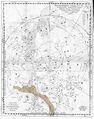 Tigris in Jakob Barsch (1661) Planisphaerium Stellatum

Mythology
mnemonic tales and cultural significance
Weblinks
References
- References (general)
- ↑ Beaulieu, P.-A., Frahm, E., Horowitz, W. & Steele, J. (2018), The Cuneiform Uranology Texts: Drawing the Constellations, American Philosophical Society Press, Philadelphia, USA.
- ↑ Ridpath, Ian, Star Tales (Cambridge: Lutterworth Press, 1988) ISBN 0-7188-2695-7 [Internet Archive link] -- a revised and expanded edition was published in 2018 [ISBN 978-07188-9478-8] -- online version on Ridpath's website.