ZIB
Authors: Gennady E. Kurtik, Euin Choung Kim, David Hilder, Susanne M Hoffmann, Wayne Horowitz, Jan Safford, Youla Azkarrula

mulZIBmeš (𒀯𒍦𒈨) = zibbātu,. 'The Tails,' is a late Babylonian name for the zodiacal constellation Pisces, consisting of parts of the two traditional Mesopotamian asterisms mulSIM.MAḪ and mulAnunītu ('The Swallow' and Anunitu). In this late time, the constellation of "the tails" was visualized as a fish-tail and bird-tail joined (Beaulieu et al. 2018: 44-45). Yet the origin is the earlier and much larger constellation of The Swallow mulSIM.MAḪ mentioned in MUL.APIN whose V-shaped tails match the V-shaped chains of stars in Pisces and whose body was imagined in modern Cetus.
Concordance, Etymology, History

Var. reading:
- mulZibmeš,
- mulZib;
- abbreviation of mulzibbātu 'Tails';
Designation of the zodiac sign and constellation Pisces in later astronomical and astrological texts [Gössmann[1] 175].
Transfer and Transformation
-
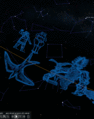 animated transformation from Babylonian to Greek constellations (SMH 2017)
 -
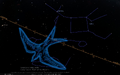 "Swallow" in Middle Babylonian (MUL.APIN), map: Stellarium 2026, drawing: Robert Perdok (LWL Planetarium Münster, Germany) 2016, adoption: SMH for IAU-WGSN 2026
 -
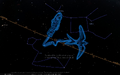 "Swallow" in "Swallow-Fish" in Late Babylonian (e.g. normal star lists described with ribbon), map: Stellarium 2026, drawing: Robert Perdok (LWL Planetarium Münster, Germany) 2016, adoption: SMH for IAU-WGSN 2026
 -
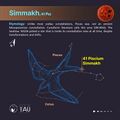 Simmakh modern star name (CC BY Sadegh Faghanpour for IAU WGSN)
 -
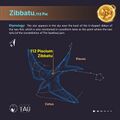 Zibbatu modern star name (CC BY Sadegh Faghanpour for IAU WGSN)


Sources and Identifications
| Sources | Identifications |
|---|---|
| Astronomical diaries.
See. [Sachs-Hunger Diaries I-III[2], passim], the designation ZIBme first occurs in a diary in -382. [Sachs-Hunger Diaries I[2], 74, no.-382 rev. 4′]. |
|
| Mathematical Astronomy. |  |
Late astrology, magic, and the calendar.
|
 |
| MLC 1866. |  |
Historical Dictionaries
| Kurtik (2022, z08) | Gössmann (1950) |
|---|---|
| вар. чтения: mulZibme, mulZib; сокращение от mulzibbātu «Хвосты»; обозначение знака зодиака и созвездия Рыбы (Pisces) в поздних астрономических и астрологических текстах [Grossmann 1950 175].
I. Источники. Астрономические дневники. См. [Sachs-Hunger Diaries I–III, passim], обозначение ZIBme впервые встречается в дневнике за -382 г. [Sachs-Hunger Diaries I, 74, No.-382 rev. 4′]. Математическая астрономия. ZIB.ME — стандартное обозначение знака зодиака Рыбы [ACT I–III; LBAT, passim]; используется уже в лунных таблицах конца V в. до н.э. [Aaboe–Sachs 1969; Britton 1989, 30–31]. Поздняя астрология, магия и календарь. (1) «Гороскопы». Обозначение знака зодиака Рыбы [BH, passim]. (2) «Микрозодиак». Деление знака зодиака Наемник(Овен) на 12 частей: 12-i-tum zittu(ḫa.la) múlzib šum3-šu2 «12-я часть, ее имя Хвосты» [TU, 14:19; Sachs 1952, 66]. (3) «Гипсома». Рыбы — гипсома Венеры, см. d06Dilbat. (4) Зодиакальная астрология. KI múlZIB.ME … «В области Рыб (родился): …сердечное смятение» [LBAT, 1593 rev. 11′; Reiner 2000]. MLC 1866. См. b12BURANUN, s19SIM.MAḪ. |
References
- ↑ Gössmann P.F. Planetarium Babylonicum, Rom, 1950 (A. Deimel. Šumerisches Lexikon 4/2).
- ↑ 2.0 2.1 2.2 Sachs A., Hunger H. Astronomical Diaries and Related Texts from Babylonia. Vol. I: Diaries from 652 B.C. to 262 B.C.; Vol. II: from 261 B.C. to 165 B.C.; Vol. III: Diaries from 164 B.C. to 75 B.C. Vienna, 1988, 1989, 1991.
- ↑ 3.0 3.1 A. Sachs, T. Pinches, J. Strassmaier, Late Babylonian Astronomical and Related Texts, London, 1955.
- ↑ Aaboe A., Sachs A. Two Lunar Texts of the Achaemenid Period from Babylon // Centaurus. 1969. Vol. 14. Р. 1-22.
- ↑ Britton J.P. An Early Function for Eclipse Magnitudes in Babylonian Astronomy / Centaurus. 1989. Vol. 32. P. 1-52.
- ↑ Thureau-Dangin F. Tablettes d’Uruk. Paris, 1922 (= TCL 6).
- ↑ Sachs A. Babylonian Horoscopes // JCS. 1952. V. 6. P. 49-75.
- ↑ Reiner E. Early Zodiologia and Related Matters / Wisdom, Gods and Literature. Studies in Assyriology in Honour of W.G.Lambert / Ed. by A.R.George and I.L.Finkel. Winona Lake, Indiana, 2000. P. 421-427.





