Lyra
Authors: Susanne M Hoffmann, Doris Vickers, Youla Azkarrula, IanRidpath

One of the 88 IAU constellations.

Etymology and History
The Greek constellation ...
Origin of Constellation
Greco-Roman
Aratus
The Tortoise too is small; when Hermes was actually still in his cradle, he hollowed out the shell and bade it be called a Lyre. [270] He set it down in front of the unknown figure, when he had brought it to the sky. The figure, as he crouches, comes near it with his left knee, while the Bird’s head at one extremity circles opposite it: the Lyre is set fast between the Bird’s head and the knee. (Kidd 1997)
Eratosthenes
Ovid, Fasti
[1, 315] Should the Nones be at hand, showers discharged from sable clouds will be your sign, at the rising of the Lyre.
[1, 653] When the seventh sun, reckoned from that day, shall have set in the sea, the Lyre will shine no longer anywhere in the sky.
[1, 655] After the setting of that constellation (the Lyre), the fire that glitters in the middle of the Lion’s breast will be sunk below the horizon at nightfall. (James George Frazer 1931)
Hipparchus
Rising (Lib II Cap V §10)
The Rising of ...
| east | south | |||
|---|---|---|---|---|
| lam1 | lam2 | lam1 | lam2 | |
| Sco 8 1/2 | Sco 18 | Leo 12 1/2 | Leo 26 | |
| star | the one north of the bright one (eps) | the eastern one of the three on the jetty | ||
| duration | 4/5 hours = 48 min = 12 degree | |||
Setting (Lib II Cap VI §10)
| west | south | |||
|---|---|---|---|---|
| lam1 | lam2 | lam1 | lam2 | |
| Aqr 4 | Aqr 12 | Ari 12 1/2 | Tau 3 | |
| star | the front one of the two bright on the jetty (beta) | the one north of the bright one (eps) | ||
| duration | 2/3 hours = 40 min = 10° | |||
Stars Mentioned
| Greek | German | English | ident. | src | lam_culm | ||
|---|---|---|---|---|---|---|---|
| Lib II Cap V §10 | rising, east, first | ||||||
| Lib II Cap V §10 | rising, east, last | ||||||
| Lib II Cap VI §2 | setting CrB, south, last | Psc 13.5 | |||||
| Lib II Cap VI §13 | setting Aql, south, first | Ari 2 | |||||
| Lib III Cap I §9 | rising Ori, south, last | Psc 13 |
Hyginus, Astronomica
The Lyre was put among the constellations for the following reason, as Eratosthenes says. Made at first by Mercury from a tortoise shell, it was given to Orpheus, son of Calliope and Oiagrus, who was passionately devoted to music. It is thought that by his skill he could charm even wild beasts to listen. When, grieving for his wife Eurydice, he descended to the Lower World, he praised the children of the gods in his song, all except Father Liber; him he overlooked and forgot, as Oineus did Diana in sacrifice. Afterwards, then, when Orpheus was taking delight in song, seated, as many say, on Mt. Olympus, which separates Macedonia from Thrace, or on Pangaion, as Eratosthenes says, Liber is said to have roused the Bacchanals against him. They slew him and dismembered his body. But others say that this happened because he had looked on the rites of Liber. The Muses gathered the scattered limbs and gave them burial, and as the greatest favour they could confer, they put as a memorial his lyre, pictured with stars, among the constellations. Apollo and Jove consented, for Orpheus had praised Apollo highly, and Jupiter granted this favour to his daughter.
Others say that when Mercury first made the lyre on Mount Cyllene in Arcadia, he made it with seven strings to correspond to the number of Atlantides, since Maia, his mother, was of their company. Later, when he had driven away the cattle of Apollo and had been caught in the act, to win pardon more easily, at Apollo's request he gave him permission to claim the invention of the lyre, and received from him a certain staff as reward. When Mercury, holding it in his hand, was journeying to Arcadia and saw two snakes with bodies intertwined, apparently fighting, he put down the staff between them. They separated then, and so he said that the staff had been appointed to bring peace. Some, in making caducei, put two snakes intertwined on the rod, because this seemed to Mercury a bringer of peace. Following his example, they use the staff in athletic contests and other contests of this kind.
But to return to the subject at hand. Apollo took the lyre, and is said to have taught Orpheus on it, and after he himself had invented the cithara, he gave the lyre to Orpheus.
Some also have said that Venus and Proserpina came to Jove for his decision, asking him to which of them he would grant Adonis. Calliope, the judge appointed by Jove, decided that each should posses him half of the year. But Venus, angry because she had not been granted what she thought was her right, stirred the women in Thrace by love, each to seek Orpheus for herself, so that they tore him limb from limb. His head, carried down from the mountain into the sea, was cast by the waves upon the island of Lesbos. It was taken up and buried by the people of Lesbos, and in return for this kindness, they have the reputation of being exceedingly skilled in the art of music. The lyre, as we have said, was put by the Muses among the stars.
Some say that because Orpheus first favored love for youths, he seemed to insult women, and for this reason they killed him. (Mary Ward 1960)
Geminos
Almagest Δύρα.
| id | Greek
(Heiberg 1898) |
English
(Toomer 1984) |
ident. |
|---|---|---|---|
| Λόρας ἀστερισμός. | Constellation of Lyra | ||
| 1 | ὁ λαμπρὸς ὁ ἐπὶ τοῦ ὀστράκου καλούμευος Δύρα. | The bright star on the shell, called Lyra | alf Lyr |
| 2 | τῶν παρακειμένων αὐτῷ β συνεχῶν ὁ βόρειος | The northernmost of the 2 stars lying near the latter, close together | eps Lyr |
| 3 | ὁ νοτιώτερος αὐτῶν. | The southernmost of them | zet Lyr |
| 4 | ὁ τούτοις ἐπόμενος καὶ μέσος τῆς ἐκφύσεως τῶν κεράτωυ | The one to the rear of these, in between the points where the horns [of the lyre] are attached | del Lyr |
| 5 | τῶν ἐν τῷ πρὸς ἀνατολὴν τοῦ ὀστράκου β συνεχῶν ὁ βόρειος. | The northernmost of the 2 stars close together in the region to the east of the shell | eta Lyr |
| 6 | ὁ νοτιώτερος αὐτῶν | The southernmost of them | tet Lyr |
| τῶν ἐν τῷ ξυγώματι προηγουμένων β ὁ βορειότερος. | The northernmost of the two advance stars in the bridge | bet Lyr | |
| ὁ νοτιώτερος αὐτῶν | The southernmost of them | nu Lyr | |
| τῶν ἐν τῷ ζυγώματι ἐπομένων β ὁ βορειότερος αὐτῶν. | The northernmost of the two rear stars in the bridge | gam Lyr | |
| ὁ ροτιώτερος αὐτῶν. | The southernmost of them | lam Lyr | |
| ἀστέρες ἱ, ὥρ α μεγέθους ἄ, γ’ β, δ’ ὅ | 10 stars, I of the first magnitude, 2 of the third, 7 of the fourth |

Stars within the Constellation Area
| id | Label | IAU design. | description | Vmag |
|---|---|---|---|---|
| 1 | Vega | HIP 91262 | Constellation lines (Vertex) | 0.03 |
| 2 | Sulafat | HIP 93194 | Constellation lines | 3.25 |
| 3 | Sheliak | HIP 92420 | Constellation lines | 3.42 |
| 4 | NAME del Lyr Cluster | NAME del Lyr Cluster | Inside the hull | 3.8 |
| 5 | δ 2 Lyrae | HIP 92791 | Constellation lines | 4.3 |
| 6 | ζ 1 Lyrae | HIP 91971 | Constellation lines | 4.36 |
| 7 | θ Lyrae | HIP 94713 | Constellation lines (Vertex) | 4.38 |
| 8 | Aladfar | HIP 94481 | Constellation lines (Vertex) | 4.398 |
| 9 | λ Lyrae | HIP 93279 | Constellation lines | 4.93 |
| 10 | * eps01 Lyr A | HIP 91919 | Constellation lines (Vertex) | 4.991 |
| 11 | 17 Lyr | HIP 93917 | Constellation lines | 5.22 |
| 12 | ν 2 Lyrae | HIP 92405 | Constellation lines | 5.226 |
| 13 | * eps02 Lyr A | HIP 91926 | Inside the hull | 5.23 |
| 14 | ι Lyrae | HIP 93903 | Constellation lines | 5.253 |
| 15 | - | HR 7162 | Inside the hull | 5.277 |
| 16 | - | HIP 91235 | Constellation lines (Vertex) | 5.41 |
| 17 | - | HIP 93718 | Inside the hull | 5.56 |
| 18 | δ 1 Lyrae | HIP 92728 | Constellation lines | 5.573 |
| 19 | ζ 2 Lyrae | HIP 91973 | Inside the hull | 5.585 |
| 20 | - | HIP 91883 | Constellation lines (Vertex) | 5.682 |
| 21 | V542 Lyr | HIP 93104 | Inside the hull | 5.883 |
| 22 | ν 1 Lyrae | HIP 92398 | Inside the hull | 5.91 |
| 23 | - | HIP 92833 | Inside the hull | 6.03 |
| 24 | Xihe | HIP 91852 | Inside the hull | 6.037 |
| 25 | - | HIP 93354 | Inside the hull | 6.038 |
| 26 | - | HIP 92243 | Inside the hull | 6.054 |
| 27 | - | HIP 93720 | Constellation lines (Vertex) | 6.06 |
| 28 | - | HIP 92551 | Inside the hull | 6.082 |
| 29 | - | HIP 93437 | Inside the hull | 6.381 |
| 30 | - | HIP 93210 | Inside the hull | 6.403 |
| 31 | - | HIP 91820 | Inside the hull | 6.44 |
| 32 | - | HIP 91707 | Inside the hull | 6.473 |
| 33 | - | HIP 91552 | Inside the hull | 6.489 |
Transfer and Transformation of the Constellation
-
 Lyra in Bayer (1603)
 -
 Lyra in Hevelius (1690)
 -
 Lyra in Flamsteed (1776)
 -
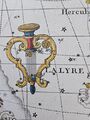 Lyra in Fortin's Atlas Céleste, 3rd edition (1795).
 -
 Lyra in Bode (1801)
 -
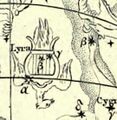 Lyra in Young (1807): A Course of Lectures on Natural Philosophy and the Mechanical Arts.
 -
 Lyra in Hall (1825)


.jpg)


Mythology
-
 Ainter of Agora 393 - ARV extra - standing boy with lyra and hare - Athens Agora Museum
 -
 Achilles Painter ARV 990 41 youth with lyra
 -
 Cartellino Painter - ARV 452 5 - youth with lyra - Athens NAM 12803
 -
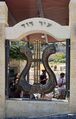 symbol of an ancient lyra
 -
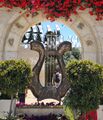 symbol of an ancient lyra
 -
 Kalymna - 560-540 BC - silver stater - head of warrior - lyra - Berlin MK BM 18200148
 -
 Statue of Erato (with lyre)

.jpg)