Bie (鳖)
Bie
Authors: Lyu Haocheng, ASE Tech Team, Susanne M Hoffmann, Ian Ridpath
| Asterism Info | |
| Native | 鳖 |
|---|---|
| Translation | River Turtle |
| Position (2000) | |
| Right ascension | 278.3757741 |
| Declination | -42.31250824 |
| Area | 0 sq. deg. |
| Stars | |
| Bright stars | 1 |
| Bayer/Flamsteed stars | 1 |
| Stars brighter than 3.00m | 0 |
| Brightest star | Bie (4.614m) |
| Taxonomy | |
| category of asterism | IAU-Star Name |
| IAU- constellations | CrA |
.png)
| Asterism Info | |
| Native | 鳖 |
|---|---|
| Romanisation | Biē |
| IPA | /pjɛ˥/ |
| Translation | River Turtle |
| Position (2000) | |
| Right ascension | ... to ... |
| Declination | ... to ... |
| Area | xx.xx sq. deg. |
| Stars | |
| Bright stars | 14 |
| Bayer/Flamsteed stars | 10 |
| Stars brighter than 3.00m | 0 |
| Brightest star | α CrA (4.10m) |
| Taxonomy | |
| category of asterism | constellation |
| IAU- constellations | CrA |
Biē (鳖, River Turtle) is a traditional Chinese asterism belonging to the Dou (Dipper) lunar mansion. Among the Three Schools of ancient Chinese astronomy, it is classified as an external constellation of the Shi School (石氏). The asterism consists of 14 stars located to the south of the Southern Dipper.
The Bu Tian Ge (步天歌 / Song of the Sky Pacers) describes it as follows: "Below the Dipper, fourteen stars are arranged in a circle; though named Bie, their form is like that of the Guansuo (贯索) asterism." In modern constellation boundaries, Bie lies within Corona Australis (the Southern Crown).
Concordance, Etymology, History
Bie means "soft-shelled turtle", an aquatic animal. The ancients imagined this group of stars as a turtle in the heavens and accordingly endowed it with the function of "governing water."” The Jin Shu: Tianwen Zhi (晋书·天文志 / Treatise on Astronomy in the History of Jin) records:
"Bie is a water creature, belonging to Taiyin (the Great Yin)."
In the traditional Chinese cosmological framework, Taiyin (太阴) governs water; Bie's subordination to Taiyin corresponds to its role in regulating water-related phenomena.
Bie is not only a celestial asterism but also carries rich symbolic meanings in ancient Chinese culture. From Neolithic jade artifacts to Shang and Zhou bronze vessels, the turtle (龟, Guī) and its close relatives, the soft-shelled turtle (鳖, Biē) and the giant soft-shelled turtle (鼋, Yuán) appear across multiple dimensions of early Chinese civilization.
Cultural History
Hongshan Culture Jade Soft-Shelled Turtles
During the late Hongshan culture (c. 5300–5000 BP), jade soft-shelled turtles (or turtles) had already become important burial goods in high-status tombs. Two jade soft-shelled turtles were excavated from Tomb No. 1 at Mound No. 1 of Locality V at the Niuheliang site (N5Z1M1), placed respectively in the left and right hands of the occupant. The occupant was an elderly male buried in one of the largest central tombs of the Hongshan culture. The artifacts are yellowish-green in color, with a nearly triangular head and a smooth back lacking the patterned ridges typical of turtle shells. Scholars believe the occupant was a high-ranking shaman, and the jade soft-shelled turtles were ritual implements used for communicating with spirits, reflecting the "jade-only burial" tradition of the late Hongshan culture.[1][2]
Shang Dynasty Jade Soft-Shelled Turtles from Fu Hao's Tomb
At the Shang dynasty site of Yinxu in Anyang, the tomb of Fu Hao (妇好, c. 1200 BC), consort of King Wu Ding (武丁, r. c. 1250–1192 BC) and the first historically attested female general in Chinese history, yielded a large number of jade soft-shelled turtles. The tomb also contained stone turtles and turtle-shaped jade carving knives. Jade soft-shelled turtles in the Shang period were regarded as important symbols of religious and political authority, continuing the Neolithic tradition of using turtle-shaped jades for spiritual and ritual purposes.
-
 Jade soft‑shelled turtle from the Niuheliang site, Hongshan culture
 -
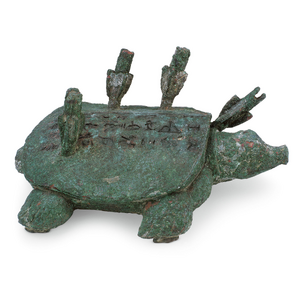 The Zuoceban Bronze Yuan
 -
 Rubbing of the Inscription on the Zuocheban Bronze Yuan


The Zuocheban Bronze Yuan (作册般铜鼋)
In 2003, the National Museum of China acquired a uniquely shaped late Shang bronze vessel — the Zuocheban Bronze Yuan (actually a soft-shelled turtle). The vessel is shaped like a giant soft-shelled turtle (yuan), with head extended, tail slightly turned to the left, and four limbs exposed. Four arrowheads are embedded in the left shoulder and carapace. A 33-character inscription on the carapace records that on the bingshen day, the Shang king went to the Huan River (洹水) to shoot turtles. The king shot one arrow, and his scribe Zuoce Ban shot three arrows in assistance — all four struck their target. The king awarded the captured turtle to Zuoce Ban and ordered him to commemorate the event on a ritual vessel. Scholars such as Yuan Junjie and Li Kai argue that this event was not ordinary hunting but an archery ritual (sheli 射礼), and that the waterborne archery rituals later performed at the Western Zhou Biyong (辟雍) pool likely originated from the late Shang waterborne archery rituals on the Huan River.[3][4][5]
The Turtle in Chinese Creation Mythology
In Chinese creation mythology, the turtle also holds an important place. In the legend of "Nüwa Mends the Sky" (女娲补天), after Nüwa melted five-colored stones to repair the heavens, she cut off the four legs of a giant turtle and used them as pillars to support the four corners of the earth. In this myth, the turtle's legs become the four poles that hold up the cosmos, giving this aquatic animal cosmological significance akin to that of a cosmic pillar.
Turtle Shell Divination (Plastromancy)

Furthermore, the ancients regarded turtles (and soft-shelled turtles) as spiritual intermediaries between heaven and mortal rulers. By applying heat to turtle shells to produce cracks — forming so-called "turtle images" (guixiang 龟象) — they predicted fortunes and misfortunes, giving rise to the enduring tradition of plastromancy (turtle-shell divination). Turtles have long been associated with longevity, believed to endure for a thousand years and survive countless calamities. The jade soft-shelled turtles clasped in the hands of the deceased at the Niuheliang tomb may also carry this symbolic meaning.
Identification of stars
| Star Names or Orders (Traditional/Qing) | Ho PENG YOKE[6] | Yi Shitong[7]
Based on catalogue in 18th century |
Pan Nai[8]
based on Xinyixiangfayao Star Map |
SUN X. & J. Kistemaker[9]
Han Dynasty |
Boshun Yang[10]
before Tang dynasty |
Boshun Yang[10]
Song Jingyou(1034) |
|---|---|---|---|---|---|---|
| 1st | α Tel | α Tel | ε CrA | ε CrA | ε CrA | ε CrA (determinative) |
| 2nd | η1 CrA | η1 CrA | HIP 93371 | γ CrA | γ CrA | γ CrA |
| 3rd | HIP 92953 | ζ CrA | γ CrA | α CrA | α CrA | α CrA |
| 4th | ζ CrA | δ CrA | α CrA (determinative) | β CrA | β CrA | β CrA |
| 5th | δ CrA | β CrA | HIP 94243 | δ CrA | δ CrA | δ CrA |
| 6th | β CrA | α CrA | β CrA | ζ CrA | ζ CrA | ζ CrA |
| 7th | α CrA | γ CrA | HIP 94130 | HIP 92953 | HIP 92953 | HIP 92953 |
| 8th | γ CrA | ε CrA | δ CrA | η2 CrA | η1 CrA | η1 CrA |
| 9th | ε CrA | V686 | ζ CrA | V718 CrA | V718 CrA | V718 CrA |
| 10th | V686 | κ CrA | HIP 92953 | θ CrA | θ CrA (determinative) | θ CrA |
| 11th | λ CrA | θ CrA | μ CrA | HIP 90887 | HIP 90887 | HIP 90887 |
| 12th | κ CrA | - | HIP 91989 | κ CrA | κ CrA | κ CrA |
| 13th | HIP 90887 | - | V686 CrA | λ CrA | λ CrA | λ CrA |
| 14th | θ CrA | - | - | V686 CrA | V686 CrA | V686 CrA |
Maps (Gallery)
| historical map | modern identification
(Yang 2023) |
same in Stellarium 24.4 |
|---|---|---|
 |
.png) |
 |
 |
_reconstructed_by_Pan_Nai_(2009).png) | |
.png) |
.png) |
_in_Stellarium..png) |
IAU Working Group on Star Names
In 2026, the name of the historical constellation "Bie" was suggested to be used for one of the stars in this constellation. The star θ CrA was recommended, as it is the historical determinative star of the asterism.
Decision: ...
References
- ↑ Liu Yuying 刘玉莹. (2022). Niuheliang Yizhi Chutu Hongshan Wenhua Dongwu Zaoxing Yuqi Yanjiu 牛河梁遗址出土红山文化动物造型玉器研究 (The Research on Niuheliang Site Excavated Hongshan Culture Animal Modeling Jade). Master's thesis. Hohhot: Inner Mongolia University.
- ↑ Li Rongcai 李荣才 & Wang Xingjie 王兴杰. (2013). "Guanyu Niuheliang Hongshan Wenhua Chutu 'Yugui' huo 'Yubie' de Mingming Wenti jiqi Jiazhi de Sikao" 关于牛河梁红山文化出土“玉龟”或“玉鳖”的命名问题及其价值的思考 (Reflections on the Naming and Value of the "Jade Turtle" or "Jade Soft-Shelled Turtle" Excavated from the Hongshan Culture Site at Niuheliang). Liaoning Shizhuan Xuebao (Shehui Kexue Ban) 辽宁师专学报(社会科学版), 2013(02).
- ↑ Yuan Junjie 袁俊杰. (2006). "Zuoceban Tongyuan Suoji Shishi de Xingzhi" 作册般铜鼋所记史事的性质 (Nature of the Historical Record on the Zuocheban Bronze Yuan). Huaxia Kaogu 华夏考古, 2006(4): 39–44.
- ↑ Li Kai 李凯. (2007). "Shilun Zuoceban Yuan yu Wanshang Sheli" 试论作册般鼋与晚商射礼 (On the Zuocheban Yuan and Late Shang Archery Rituals). Zhongyuan Wenwu 中原文物, 2007(3): 46–50.
- ↑ Zhu Fenghan 朱凤瀚. (2005). "Zuoceban Yuan Tanxi" 作册般鼋探析 (An Analysis of the Zuocheban Yuan). Zhongguo Lishi Wenwu 中国历史文物, 2005(1): 6–10.
- ↑ P.-Y. Ho, "Ancient And Mediaeval Observations of Comets and Novae in Chinese Sources", Vistas in Astronomy, 5(1962), 127-225.
- ↑ Yi Shitong伊世同. Zhongxi Duizhao Hengxing Tubiao中西对照恒星图表1950. Beijing: Science Press.1981.
- ↑ Pan Nai潘鼐. Zhongguo Hengxing Guance shi中国恒星观测史[M]. Shanghai: Xuelin Pree. 1989. Fig 55.
- ↑ Sun Xiaochun. & Kistemaker J. The Chinese sky during the Han. Leiden: Brill. 1997, Pp241-6.
- ↑ 10.0 10.1 B.-S. Yang杨伯顺, Zhongguo Chuantong Hengxing Guance Jingdu ji Xingguan Yanbian Yanjiu 中国传统恒星观测精度及星官演变研究 (A Research on the Accuracy of Chinese Traditional Star Observation and the Evolution of Constellations), PhD thesis, (Hefei: University of Science and Technology of China, 2023). 235-296.





