Tiangang (天綱)
Tiangang
Authors: Lyu Haocheng, ASE Tech Team, Susanne M Hoffmann
| Asterism Info | |
| Native | 天綱 |
|---|---|
| Romanisation | Tiān Gāng |
| IPA | /tʰjɛn˥.kɑŋ˥/ |
| Translation | Celestial Rope |
| Position (2000) | |
| Right ascension | 337.8787083 |
| Declination | -32.34333333 |
| Area | 0 sq. deg. |
| Stars | |
| Bright stars | 1 |
| Bayer/Flamsteed stars | 1 |
| Stars brighter than 3.00m | 0 |
| Brightest star | β Psc (4.29m) |
| Taxonomy | |
| category of asterism | constellation |
| IAU- constellations | PsA |
Tiān Gāng (天綱, Celestial Rope) is a traditional Chinese asterism belonging to the Shi (室) mansion, the sixth of the seven mansions of the Black Tortoise of the North in the Twenty-Eight Mansions system. Among the Three Schools of ancient Chinese astronomy, it is classified as a Wu Xian asterism. The asterism consists of a single star located southwest of Běiluò Shīmén (北落師門, α Piscis Austrini, Fomalhaut). In modern constellation boundaries, Tiangang lies within Piscis Austrinus (the Southern Fish). The name "Tiān Gāng" literally means "Celestial Rope" — a reference to the large ropes used to pitch tents — and symbolically represents the Celestial Military Tent of the emperor on campaign.
Concordance, Etymology, History
The Chinese character 綱 (gāng) originally means a rope — specifically the main rope of a net. Tiangang thus means "the celestial rope." Wu Xian (巫咸) states: "Tiangang is a great rope; it is used to set up tents, as required when the Emperor goes on tours, bestows rewards, and encamps in the field." Tiangang thus came to symbolize the military tent of the emperor.
This interpretation is echoed in Li Bo's Tianwen Daxiang Fu (天文大象賦 / Rhapsody on the Great Images of the Celestial Sphere), which describes: "The Celestial Money accumulates like a mountain of tribute; the Celestial Rope provides rest and a field banquet." (天錢納贐以山積,天綱憩輿而野饗) Here, Tiangang is depicted as the emperor's resting place and banquet site during military campaigns.
The Book of Jin (Jinshu, 晉書) states in its "Treatise on Astronomy": "One star southwest of Beiluo Shimen (北落師門) is called Tiangang; it governs the military tent." The History of Song, Treatise on Astronomy (Songshi: Tianwen Zhi, 宋史·天文志) adds: "Tiangang, one star, southwest of Beiluo Shimen (北落師門) — it governs the military tent and palace lodges, where the Emperor gathers for hunting expeditions."
Tiangang is located adjacent to Beiluo Shimen (北落師門) (Fomalhaut) — the gate of the northern military camp; Tiangang is the emperor's tent within that camp — the command post where the emperor presides when personally leading a campaign. Together with the surrounding asterisms — Lěibìzhèn (壘壁陣, Line of Ramparts), Yǔlínjūn (羽林軍, Palace Guard) — they form a complete celestial military encampment.
Archaeological Evidence
The concept of the celestial military tent (武帳, wǔzhàng) is corroborated by archaeological finds of actual tent structures (幄帳, wòzhàng) from the Han dynasty. The Book of the Later Han (後漢書) records that Emperor Guangwu (光武帝, r. 25–57 CE) possessed a "military tent", which was distinct from ordinary tents and associated with imperial authority.
Tent fittings (帳構, zhànggòu) — bronze or iron joint components used to assemble tent frames — have been excavated from several high-status Han and Wei-Jin tombs. The most famous example is the gilded bronze tent fittings from the tomb of Liu Sheng (劉勝), Prince Jing of Zhongshan (d. 113 BCE), at Mancheng, Hebei. These 102 bronze components, employing mortise-and-tenon joints and folding mechanisms, could be assembled into a rectangular tent approximately 3 m long, 2 m wide, and 2.3 m high, with a hipped roof.[1] The components used mortise-and-tenon joints for easy assembly and disassembly, reflecting the practical needs of military campaigns. This sophisticated metal-framed system represents a technological advancement from earlier rope-bound structures to the "military tents" used in Han dynasty campaigns.
Further evidence comes from mural paintings. The late Eastern Han (c. 2nd century CE) tomb No. 2 at Dahuting (打虎亭), Mi County, Henan (now Xinmi City), contains a mural on the north wall of the central chamber depicting a banquet scene. In the left portion of the mural, a hip-roofed tent (幄幕) is shown with four flags behind it; the host sits inside on a couch, while guests are seated on either side.[2]
-
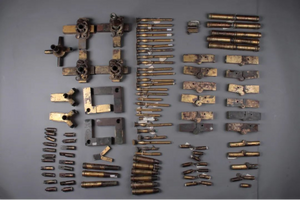 Gilded bronze tent fittings (帳構) of the Western Han dynasty, excavated from the Mancheng Han tombs.
 -
 Reconstruction drawing of a rectangular tent with a hipped roof.
 -
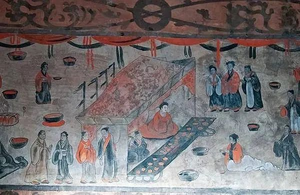 Mural of a tent scene (幄帳) from the Han tomb at Dahuting, Mi County, Henan (Eastern Han dynasty).
.png)
.png)

Identification of stars
The identification of Tiangang has shifted over time. The early Tiangang star was likely γ PsA. The Tongzhan Daxiangli Xingjing (通占大象曆星經) records Tiangang as two stars, although the star numbers in this text are known to contain numerous errors. This alternative identification, however, appears only in this text; the mainstream tradition consistently records it as a single star. If accepted, they would correspond to γ and δ PsA.
During the Northern Song Huangyou reign (1052 CE), the observation of Tiangang was revised to β PsA, and this identification became fixed. The Yuan dynasty Tianwen Huichao (天文匯抄, 14th century) instead placed it at γ Gru, far from Beiluo Shimen (北落師門); the late Ming Xianglin (象林, 17th century), a non-official star map, followed a similar identification. However, most contemporary star charts continued to depict it beside Beiluo Shimen (北落師門), indicating that the β PsA identification remained a mainstream tradition.
In the late Ming, the Jesuit-led official star catalogue deleted Tiangang altogether. It was restored in the 18th-century Qing catalogue Yixiang Kaocheng (儀象考成), but reassigned to δ PsA.
| Star Names or Orders(Qing) | Han Dynasty
(SUN X. & J. Kistemaker[3]) |
before Tang dynasty: 3rd to 6th Century
(Boshun Yang[4]) |
Song Dynaty: Huangyou, 1052
(Pan Nai[5], based on Xinyixiangfayao Star Map) |
Yuan dynasty: 1279-1368
(Pan Nai[6]) |
Qing dynasty: 18th Century
(Yi Shitong[7]) |
Ho PENG YOKE[8] |
|---|---|---|---|---|---|---|
| Tiangang | β PsA | γ PsA | β PsA | γ Gru | δ PsA | δ PsA |
Maps (Gallery)
| historical map | modern identification
(Yang 2023) |
same in Stellarium |
|---|---|---|
 |
.png) |
 |
 | ||
  |
_Reconstructed_by_PAN_Nai_(2009).png) |
_by_Pan_Nai_in_Stellarium.png) |
 |
_Reconstructed_by_Boshun_Yang_(2023).png) |
_in_Stellrium.png) |
 |
 |
 |
IAU Working Group on Star Names
In 2026, the name "Tiangang" was proposed for β PsA in this constellation, as β PsA represents the later identification of the star.
Decision: ...
References
- ↑ Mancheng Han Mu Fajue Baogao 满城汉墓发掘报告 (Excavation Report of the Han Tombs at Mancheng). Beijing: Wenwu Chubanshe, 1980.
- ↑ Mi Xian Dahuting Han Mu 密县打虎亭汉墓 (The Han Tombs at Dahuting, Mi County). Beijing: Wenwu Chubanshe, 1993.
- ↑ Sun Xiaochun. & Kistemaker J. The Chinese sky during the Han. Leiden: Brill. 1997, Pp241-6.
- ↑ B.-S. Yang杨伯顺, Zhongguo Chuantong Hengxing Guance Jingdu ji Xingguan Yanbian Yanjiu 中国传统恒星观测精度及星官演变研究 (A Research on the Accuracy of Chinese Traditional Star Observation and the Evolution of Constellations), PhD thesis, (Hefei: University of Science and Technology of China, 2023). 235-296.
- ↑ Pan Nai潘鼐. Zhongguo Hengxing Guance shi中国恒星观测史[M]. Shanghai: Xuelin Pree. 1989. Fig 55.
- ↑ Pan Nai潘鼐. Zhongguo Hengxing Guance shi中国恒星观测史[M]. Shanghai: Xuelin Pree. 2009. p435-443.
- ↑ Yi Shitong伊世同. Zhongxi Duizhao Hengxing Tubiao中西对照恒星图表1950. Beijing: Science Press.1981.
- ↑ P.-Y. Ho, “Ancient And Mediaeval Observations of Comets and Novae in Chinese Sources,” Vistas in Astronomy, 5(1962), 127-225.





