Lintangkumba
Authors: Youla Azkarrula, ASE Tech Team

| Asterism Info | |
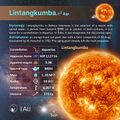
| Native | Lintangkumba |
|---|---|
| Translation | asterism of a vessel with sacred water |
| Position (2000) | |
| Right ascension | 342.3979208 |
| Declination | -13.59262854 |
| Area | 0 sq. deg. |
| Stars | |
| Bright stars | 1 |
| Bayer/Flamsteed stars | 1 |
| Stars brighter than 3.00m | 0 |
| Brightest star | Lintangkumba (3.98m) |
| Taxonomy | |
| category of asterism | IAU-Star Name |
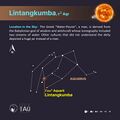
| IAU- constellations | Aqr |

Lintangkumba is a modern star name adopted by the International Astronomical Union in the IAU-Catalog of Star Names (IAU-CSN). Its origin is Indonesian (Bahasa Indonesia), a modern language created from the Malay (1928-1945). It is the name of the star tau02 Aqr in constellation Aquarius.
Concordance, Etymology, History

Lintangkumba is an Indic name from Bali (Indonesia), where it used until today for a cultural calendar that helps determining best times for seasonal activities like agriculture, sailing, hunting specific animals, and also for religious purposes in Balinese Hinduism and local belief.
It is attested in a series called Palelintangan that has been in use on the islands of Java and Bali from ~700 CE on, when first settlers came from India and brought Hinduism as religion, Sanskrit as writing form and other cultural goods from Eurasia. In the local traditions on the tropical islands, this was merged with Oceanic knowledge, which gave birth to the traditional Palelintangan.
Lintang in Bahasa Indonesia means asterism; 'kumba' in Balinese is a vessel with sacred water; it derives from Sanskrit कुम्भ (kumbha), jar or pitcher. In both Indian and Indonesian cultures, it is a name for the constellation in Aquarius. In India, it also designates the rāśi (zodiac sign).
Mythology
IAU Working Group on Star Names
The name was discussed and adopted by the IAU WGSN in 2026.
-
 (CC BY Sadegh Faghanpour for IAU WGSN)
-
 (CC BY Sadegh Faghanpour for IAU WGSN)