Simmakh
Authors: Susanne M Hoffmann, ASE Tech Team

| Asterism Info | |
| Native | SIM.MAḪ |
|---|---|
| Translation | Swallow |
| Position (2000) | |
| Right ascension | 5.149425122 |
| Declination | 8.190271705 |
| Area | 0 sq. deg. |
| Stars | |
| Bright stars | 1 |
| Bayer/Flamsteed stars | 1 |
| Stars brighter than 3.00m | 0 |
| Brightest star | Simmakh (5.37m) |
| Taxonomy | |
| category of asterism | IAU-Star Name |
| IAU- constellations | Psc |
Simmakh is a modern star name adopted by the International Astronomical Union in the IAU-Catalog of Star Names (IAU-CSN). Its origin is Sumerian, from SIM.MAḪ. It is the name of the star d Psc (HIP 1645) in constellation Pisces.
Concordance, Etymology, History

Babylonian constellation that has undergone massive transformations: the original Giant Swallow was turned into a Swallow-Fish and into two fish connected with a ribbon. It is located in the area of modern Pisces. Alternative Mesopotamian terms are mulŠIM.MAḪ (𒀯𒋆𒈤) and (mul)Šinūnūtu.
The characteristic folked tail of a swallow actually matches the pattern of stars in the sky very well; so it is very likely the original image seen in the asterism that is now considered a V-shaped ribbon.
The transformation of the constellation of The Swallow (see SIM.MAḪ) in ancient Mesopotamia is characterised by the original image of a Giant Swallow which must be located in Cetus, as its tails are imagined in the ribbon of Pisces, to a later version of a much smaller bird (swallow) whose body is roughly in the southern fish-ellipse of Pisces. The second image is reconstructed from coordinates given in Late Babylonian texts, e.g. the normal star list in which reads "DUR sim.ma", "Swallow Ribbon" [Roughton-Steele-Walker 2004[1], 551:21′, 553], suggesting a bird connected to a fish in the northern fish-ellipse. Such an image of a bird and a fish connected by a V-shaped ribbon is preserved on seals in Uruk.
Yet earlier texts like MUL.APIN only list a Swallow and no fish in this area. The stars of Anu (no. 2), MUL.APIN I i 41 = (Anu 2right)[2]:
- MUL ša2 ina IGI-it mulAŠ.IKU GUB-zu mulŠi-nu-nu-tu4
- "The star that stands before the Field, the Swallow"
Mythology
IAU Working Group on Star Names
The name was suggested to the IAU WGSN in 2023. It was adopted for a star south of the Pegasus square which matches both image reconstructions: the earlier large swallow (at the tip of its tail) and the late small swallow (in the body/head).
The name was adopted by the IAU WGSN in September 2026.
-
 (CC BY Sadegh Faghanpour for IAU WGSN)
-
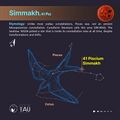 (CC BY Sadegh Faghanpour for IAU WGSN)

Weblinks
Reference
- Ian Ridpath's website (Star Tales )
- ↑ Roughton N.A., Steele J.M., Walker C.B.F. A Late Babylonian Normal and Ziqpu Star Text // AHES 58 (2004) 537-572.
- ↑ Hoffmann, S. M. and Krebernik, M. (2023). What do deities tell us about the celestial positioning system, in: R. Rollinger, I. Madreiter, M. Lang, C. Pappi (eds.). The Intellectual Heritage of the Ancient Near East, Papers held at the 64th Rencontre Assyriologique International and 12th Melammu Symposium July 16-20 2018, Innsbruck. Austrian Academy of Sciences Press, 539-579