Baijiu (败臼)
Authors: Boshun YANG, ASE Tech Team, Susanne M Hoffmann

| Asterism Info | |
| Native | 敗臼 |
|---|---|
| Translation | Broken Mortar |
| Position (2000) | |
| Right ascension | 326.236707 |
| Declination | -33.02578182 |
| Area | 0 sq. deg. |
| Stars | |
| Bright stars | 1 |
| Bayer/Flamsteed stars | 1 |
| Stars brighter than 3.00m | 0 |
| Brightest star | Baijiu (4.34m) |
| Taxonomy | |
| category of asterism | IAU-Star Name |
| IAU- constellations | PsA |
Bài Jiù (Broken Mortar, 敗臼) is a Chinese asterism of four stars belonging to the Shi school and usually assigned to the lodge Xu (虛). Its tradition is traced to the Han-period star catalogue system. Historical identifications place it in parts of modern Piscis Austrinus and Grus.
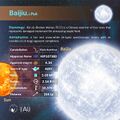
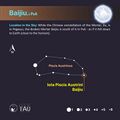
Baijiu is a modern IAU-star name for Iota PsA since September 2026.
Concordance, Etymology, History

Literal meaning and material culture
Here bai (敗) is best understood as damage or deterioration. The Shuowen jiezi (說文解字), under pu (攴), glosses it as “to destroy”; under jiu (臼), it explains that mortars were initially hollows dug in the ground and later cavities cut into wood or stone. The immediate image is thus a pounding implement that has become unserviceable. Popular translation is “Decayed Mortar”, while Broken Mortar or Worn-out Mortar better reflects its original meaning—here “败” does not necessarily refer to material decay.
For the material history of mortars and pestles, their use in processing grain, and their association with military provisions, see Chu and Jiu.
Modern explanations differ. Sun & Kistemaker interpret Baijiu as a large mortar-shaped receptacle for waste. Osaki Shoji understands it as an old mortar that, due to object worship, was not discarded after being damaged. These readings invoke reuse or taboo, but but no clear records directly supporting these specific uses or taboos have yet been found.
Symbolism
The early astrological meanings of Baijiu were primarily concerned with the order of everyday life and the food supply. According to the Shi shi tradition quoted in the Kaiyuan zhanjing (開元占經), if one of its stars was missing, the people would “sell their cauldrons (fu 釜) and steamers (zeng 甑) and leave the place.” The History of the Song (宋史) elaborates on this interpretation: if the asterism lacked a star, people would sell their cooking vessels, and if all four stars disappeared, they would leave their homes. The cauldron and steamer were used respectively for boiling and steaming food. Selling these essential household implements and abandoning one’s dwelling thus provided a concrete image of ruined livelihoods and forced migration. This meaning broadly resembles that assigned to the Inner Pestle and Mortar in the Gan tradition. At the same time, the statements that Baijiu “governs matters of orderly administration” (zhu zhengzhi zhi shi 主正治之事) in the Jingzhou zhan (荊州占), and “governs government affairs” (zhu zhengzhi 主政治) in the transmitted Xingjing (星經), indicate that the asterism was also understood within a broader framework of social order and state governance.
The symbolism of Baijiu was further extended to disasters affecting the state. The Shi shi xingjing (石氏星經) states that “another tradition holds that Baijiu governs calamities.” The Huangdi zhan (黃帝占) regards faint and steady stars as auspicious, whereas brightness and movement portend illness or anxiety for the ruler, distress among the people, and death or mourning. Li Bo’s (李播) Tianwen daxiang fu (天文大象賦) likewise declares: “Baijiu shines forth to reveal calamities.” The divination text also match the overall insufficient brightness of the four stars of the Baijiu.
By the Song period, the interpretation of Baijiu appears to have undergone a further change. The Qianxiang tongjian (乾象通鑑) preserves numerous astrological passages derived from earlier manuals, among which predictions concerning the Northern Di (北狄), the Xiongnu (匈奴), and warfare on the frontiers are especially prominent. This interpretive strand seems to have incorporated Baijiu into the frontier-defence narrative represented by nearby asterisms such as Tianleicheng (天壘城) and Yulin (羽林). It remains uncertain, however, whether these meanings first arose during the Song period or were merely preserved in Song sources.
The most cautious interpretation, therefore, is that Baijiu took the “damaged implement for processing staple food” as its basic image and consequently came to symbolize famine, the collapse of livelihoods, and displacement. In different astrological traditions, it was further associated with political disorder, disasters affecting the state, and threats along the frontiers. The extant evidence reveals the accumulation and coexistence of multiple meanings, but it does not establish a clear, unidirectional chronology for their development.
Identification of stars
| Star Names or Orders(Qing) | Han Dynasty (SUN X. & J. Kistemaker[1]) | 3rd to 6th Century (Boshun Yang[2]) | Song Dynaty (Boshun Yang[2], 1034 CE) | Song Dynasty (Pan Nai[3], 1052 CE) | Song Dynasty (Boshun Yang[2], 1052 CE) | Qing Dynaty (Yi Shitong[4], 18th Century) | Ho PENG YOKE[5] |
|---|---|---|---|---|---|---|---|
| 1st | Iota PsA(determinative) | Iota PsA(determinative) | Lambda Gru(determinative) | Mu¹ Gru(determinative) | Mu¹ Gru(determinative) | Gamma Gru | Gamma Gru |
| 2nd | Gamma Gru | Nu PsA | Delta² Gru | Alpha Gru | Delta² Gru | Lambda Gru | Lambda Gru |
| 3rd | Gamma PsA | Beta PsA | Theta Gru | Beta Gru | Theta Gru | Gamma PsA | Gamma PsA |
| 4th | 51G PsA | Epsilon PsA | Phi Gru | Rho Gru | Phi Gru | 19 PsA | 19 PsA |
Maps (Gallery)
| historical map | modern identification | same in Stellarium |
|---|---|---|
 |
 |
 .png) |
 | ||
 |
_reconstructed_by_Boshun_Yang.jpg) |
_in_Stellarium.jpg) |
 |
_reconstructed_by_Boshun_Yang.jpg) |
_reconstructed_by_Boshun_Yang_in_Stellarium.jpg) |
 |
_reconstructed_by_Pan_Nai.jpg) |
_reconstructed_by_Pan_Nai_in_Stellarium.jpg) |
 |
||
 |
 |
 |
IAU Working Group on Star Names
In 2026, the name of the historical constellation "Baijiu" was suggested to be used for Iota PsA in this constellation, for it was used as the earliest determinative star.
Decision: adopted on 17 September 2026.
-
 (CC BY Sadegh Faghanpour for IAU WGSN)
 -
 (CC BY Sadegh Faghanpour for IAU WGSN)

References
- ↑ Sun Xiaochun. & Kistemaker J. The Chinese sky during the Han. Leiden: Brill. 1997, Pp241-6.
- ↑ 2.0 2.1 2.2 B.-S. Yang杨伯顺, Zhongguo Chuantong Hengxing Guance Jingdu ji Xingguan Yanbian Yanjiu 中国传统恒星观测精度及星官演变研究 (A Research on the Accuracy of Chinese Traditional Star Observation and the Evolution of Constellations), PhD thesis, (Hefei: University of Science and Technology of China, 2023), Pp297-304.
- ↑ Pan Nai潘鼐. Zhongguo Hengxing Guance shi中国恒星观测史[M]. Shanghai: Xuelin Pree. 1989, Pp220-226.
- ↑ Yi Shitong伊世同. Zhongxi Duizhao Hengxing Tubiao中西对照恒星图表1950. Beijing: Science Press.1981.
- ↑ P.-Y. Ho, “Ancient And Mediaeval Observations of Comets and Novae in Chinese Sources,” Vistas in Astronomy, 5(1962), 127-225.





