Gouguo (狗国)
Authors: Lyu Haocheng, Eric Mamajek, ASE Tech Team, Susanne M Hoffmann

| Asterism Info | |
| Native | 狗国 |
|---|---|
| Translation | Territory of Dog |
| Position (2000) | |
| Right ascension | 300.6645021 |
| Declination | -27.70984435 |
| Area | 0 sq. deg. |
| Stars | |
| Bright stars | 1 |
| Bayer/Flamsteed stars | 1 |
| Stars brighter than 3.00m | 0 |
| Brightest star | Gouguo (4.58m) |
| Taxonomy | |
| category of asterism | IAU-Star Name |
| IAU- constellations | Sgr |

| Asterism Info | |
| Native | 狗国 |
|---|---|
| Romanisation | Gǒu Guó |
| IPA | /koʊ˨˩˦.kwo˧˥/ |
| Translation | Territory of Dog |
| Position (2000) | |
| Right ascension | ... to ... |
| Declination | ... to ... |
| Area | xx.xx sq. deg. |
| Stars | |
| Bright stars | 4 |
| Bayer/Flamsteed stars | 4 |
| Stars brighter than 3.00m | 0 |
| Brightest star | 59 Sgr (4.53m) |
| Taxonomy | |
| category of asterism | constellation |
| IAU- constellations | Sgr |
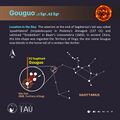
Gǒu Guó (狗国, Territory of Dog), is a traditional Chinese asterism belonging to the Dou (斗 / Dipper) lunar mansion. Within the "Three Schools" of ancient Chinese astronomy, it is classified as a Gan School (甘氏) asterism. Gou Guo consists of four stars located to the southeast of Jian (建) (建星 / Establishment Star). In modern constellation boundaries, Gou Guo lies within Sagittarius.
In August 2026, the name Gouguo was adopted by IAU WGSN as the the name for the star designated 62 Sgr (c Sgr), as this was the determinative star for this ancient constellation in the early time, before Tang Dynasty.
Concordance, Etymology, History
The name "Gou Guo" literally means "territory of dog". This asterism corresponds to the non-Han peoples of northern and northeastern China.
Gou Guo belongs to the Dou (Dipper) mansion, which is part of the Northern Black Tortoise in the Four Symbols system — positioned precisely at the boundary between the Eastern Azure Dragon and the Northern Black Tortoise. Gou Guo itself lies in the northeastern sector of the sky, and thus corresponds to the non-Han peoples of northeastern China. Similarly, other asterisms representing non-Han peoples elsewhere in the sky are generally aligned with the geographical directions associated with their respective Four Symbols.
The Gan Shi Zan (Gan's Eulogy) records:
"Gou Guo governs the Xianbei (鲜卑), Wuhuan (乌丸), and Okjeo (沃沮)."
The Song Shi, Tianwen Zhi (Treatise on Astronomy in the History of Song) provides a more detailed account, stating that Gou Guo:
"governs the Samhan (三韩), Xianbei, Wuhuan, Xianyun (玁狁), Okjeo, and their like."
These peoples—Xianbei, Wuhuan (乌丸/乌桓, alternative transcriptions of the same name from different periods), and Okjeo—were all ancient ethnic groups inhabiting northern and northeastern China. The Gou Guo stars were used for divining the fortunes and misfortunes of these northern "barbarian" states. The Huangdi Zhan (Yellow Emperor's Divination) states:
"If the stars of Gou Guo are not complete, there will be great bandits in the realm."
The Song Shi, Tianwen Zhi similarly notes:
"If the stars are not complete, there will be bandits; if they are dim, all is peaceful; if they are bright, border bandits will arise."
In other words, if these stars appear incomplete in number or abnormally bright, it portends great banditry or border troubles.
Corresponding Historical Peoples
The name "Gou Guo" was not originally an asterism name but a legendary ethnonym from the pre-Qin period, possibly related to the ancient Quanrong (犬戎, Dog Rong) tribe. Works such as the Yi Zhou Shu (Lost Book of Zhou) and the Western Han Huainanzi, Dixing Xun (Treatise on Topography) mention "Gou Guo" as a "Rong-Di" (戎狄) state to the west or north of the Central Plains.
As an asterism, however, Gou Guo's meaning is not directly inherited from these ancient legends. The Gou Guo asterism symbolizes the Xianbei, Wuhuan, and Okjeo—peoples that were active in northeastern China from the Han through the Wei-Jin periods.
Xianbei (鲜卑)

The Xianbei were an ancient nomadic people of northern East Asia, belonging to the Donghu (Eastern Hu) lineage. After the Donghu were defeated by the Xiongnu around the Qin-Han transition (late 3rd century BCE), the Xianbei retreated to the Greater Khingan Range. As the Xiongnu were crushed by the Han dynasty (chiefly during the 1st–2nd centuries CE), the Xianbei rapidly expanded westward into the vacuum left by the Xiongnu and rose to become the new steppe overlords. During the Wei-Jin period (220–420 CE), the Xianbei reached the height of their power, founding multiple states including the Former Yan (337-370), Later Yan (384-409), Southern Yan (398-410), Western Qin (385-400, 409-431), Southern Liang (397-414), and most notably the Northern Wei (386-534), which unified northern China. The Xianbei were one of the most influential northern peoples in Chinese history.[1]
Wuhuan (乌桓/乌丸)
The Wuhuan were a proto-Mongolic people of the Donghu lineage, dwelling south of the Xianbei. Their name first appears in the Shiji, Xiongnu Liezhuan (Records of the Grand Historian: Biography of the Xiongnu). During the reign of Emperor Wu of Han (r. 141-87 BCE), the Wuhuan submitted to the Han and were relocated southward to the region beyond the Great Wall in the five commanderies of Shanggu, Yuyang, Youbeiping, Liaoxi, and Liaodong—a frontier zone between agricultural and pastoral regions. Consequently, the Wuhuan long remained a people caught between the Han dynasty, the Xiongnu, and the Xianbei. In the late Eastern Han (late 2nd-early 3rd century CE), the Wuhuan grew powerful but were eventually subjugated by Cao Cao in 207 CE; their population was largely absorbed into the Xianbei and Han populations. In post-Wei-Jin historical texts, "Wuhuan" (乌桓) is often written as "Wuhuan" (乌丸)—the two are variant transcriptions of the same ethnonym.[1]
Okjeo (沃沮)
The Okjeo, also written as Woqie (沃且), were an ancient tribal state in northeastern Asia, distributed mainly around the Tumen River basin and the Sea of Japan coast of the northern Korean Peninsula. They were divided into Eastern Okjeo and Northern Okjeo; Eastern Okjeo is sometimes referred to simply as Okjeo or as Southern Okjeo. The Okjeo were once subject to Wiman Joseon (c. 194-108 BCE) and later to the Han dynasty's Four Commanderies, specifically the Xuantu (玄菟) and Lelang (乐浪) commanderies, before eventually coming under the sway of Goguryeo. Their territory encompassed parts of present-day eastern Jilin Province in China, the Hamgyong provinces of North Korea, and the Primorsky Krai region of Russia.
13th-19th centuries

After the Wei-Jin period, ethnonyms such as Xianbei and Okjeo gradually disappeared from the historical stage, but "Gou Guo" persisted as an asterism name and divinatory object. From the Yuan through the Qing dynasties (13th–19th centuries), Chinese sources referred to the peoples of the middle and lower Amur River basin as "Gou Guo" or "Shi Quan Bu" (使犬部, Dog-using Tribe), corresponding primarily to the modern Hezhen (Nanai) people. This later "Gou Guo" derived its name from the local practice of using dogs for sled transportation—for instance, the courier stations established along the lower Amur River in the Ming dynasty were called "dog stations" (狗站)—and has no direct connection to the asterism of the same name.[2]
Identification of stars
After the Huangyou reign period (1052 CE) of the Northern Song dynasty, the four stars of Gou Guo were fixed as ω Sgr, 60 Sgr, 62 Sgr, and 59 Sgr. Subsequent star charts and catalogues have consistently affirmed this identification.
However, in pre-Huangyou star charts—such as the Cheonsang Yeolcha Bunyajido and the Dunhuang Star Chart, as well as pre-Huangyou star catalogues like the Jingyou Star Catalogue—the position of Gou Guo differs; it was likely located near 52 Sgr in earlier times. The scholar Yang Boshun, through data correction and identification of the 3rd-century Chen Zhuo star catalogue, found that the determinative star in the early observational records corresponds to 62 Sgr[3], the same as in the later period. This suggests that the asterism underwent more than one change over the course of its history, and its final position was the result of a long process of adjustment.
| Star Names or Orders(Qing) | Ho PENG YOKE[4] | Yi Shitong[5]
Based on catalogue in 18th century |
Pan Nai[6]
based on Xinyixiangfayao Star Map |
Pan Nai[7]
based on catalogues in Yuan dynasty |
SUN X. & J. Kistemaker[8]
Han Dynasty |
Boshun Yang[3]
before Tang dynasty |
Boshun Yang[3]
Song Jingyou(1034) |
|---|---|---|---|---|---|---|---|
| 1st | ω Sgr | ω Sgr | ω Sgr (Determinative) | ω Sgr (Determinative) | ω Sgr | ω Sgr | 56 Sgr (Determinative) |
| 2nd | 60 Sgr | 60 Sgr | 60 Sgr | 60 Sgr | 60 Sgr | 60 Sgr | 52 Sgr |
| 3rd | 62 Sgr | 62 Sgr | 62 Sgr | 62 Sgr | 62 Sgr | 62 Sgr (Determinative) | χ1 Sgr |
| 4th | 59 Sgr | 59 Sgr | 59 Sgr | 59 Sgr | 59 Sgr | 59 Sgr | 50 Sgr |
Maps (Gallery)
| historical map | modern identification
(Yang 2023) |
same in Stellarium 24.4 |
|---|---|---|
 |
.png) |
|
  |
_reconstructed_by_Boshun_Yang_(2023).png) |
_in_Stellarium_reconstructed_by_Boshun_Yang.png) |
 .png) |
_reconstructed_by_Pan_Nai_(2009).png) |
|
IAU Working Group on Star Names
In 2026, the name "Gouguo" was proposed to WGSN to be used for the star 62 Sgr, as it was as one of the reported determinative stars for the ancient constellation of this name. Note that the other star that appears to be the determinative star documented in several works is ω Sgr, which has the IAU name Terebellum.
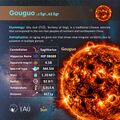
In August 2026, the WGSN adopted the name Gouguo for the star designated 62 Sgr (V3872 Sgr, HR 7650, HD 189763, HIP 98688). The star is a red giant star of spectral type M4.5III (Keenan & McNeil 1989), at distance approximately 138 parsecs. The star is catalogued as a semi-regular variable star (V3872 Sgr) in the AAVSO International Variable Star Index, with reported range of apparent V magnitude 4.45 to 4.64. Indeed the reported mean Johnson V magnitude for the star ranges from V = 4.43 (Hipparcos catalogue, ESA 1997) to V = 4.59 (Johnson et al. 1966). Tabur et al. (2009) report variability with periods of 24.0, 30.4, 31.3, 42.8, 50.5, and 234.7 days in a multi-year photometric survey of V3872 Sgr. Kervella et al. (2022) estimates this red giant star to have a diameter of 178.35 (+-9.08) times that of the Sun, which if placed in our solar system it would reach out to 0.83 astronomical units, and consume Mercury and Venus (but not reach Earth)! Thus far the star appears to be single.
The star sometimes appears in historical sources with the Roman letter designation "c Sgr", however these particular designations are generally deprecated in modern catalogs in favor of e.g., Flamsteed number designations, as some Roman letters can be confused with Greek letters (e.g., Bright Star Catalog, Hoffleit & Warren 1982).
-
 (CC BY Sadegh Faghanpour for IAU WGSN)
 -
 (CC BY Sadegh Faghanpour for IAU WGSN)

References
- ↑ 1.0 1.1 Wang Wenguang 王文光. (2018). "Liang Han shiqi Wuhuan, Xianbei de lishi renleixue yanjiu" 两汉时期乌桓、鲜卑的历史人类学研究 (A Historical Anthropological Study of the Wuhuan and Xianbei during the Han Dynasties). In Zhongguo Minzushi de Lishi Renleixue Yanjiu 中国民族史的历史人类学研究 (Study on China's Ethnic History from a View of Historical Anthropology). Beijing: Social Sciences Academic Press.
- ↑ Sasaki Shiro 佐佐木 史郎 & Xiao Ke 肖可 (trans.). (1994). "Guanyu 'Shiquanbu' yu 'Hezhe' minzuxue de kaocha" 关于“使犬部”与“赫哲”民族学的考察 (An Ethnological Study on the "Dog-using Tribe" and the Hezhen). Manyu Yanjiu 满语研究 (Manchu Studies), 1994(1).
- ↑ 3.0 3.1 3.2 B.-S. Yang杨伯顺, Zhongguo Chuantong Hengxing Guance Jingdu ji Xingguan Yanbian Yanjiu 中国传统恒星观测精度及星官演变研究 (A Research on the Accuracy of Chinese Traditional Star Observation and the Evolution of Constellations), PhD thesis, (Hefei: University of Science and Technology of China, 2023). 235-296.
- ↑ P.-Y. Ho, “Ancient And Mediaeval Observations of Comets and Novae in Chinese Sources,” Vistas in Astronomy, 5(1962), 127-225.
- ↑ Yi Shitong伊世同. Zhongxi Duizhao Hengxing Tubiao中西对照恒星图表1950. Beijing: Science Press.1981.
- ↑ Pan Nai潘鼐. Zhongguo Hengxing Guance shi中国恒星观测史[M]. Shanghai: Xuelin Pree. 1989. Fig 55.
- ↑ Pan Nai潘鼐. Zhongguo Hengxing Guance shi中国恒星观测史[M]. Shanghai: Xuelin Pree. 2009. p435-443.
- ↑ Sun Xiaochun. & Kistemaker J. The Chinese sky during the Han. Leiden: Brill. 1997, Pp241-6.





