Neichu (內杵) and Jiu (臼)
Authors: Boshun YANG
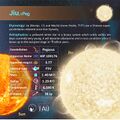
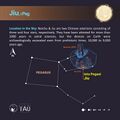
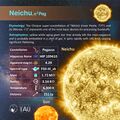
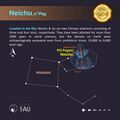
Nèichǔ (Inner Pestle, 內杵) is a three-star Chinese asterism and Jiù (Mortar, 臼) is a four star Chinse asterism. They belong to the Gan school, represented in black in the three-school tradition. Under modern IAU boundaries, their members fall in Pegasus and Lacerta.


Concordance, Etymology, History
A chu (Pestle杵) was a rod-shaped implement used for pounding grain, normally in combination with a mortar (jiu 臼). Together, the pestle and mortar formed one of the most basic devices for processing foodstuffs. They could be used to dehusk grain, pound rice, produce flour, and prepare ritual food; implements of similar form were also employed for grinding medicinal ingredients or working other materials. The Xici II commentary of the Book of Changes states: “…cut wood to make pestles and dug the earth to make mortars; through the benefit of mortar and pestle, the myriad people were sustained斷木為杵,掘地為臼;臼杵之利,萬民以濟.” Early mortars could be made by hollowing depressions directly into the ground or into blocks of stone, while pestles were fashioned from short pieces of wood or elongated stones. Archaeological evidence indicates that the invention of the pestle and mortar reaches far back into prehistory. Stone pestles have been excavated at both the Baozitou site in Nanning and the Zengpiyan site in Guilin, which date to approximately 10,000–9,000 years ago.
The prefix nei (Inner内) does not indicate that the implement was kept indoors. Rather, it served as a distinguishing element within the nomenclature of Chinese asterisms. Yang Boshun has argued that the Gan school deliberately coined some of its asterism names with reference to names already used in the Shi-school system. Since the Shi school already had an asterism called Chu 杵, the Gan school designated another one as Neichu (Inner Pestle內杵), “Inner Pestle.” Comparable pairs include Tianjie (Celestial Steps天階)–Neijie (Inner Steps內階) and Ping (Screen屏)–Waiping (Outter外屏). The name Neichu therefore served primarily to distinguish this asterism from another Chu belonging to the Shi-school tradition and located south of the lunar lodge Ji 箕.
Sun Xiaochun and Jacob Kistemaker treated Neichu, Jiu 臼, and the nearby Tianchu 天廚 as a coherent group within the same sector of the sky. They connected these asterisms with the ancestral-temple imagery associated with the neighboring lodges Shi 室 and Bi 壁, interpreting them as cooking and food-processing facilities used to prepare special offerings for ancestral rites. This interpretation emphasizes the idea of a ritual kitchen. Other sources, however, including the Kaiyuan zhanjing, the Xingjing, and the astronomical treatise of the History of the Song, preserve prognostications concerning the “annual harvest” and “military provisions.” In this context, the pestle and mortar symbolized the harvesting, storage, and processing of grain, especially supplies intended for the army. Although these interpretations may derive from different intellectual and astrological contexts, they share the same central semantic field: the harvesting, storage, and processing of food grains.
Identification of stars
Before the transmission of European astronomy to China, the identification of the three stars of Neichu and Jiu remained generally stable. During the astronomical reforms of the late Ming period, however, the whole asterism Neichu and one star of Jiu appears to have been omitted, possibly because its constituent stars were difficult to identify. When Jesuit astronomers compiled new star catalogues in the Qing dynasty, they attempted to restore the traditional Chinese asterism system; nevertheless, their identification of the stars of Neichu differed from that followed before the late Ming reforms.
| Star Names or Orders(Qing) | Han Dynasty (SUN X. & J. Kistemaker[1]) | 3rd to 6th Century (Boshun Yang[2]) | Song Dynaty (Boshun Yang[2], 1034 CE) | Song Dynasty (Pan Nai[3], 1052 CE) | Qing Dynaty (Yi Shitong[4], 18th Century) | Ho PENG YOKE[5] | |
|---|---|---|---|---|---|---|---|
| Neichu | 1st | pi 1 Peg | pi2 Peg | pi2 Peg (determinative) | pi2 Peg (determinative) | 1 Lac | 1 Lac |
| 2nd | HIP 109654 | HIP 109654 | HIP 109654 | pi2 Peg | pi2 Peg | ||
| 3rd | 1 Lac | 1 Lac | 1 Lac | 1 Lac | 23 Peg | 23 Peg | |
| Jiu | 1st | iota Peg | iota Peg (determinative) | iota Peg (determinative) | iota Peg (determinative) | mu1 Cyg | mu1 Cyg |
| 2nd | 23 Peg | 23 Peg | 23 Peg | 23 Peg | kappa Peg | kappa Peg | |
| 3rd | HIP 109602 | HIP 109602 | HIP 109602 | HIP 109602 | iota Peg | iota Peg | |
| 4th | 32 Peg | 32 Peg | 32 Peg | 32 Peg | 32 Peg | 32 Peg |
Maps (Gallery)
| historical map | modern identification
(Yang 2023) |
same in Stellarium 24.4 |
|---|---|---|
IAU Working Group on Star Names
In 202x, the name of the historical constellation "xxx" was suggested to be used for one of the stars in this constellation. ...
Decision: ...
References
- ↑ Sun Xiaochun. & Kistemaker J. The Chinese sky during the Han. Leiden: Brill. 1997, Pp241-6.
- ↑ 2.0 2.1 B.-S. Yang杨伯顺, Zhongguo Chuantong Hengxing Guance Jingdu ji Xingguan Yanbian Yanjiu 中国传统恒星观测精度及星官演变研究 (A Research on the Accuracy of Chinese Traditional Star Observation and the Evolution of Constellations), PhD thesis, (Hefei: University of Science and Technology of China, 2023).
- ↑ Pan Nai潘鼐. Zhongguo Hengxing Guance shi中国恒星观测史[M]. Shanghai: Xuelin Pree. 1989.
- ↑ Yi Shitong伊世同. Zhongxi Duizhao Hengxing Tubiao中西对照恒星图表1950. Beijing: Science Press.1981.
- ↑ P.-Y. Ho, “Ancient And Mediaeval Observations of Comets and Novae in Chinese Sources,” Vistas in Astronomy, 5(1962), 127-225.