Yunyu (雲雨)
Authors: Boshun YANG, ASE Tech Team, Susanne M Hoffmann

| Asterism Info | |
| Native | 雲雨 |
|---|---|
| Translation | Cloud and Rain |
| Position (2000) | |
| Right ascension | 349.2914046 |
| Declination | 3.282290469 |
| Area | 0 sq. deg. |
| Stars | |
| Bright stars | 1 |
| Bayer/Flamsteed stars | 1 |
| Stars brighter than 3.00m | 0 |
| Brightest star | Yunyu (3.7m) |
| Taxonomy | |
| category of asterism | IAU-Star Name |
| IAU- constellations | Psc |
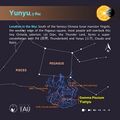
Yún Yǔ (Cloud and Rain, 雲雨) is a four-star Chinese asterism belonging to the outer asterisms of the Gan school. It lies south of Pīlì and all major reconstructions locate it in modern Pisces. It represents clouds and rainfall and was said to govern the rain that brings living things to completion. Yunyu, Leidian (雷電), and Pili (霹靂) form a neighboring meteorological cluster.
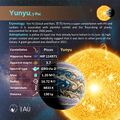
Yunyu is a modern IAU-star name since September 2026; it refers to the star γ Psc in Pisces.
Concordance, Etymology, History
Name and Etymology
“Cloud” (yún 雲) denotes water vapour gathered in the sky, while “rain” (yǔ 雨) is water that descends from clouds. The Shiming (Explanation of Names) states that “rain assists” (yǔ zhě fǔ yě 雨者輔也), emphasizing its role in supporting the seasonal cycle and nourishing living things. The Tuan Commentary to Qian in the Zhouyi similarly declares: “Clouds move and rain is bestowed; the myriad things flow into their forms” (雲行雨施,品物流形). The name of the Yúnyǔ asterism thus condenses two successive and interdependent natural processes into a single unit.
Following Song Yu’s (fl. 3rd century) “Gaotang fu” (Rhapsody on Gaotang), the expression yúnyǔ also acquired the literary sense of an encounter with a goddess and, by extension, became a euphemism for sexual relations. This later usage, however, is unrelated to the Yúnyǔ asterism itself. A verse attributed to the Gan astronomical tradition, possibly composed by Chen Zhuo, states under Yúnyǔ: “When cloud and rain arise in harmony, auspicious abundance rain brings luxuriant growth” (雲雨興和,休祈茂孽). The passage therefore associates harmonious clouds and rain with plentiful, auspicious rainfall and the flourishing of plants.
Material Culture, Persons, and Rain Governance
In traditional China, agriculture was long regarded as the foundation of the state and the livelihood of its people, while timely rainfall was essential to agricultural production. Precipitation directly affected sowing, crop growth, harvests, and even grain prices. Astrologers of imperial China consequently held that the Yúnyǔ asterism “governs rain and moisture and brings the myriad things to maturity” (主雨澤,成萬物). Variations in its appearance and encounters with planets were interpreted as signs of rainfall and agricultural conditions. A bright Yúnyǔ, for example, was believed to portend abundant rain, whereas Mercury (which literally means “planet of water”) remaining within the asterism foretold severe flooding. Observing Yúnyǔ thus became one means of predicting the success or failure of the harvest and, by extension, social stability.
Yúnyǔ, Léidiàn (Thunder and Lightning), and Pīlì (Thunderbolt) form a cluster of adjacent meteorological asterisms. All lie south of the Shì lodge in the northern celestial region regarded as the Black Tortoise (Xuánwǔ). In the Five Phases system, the north corresponds to Water. Elements of thunder, lightning, clouds, and rain were therefore organized in this part of the sky into an interconnected “Northern Water Bureau.”
As knowledge of the asterisms entered state ritual, visual traditions, and religious practice, some asterisms that had originally denoted purely natural phenomena gradually became personified and invested with divine officials. During the Song dynasty, court ritual increasingly represented natural deities in anthropomorphic form, while Daoist conceptions of a celestial bureaucracy also became more elaborate. Stars and natural forces such as wind, rain, thunder, and lightning were consequently incorporated into a hierarchy of divine officials and generals, each possessing a title, specialized duties, and a defined rank.
Against this cultural background, the Southern Song Zhongxing tianwen zhi interpreted Yúnyǔ as Yúnjiàng, the “Cloud General,” and Yǔshī, the “Master of Rain.” It grouped them with Léigōng, the “Lord of Thunder,” and Diànmǔ, the “Lightning Matron,” who corresponded to the Léidiàn asterism, as well as what the text calls the “Thunderbolt (and) Axe Officer” (霹靂斧吏), describing them collectively as “numinous essences of the Northern Water Bureau” (北方水府之精). Both the Cloud General and the Master of Rain had existed as nature deities before the Southern Song. The passage therefore reflects a Song scholarly reinterpretation in which traditional meteorological asterisms were incorporated into a bureaucratically structured pantheon through identification with established deities.
Identification of stars
| Star Names or Orders(Qing) | Han Dynasty (SUN X. & J. Kistemaker[1]) | 3rd to 6th Century (Boshun Yang[2]) | Song Dynaty (Boshun Yang[2], 1034 CE) | Song Dynasty (Pan Nai[3], 1052 CE) | Song Dynasty (Boshun Yang[2], 1052 CE) | Yuan Dynasty (Pan Nai[4], 14th century) | Qing Dynaty (Yi Shitong[5], 18th Century) |
|---|---|---|---|---|---|---|---|
| 1st | κ Psc | γ Psc (Determinative) | γ Psc (Determinative) | κ Psc (Determinative) | κ Psc (Determinative) | TX Psc | κ Psc |
| 2nd | 16 Psc | κ Psc | κ Psc | 14 Psc | 14 Psc | λ Psc | 12 Psc |
| 3rd | λ Psc | λ Psc | λ Psc | HIP 117887
= XZ Psc |
HIP 117887
= XZ Psc |
21 Psc | 21 Psc |
| 4th | 19 Psc | 19 Psc | 19 Psc | λ Psc | λ Psc | 22 Psc | λ Psc |
Maps (Gallery)
| historical map | modern identification | same in Stellarium |
|---|---|---|
 |
 |
 |
 |
_reconstructed_by_Boshun_Yang.jpg) |
_in_Stellarium.jpg) |
 |
_reconstructed_by_Boshun_Yang.jpg) |
_in_Stellarium.jpg) |
 |
_reconstructed_by_Pan_Nai.jpg) |
|
_reconstructed_by_Boshun_Yang.jpg) |
_in_Stellarium.jpg) | |
 |
 |
 |
IAU Working Group on Star Names
In 2026, the name of the historical constellation "Yunyu" was suggested to be used for γ Psc in this constellation for it was used as the earliest determinative star.
Decision: adopted on 17 Sept 2026.
-
 (CC BY Sadegh Faghanpour for IAU WGSN)
 -
 (CC BY Sadegh Faghanpour for IAU WGSN)

References
- ↑ Sun Xiaochun. & Kistemaker J. The Chinese sky during the Han. Leiden: Brill. 1997, Pp241-6.
- ↑ 2.0 2.1 2.2 B.-S. Yang杨伯顺, Zhongguo Chuantong Hengxing Guance Jingdu ji Xingguan Yanbian Yanjiu 中国传统恒星观测精度及星官演变研究 (A Research on the Accuracy of Chinese Traditional Star Observation and the Evolution of Constellations), PhD thesis, (Hefei: University of Science and Technology of China, 2023), Pp297-304.
- ↑ Pan Nai潘鼐. Zhongguo Hengxing Guance shi中国恒星观测史[M]. Shanghai: Xuelin Pree. 1989, Pp220-226.
- ↑ Pan Nai潘鼐. Zhongguo Hengxing Guance shi中国恒星观测史[M]. Shanghai: Xuelin Pree. 2009. p435-443.
- ↑ Yi Shitong伊世同. Zhongxi Duizhao Hengxing Tubiao中西对照恒星图表1950. Beijing: Science Press.1981.





