Simmakh: Difference between revisions
No edit summary |
|||
| (6 intermediate revisions by 2 users not shown) | |||
| Line 2: | Line 2: | ||
Authors: {{PAGEAUTHORS}} | Authors: {{PAGEAUTHORS}} | ||
---- | ---- | ||
[[File: | [[File:Simmakh profileCard SadeghFaghanpour-IAU-WGSN.jpg|thumb|modern star name (CC BY Sadegh Faghanpour for IAU WGSN)]] | ||
{{Infobox constellation | |||
| name = Simmakh | |||
| native = SIM.MAḪ | |||
| translation = Swallow | |||
| pronounce = | |||
| IPA = | |||
| culture = IAU | |||
| RA = 5.149425122 | |||
| dec = 8.190271705 | |||
| areatotal = 0 | |||
| numbermainstars = 1 | |||
| numberbfstars = 1 | |||
| numberstarsplanets = | |||
| numberbrightstars = 0 | |||
| numbernearbystars = | |||
| brighteststarname = Simmakh | |||
| starmagnitude = 5.37 | |||
| neareststarname = | |||
| stardistance = | |||
| numbermessierobjects = | |||
| meteorshowers = | |||
| bordering = Psc | |||
| notes = | |||
| cat = IAU-Star Name | |||
}} | |||
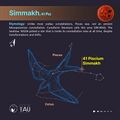
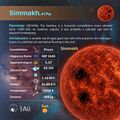
Simmakh is a modern star name adopted by the International Astronomical Union in the IAU-Catalog of Star Names (IAU-CSN). Its origin is Sumerian, from [[SIM.MAḪ]]. It is the name of the star d Psc (HIP 1645) in constellation [[Pisces]]. | Simmakh is a modern star name adopted by the International Astronomical Union in the IAU-Catalog of Star Names (IAU-CSN). Its origin is Sumerian, from [[SIM.MAḪ]]. It is the name of the star d Psc (HIP 1645) in constellation [[Pisces]]. | ||
==Concordance, Etymology, History== | ==Concordance, Etymology, History== | ||
see concordance of the '''original Babylonian''' constellations | |||
* <sup>mul</sup>[[SIM.MAḪ]] (𒀯𒋆𒈤), The Swallow [bird], that occurs in Middle Babylonian literature and whose tails [[KUNmeš|KUN<sup>meš</sup>]] are reported in the "path of the moon" | |||
* <sup>mul</sup>[[ZIB]]<sup>meš</sup> (𒀯𒍦𒈨), The Tails that occurs in Late Babylonian literature | |||
[[File:A_reflection_flight_of_barn_swallow.jpg|thumb|a reflection flight of barn swallow captured in bagmati river in kathmandy valley in nepal (CC BY SA Prasan Shrestha)]] | [[File:A_reflection_flight_of_barn_swallow.jpg|thumb|a reflection flight of barn swallow captured in bagmati river in kathmandy valley in nepal (CC BY SA Prasan Shrestha)]] | ||
Babylonian constellation that has undergone massive transformations: the original Giant Swallow was turned into a Swallow-Fish and into two fish connected with a ribbon. It is located in the area of modern [[Pisces]]. Alternative Mesopotamian terms are <sup>mul</sup>ŠIM.MAḪ (𒀯𒋆𒈤) and <sup>(mul)</sup>''Šinūnūtu''. | Babylonian constellation that has undergone massive transformations: the original Giant Swallow was turned into a Swallow-Fish and into two fish connected with a ribbon. It is located in the area of modern [[Pisces]]. Alternative Mesopotamian terms are <sup>mul</sup>ŠIM.MAḪ (𒀯𒋆𒈤) and <sup>(mul)</sup>''Šinūnūtu''. | ||
| Line 12: | Line 42: | ||
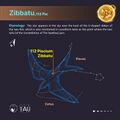
The characteristic folked tail of a swallow actually matches the pattern of stars in the sky very well; so it is very likely the original image seen in the asterism that is now considered a V-shaped ribbon. | The characteristic folked tail of a swallow actually matches the pattern of stars in the sky very well; so it is very likely the original image seen in the asterism that is now considered a V-shaped ribbon. | ||
The transformation of the constellation of The Swallow (see [[SIM.MAḪ]]) in ancient Mesopotamia is characterised by the original image of a Giant Swallow which must be located in Cetus, as its tails are imagined in the ribbon of Pisces, to a later version of a much smaller bird (swallow) whose body is roughly in the southern fish-ellipse of Pisces. The second image is reconstructed from coordinates given in Late Babylonian texts, e.g. the normal star list in which reads "DUR sim.ma", "Swallow Ribbon" [Roughton-Steele-Walker 2004<ref name=":14">''Roughton N.A., Steele J.M., Walker C.B.F.'' A Late Babylonian Normal and ''Ziqpu'' Star Text // AHES 58 (2004) 537-572.</ref>, 551:21′, 553], suggesting a bird connected to a fish in the northern fish-ellipse. Such an image of a bird and a fish connected by a V-shaped ribbon is preserved on seals in Uruk. | The transformation of the constellation of The Swallow (see [[SIM.MAḪ]]) in ancient Mesopotamia is characterised by the original image of a Giant Swallow which must be located in Cetus, as its tails are imagined in the ribbon of Pisces, to a later version of a much smaller bird (swallow) whose body is roughly in the southern fish-ellipse of Pisces. The second image is reconstructed from coordinates given in Late Babylonian texts, e.g. the normal star list in which reads "DUR sim.ma", "Swallow Ribbon" [Roughton-Steele-Walker 2004<ref name=":14">''Roughton N.A., Steele J.M., Walker C.B.F.'' A Late Babylonian Normal and ''Ziqpu'' Star Text // AHES 58 (2004) 537-572.</ref>, 551:21′, 553], suggesting a bird connected to a fish in the northern fish-ellipse. Such an image of a bird and a fish connected by a V-shaped ribbon is preserved on seals in Uruk. | ||
<gallery> | |||
File:Psc-And-Aqr grp-GIF engl.gif|alt=Andromeda, Pisces and adjacent constellation in their transformation.|animated transformation from Babylonian to Greek constellations (SMH 2017) | |||
File:Swallow inStellarium MULAPIN.png|"Swallow" in Middle Babylonian (MUL.APIN), map: Stellarium 2026, drawing: Robert Perdok (LWL Planetarium Münster, Germany) 2016, adoption: SMH for IAU-WGSN 2026 | |||
File:Swallow inStellarium LB-swallowfish.png|"Swallow" in "Swallow-Fish" in Late Babylonian (e.g. normal star lists described with ribbon), map: Stellarium 2026, drawing: Robert Perdok (LWL Planetarium Münster, Germany) 2016, adoption: SMH for IAU-WGSN 2026 | |||
File:Simmakh stickfigure SadeghFaghanpour-IAU-WGSN.jpg|(CC BY Sadegh Faghanpour for IAU WGSN) | |||
File:Zibbatu stickfigure SadeghFaghanpour-IAU-WGSN.jpg|(CC BY Sadegh Faghanpour for IAU WGSN) | |||
</gallery> | |||
Yet earlier texts like MUL.APIN only list a Swallow and no fish in this area. The stars of Anu (no. 2), MUL.APIN I i 41 = (Anu 2right)<ref>Hoffmann, S. M. and Krebernik, M. (2023). What do deities tell us about the celestial positioning system, in: R. Rollinger, I. Madreiter, M. Lang, C. Pappi (eds.). The Intellectual Heritage of the Ancient Near East, Papers held at the 64th Rencontre Assyriologique International and 12th Melammu Symposium July 16-20 2018, Innsbruck. Austrian Academy of Sciences Press, 539-579</ref>: <blockquote> | |||
* MUL ''ša''<sub>2</sub> ''ina'' IGI-''it'' <sup>mul</sup>AŠ.IKU GUB-''zu'' <sup>mul</sup>''Ši-nu-nu-tu''<sub>4</sub> | |||
* "The star that stands before the Field, the Swallow" </blockquote> | |||
==Mythology== | ==Mythology== | ||
no mythology known | |||
==IAU Working Group on Star Names== | ==IAU Working Group on Star Names== | ||
| Line 26: | Line 65: | ||
<gallery> | <gallery> | ||
File: | File:Simmakh profileCard SadeghFaghanpour-IAU-WGSN.jpg|(CC BY Sadegh Faghanpour for IAU WGSN) | ||
File: | File:Simmakh stickfigure SadeghFaghanpour-IAU-WGSN.jpg|(CC BY Sadegh Faghanpour for IAU WGSN) | ||
</gallery> | </gallery> | ||
Latest revision as of 07:26, 5 October 2026
Authors: Susanne M Hoffmann, ASE Tech Team

| Asterism Info | |
| Native | SIM.MAḪ |
|---|---|
| Translation | Swallow |
| Position (2000) | |
| Right ascension | 5.149425122 |
| Declination | 8.190271705 |
| Area | 0 sq. deg. |
| Stars | |
| Bright stars | 1 |
| Bayer/Flamsteed stars | 1 |
| Stars brighter than 3.00m | 0 |
| Brightest star | Simmakh (5.37m) |
| Taxonomy | |
| category of asterism | IAU-Star Name |
| IAU- constellations | Psc |
Simmakh is a modern star name adopted by the International Astronomical Union in the IAU-Catalog of Star Names (IAU-CSN). Its origin is Sumerian, from SIM.MAḪ. It is the name of the star d Psc (HIP 1645) in constellation Pisces.
Concordance, Etymology, History
see concordance of the original Babylonian constellations
- mulSIM.MAḪ (𒀯𒋆𒈤), The Swallow [bird], that occurs in Middle Babylonian literature and whose tails KUNme(š) are reported in the "path of the moon"
- mulZIBmeš (𒀯𒍦𒈨), The Tails that occurs in Late Babylonian literature

Babylonian constellation that has undergone massive transformations: the original Giant Swallow was turned into a Swallow-Fish and into two fish connected with a ribbon. It is located in the area of modern Pisces. Alternative Mesopotamian terms are mulŠIM.MAḪ (𒀯𒋆𒈤) and (mul)Šinūnūtu.
The characteristic folked tail of a swallow actually matches the pattern of stars in the sky very well; so it is very likely the original image seen in the asterism that is now considered a V-shaped ribbon.
The transformation of the constellation of The Swallow (see SIM.MAḪ) in ancient Mesopotamia is characterised by the original image of a Giant Swallow which must be located in Cetus, as its tails are imagined in the ribbon of Pisces, to a later version of a much smaller bird (swallow) whose body is roughly in the southern fish-ellipse of Pisces. The second image is reconstructed from coordinates given in Late Babylonian texts, e.g. the normal star list in which reads "DUR sim.ma", "Swallow Ribbon" [Roughton-Steele-Walker 2004[1], 551:21′, 553], suggesting a bird connected to a fish in the northern fish-ellipse. Such an image of a bird and a fish connected by a V-shaped ribbon is preserved on seals in Uruk.
-
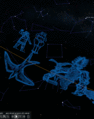 animated transformation from Babylonian to Greek constellations (SMH 2017)
-
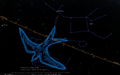 "Swallow" in Middle Babylonian (MUL.APIN), map: Stellarium 2026, drawing: Robert Perdok (LWL Planetarium Münster, Germany) 2016, adoption: SMH for IAU-WGSN 2026
-
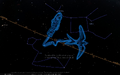 "Swallow" in "Swallow-Fish" in Late Babylonian (e.g. normal star lists described with ribbon), map: Stellarium 2026, drawing: Robert Perdok (LWL Planetarium Münster, Germany) 2016, adoption: SMH for IAU-WGSN 2026
-
 (CC BY Sadegh Faghanpour for IAU WGSN)
-
 (CC BY Sadegh Faghanpour for IAU WGSN)


Yet earlier texts like MUL.APIN only list a Swallow and no fish in this area. The stars of Anu (no. 2), MUL.APIN I i 41 = (Anu 2right)[2]:
- MUL ša2 ina IGI-it mulAŠ.IKU GUB-zu mulŠi-nu-nu-tu4
- "The star that stands before the Field, the Swallow"
Mythology
no mythology known
IAU Working Group on Star Names
The name was suggested to the IAU WGSN in 2023. It was adopted for a star south of the Pegasus square which matches both image reconstructions: the earlier large swallow (at the tip of its tail) and the late small swallow (in the body/head).
The name was adopted by the IAU WGSN in September 2026.
-
 (CC BY Sadegh Faghanpour for IAU WGSN)
-
(CC BY Sadegh Faghanpour for IAU WGSN)
Weblinks
Reference
- Ian Ridpath's website (Star Tales )
- ↑ Roughton N.A., Steele J.M., Walker C.B.F. A Late Babylonian Normal and Ziqpu Star Text // AHES 58 (2004) 537-572.
- ↑ Hoffmann, S. M. and Krebernik, M. (2023). What do deities tell us about the celestial positioning system, in: R. Rollinger, I. Madreiter, M. Lang, C. Pappi (eds.). The Intellectual Heritage of the Ancient Near East, Papers held at the 64th Rencontre Assyriologique International and 12th Melammu Symposium July 16-20 2018, Innsbruck. Austrian Academy of Sciences Press, 539-579