Ashvini: Difference between revisions
No edit summary |
→Identification: corrected the spellings |
||
| (13 intermediate revisions by 3 users not shown) | |||
| Line 2: | Line 2: | ||
Authors: {{PAGEAUTHORS}} | Authors: {{PAGEAUTHORS}} | ||
---- | ---- | ||
[[File:Ashvini nakshatras in Temple draw+lbl 4ase.jpg|thumb|Ashvini | [[File:Ashvini nakshatras in Temple draw+lbl 4ase.jpg|thumb|Ashvini ''nakṣatra'' in Tirupperunthurai (Athmanathaswamy temple) near Aranthangi, India, 10th century CE. (SMH 2025).]] | ||
{{Infobox constellation | |||
| name = अश्विनी (Ashvini) | |||
| native = अश्विनी | |||
| translation = Aśvini | |||
| pronounce = Ashvini | |||
| IPA = ɐʃʋiːniː | |||
| culture = Indian_nakshatras | |||
| RA = 28.38255387 to 34.53137755 | |||
| dec = 17.81755601 to 23.46241755 | |||
| areatotal = 18.61 | |||
| numbermainstars = 10 | |||
| numberbfstars = 9 | |||
| numberstarsplanets = | |||
| numberbrightstars = 2 | |||
| numbernearbystars = | |||
| brighteststarname = [[Hamal]] | |||
| starmagnitude = 2.01 | |||
| neareststarname = | |||
| stardistance = | |||
| numbermessierobjects = | |||
| meteorshowers = | |||
| bordering = Ari | |||
| notes = | |||
| cat = constellation | |||
}} | |||
[[File:1 Ashvini stellarium.gif|thumb|Ashvini drawing in the stars, animated GIF (SMH 2025)]] | [[File:1 Ashvini stellarium.gif|thumb|Ashvini drawing in the stars, animated GIF (SMH 2025)]] | ||
Aśvini (अश्विनी) is the name of an Indian twin deity that is asscoiated with the first nakshatra. As gods they initially represent physicians; as asterism they are associated with the star β and γ Arietis in [[Aries]]. However, the oldest reconstruction of the image shows a horse head with three stars, suggesting that α Arietis might also have belonged to the asterism. | Aśvini (अश्विनी) is the name of an Indian twin deity that is asscoiated with the first nakshatra. As gods they initially represent physicians; as asterism they are associated with the star β and γ Arietis in [[Aries]].<ref name=":0">Bill M. Mak (2026). Foreign Astral Sciences in ChinaFrom the Six Dynasties to the Northern Song, Routledge</ref><ref name=":1">David Brown (2018). The interactions of ancient astral science, Hempen Verlag, Bremen.</ref><ref name=":2">Pingree, D. and Morrissey, P., “On the Identification of the Yogataras of the Indian Naksatras”, Journal for the History of Astronomy, vol. 20, p. 99, 1989. doi:10.1177/002182868902000202.</ref> However, the oldest reconstruction of the image shows a horse head with three stars, suggesting that α Arietis might also have belonged to the asterism. | ||
==Etymology and History== | ==Etymology and History== | ||
| Line 22: | Line 47: | ||
===Origin of Constellation=== | ===Origin of Constellation=== | ||
''Aśvinī'' is mythologically associated with the twin physicians of the Gods. As an asterism, it is represented with a horse head. All alternative names of the ''nakṣatra'' mean "horse", and so do the word “aśva” (अश्व) and all other names listed above. The list is not exhaustive. | |||
====Identification==== | ====Identification==== | ||
It is common in historical sources that one coordinate stands (pars pro toto) for a group: e.g. in case of twilight observations only the brightest star is visible, and in case of several other settings (e.g. for globe makers) it is unnecessary to list all stars with coordinates, in particular concerning the margins of error of the measurements, which is often in the order of the size of the nakshatras. | |||
( | The coordinates of nakshatras (Sen and Shukla, 2000<ref>Sen P C and Shukla K S, 2000, History of Indian Astronomy, Indian National Science Academy. New Delhi. </ref>) fix a unique star for identification. The star lists (Sarma, 2020<ref>Sarma S R, 2020, online catalogue of astrolabes, <nowiki>https://srsarma.in/catalogue.php</nowiki></ref>) in the manuals for the use of astrolabes by Mahendra Suri and Malayendu, with coordinates, provide important clues. These coordinates differ from the currently used ecliptic longitude – latitude system (Saha and Lahiri, 1950;<ref>Saha, M. N. and Lahiri, N. C, ''Indian Calendar'', reprint 1992, CSIR, New Delhi, 1954, p. 263.</ref> Abhyankar, 2006<ref>Abhyankar, K.D., 2006. Dhruvaka-Vikṣepa system of astronomical coordinates. Indian Journal of History of Science, 41(2), 151 –157</ref>). The bright star among the group constituting the ''nakṣatra'' is called the ''yogatāra'' (Brahmagupta, KK, 1.9.3-6)<ref>Subbarayappa, B V and Sarma, K V, 1985, Indian Astronomy- A Source Book, Nehru Centre, Mumbai</ref>. Thus, the same name is to be understood as an asterism (''nakṣatra'') with a group of stars, and also as a single brightest star in the group (''yogatāra'') depending on the context. | ||
This is true for all 28 ''nakṣatra''s used for marking the positions of the moon (the sun and planets also), listed in the Atharva Veda. The number of stars in each ''nakṣatra'' is specified in the addendum of the Atharva Veda named Parisista, ''Nakṣatrakalpa'' (19.7.1-5).<ref>Subbarayappa B V and Srama K V, 185, Indian Astronomy A Source Book, Nehru Cntre, Mumbai</ref> | |||
===== Constellation of two to six stars ===== | |||
The constellation Ashvini is depicted with two, three or even six stars. Hence, we are certain that there are more than one. | |||
The number of stars in the ''nakṣatra'' are | |||
{| class="wikitable" | {| class="wikitable" | ||
|+ | |+ | ||
! | ! | ||
! | !Atharva Veda | ||
!Tirupperunthurai | |||
! | !Chinese | ||
Tirupperunthurai | !(Jones 1790) | ||
! | |||
Chinese | |||
! | |||
(Jones 1790) | |||
|- | |- | ||
| | |# | ||
| | |2 stars | ||
|6 stars | |6 stars | ||
|3 stars | |3 stars | ||
|3 stars | |3 stars | ||
|- | |||
|ident. | |||
|β, γ Ari | |||
|η, κ, λ, β, γ, ι Ari | |||
|β, γ, α Ari | |||
|β, γ, α Ari | |||
|} | |} | ||
[[File:Asvini.jpg|thumb|An approximate match of stars for the pattern engraved in the temple (diagram by Shylaja)]] | |||
===== Single Coordinate ===== | |||
The asterism ''Aśvinī'' was used to estimate the errors, so that the other (of the 28) faint stars can be identified with the least confusion in this coordinate conversion. Its coordinates in '''early modern astrolabe''' instruments agree with '''β Arietis''', though it is not the brightest (Venketeswara Pai and Shylaja 2016)<ref>R. Venketeswara Pai and B. S. Shylaja , 2016, Measurement of coordinates of Nakśatras in Indian astronomy, Current Science, vol 111, issue 9, 1551-8 </ref>. | |||
However, in '''Vedic times''', i.e. the first and late second millennium BCE, only right ascension was measured, as stars were observed in culmination (meridian transit). At that time, the '''stars β and γ Arietis''' had the same right ascension and were, thus, '''indistinguishable by measurements'''. This is likely the reason why the Arthava Veda counts two stars towards the asterism: namely β and γ Arietis.<ref name=":0" /><ref name=":1" /><ref name=":2" /> | |||
===== Visualisation ===== | |||
The search for a diagrammatic representation of the ''nakṣatra''s led to a 1000-year-old engraving in a temple named Avudaiyarkoil in Tamil Nadu near Pudukkottai; the image from a tourist notebook is reproduced below.<ref>Yadhumurthy <nowiki>https://yadhumooray.wordpress.com/2011/12/20/avudaiyarkoil/</nowiki> | |||
</ref> | |||
Alexander Jones<ref>Jones, A, Asiatic researches, or, Transactions of the Society, instituted in Bengal for inquiring into the history and antiquities, the arts, sciences and literature of Asia, London, [s.n.], 1799- | |||
<nowiki>https://www.biodiversitylibrary.org/bibliography/42394</nowiki> | |||
v.2 1799: <nowiki>https://www.biodiversitylibrary.org/item/93171</nowiki></ref> prepared the sketches of the ''nakṣatra''s based on the description provided to him by local astronomers. The scales of the drawings are not specified. An alternate identification with the 6-star pattern for ''Aśvinī'' is also shown below. | |||
[[File:VedicNakshatras stellarium2026.jpg|center|thumb|800x800px|Vedic Nakshatras Rohini, Krittika, Bharani, Ashvini and Revati in Stellarium 2026 (after temple depictions from ~1000 CE); CC BY Susanne M Hoffmann.]] | |||
==== Stars within the Constellation Area ==== | ==== Stars within the Constellation Area ==== | ||
| Line 117: | Line 168: | ||
| 5.892 | | 5.892 | ||
|} | |} | ||
===Transfer and Transformation of the Constellation=== | |||
=== Transfer and Transformation of the Constellation === | |||
<gallery> | <gallery> | ||
File:Ashvini nakshatras in Temple draw+lbl 4ase.jpg|Ashvini 10th century CE | File:Ashvini nakshatras in Temple draw+lbl 4ase.jpg|Ashvini 10th century CE | ||
File:Tibet nakshatra 27.png|Ashvini Tibetean | File:Tibet nakshatra 27.png|Ashvini Tibetean | ||
File:婁宿(仏像図彙).png|Ashvini (Chinese) | File:婁宿(仏像図彙).png|Ashvini (Chinese) | ||
File:1 ashvini draw.png|Ashvini reconstructed by Jones ( | File:1 ashvini draw.png|Ashvini reconstructed by Jones (1790). | ||
File:Nakshatra temple magDraw lbl.jpg|Display of all 28th nakshatra in silver arch with candles in Tirupperunthurai (Athmanathaswamy temple) near Aranthangi, India, 10th century CE. (SMH 2025). | File:Nakshatra temple magDraw lbl.jpg|Display of all 28th nakshatra in silver arch with candles in Tirupperunthurai (Athmanathaswamy temple) near Aranthangi, India, 10th century CE. (SMH 2025). | ||
File:Nakshatras in Temple draw+lbl 4ase.jpg|Display of all 28th nakshatra in a door frame in Tirupperunthurai (Athmanathaswamy temple) near Aranthangi, India, 10th century CE. (SMH 2025). | File:Nakshatras in Temple draw+lbl 4ase.jpg|Display of all 28th nakshatra in a door frame in Tirupperunthurai (Athmanathaswamy temple) near Aranthangi, India, 10th century CE. (SMH 2025). | ||
Latest revision as of 10:31, 19 November 2026
Authors: Susanne M Hoffmann, Shylaja, Youla Azkarrula

| Asterism Info | |
| Native | अश्विनी |
|---|---|
| Romanisation | Ashvini |
| IPA | ɐʃʋiːniː |
| Translation | Aśvini |
| Position (2000) | |
| Right ascension | 28.38255387 to 34.53137755 |
| Declination | 17.81755601 to 23.46241755 |
| Area | 18.61 sq. deg. |
| Stars | |
| Bright stars | 10 |
| Bayer/Flamsteed stars | 9 |
| Stars brighter than 3.00m | 2 |
| Brightest star | Hamal (2.01m) |
| Taxonomy | |
| category of asterism | constellation |
| IAU- constellations | Ari |

Aśvini (अश्विनी) is the name of an Indian twin deity that is asscoiated with the first nakshatra. As gods they initially represent physicians; as asterism they are associated with the star β and γ Arietis in Aries.[1][2][3] However, the oldest reconstruction of the image shows a horse head with three stars, suggesting that α Arietis might also have belonged to the asterism.
Etymology and History
Name Variant:
- Adya,
- Asva,
- Asvi,
- Dasra,
- Hari,
- Haya,
- Turaga,
- Turanaga,
- Vaaji

Origin of Constellation
Aśvinī is mythologically associated with the twin physicians of the Gods. As an asterism, it is represented with a horse head. All alternative names of the nakṣatra mean "horse", and so do the word “aśva” (अश्व) and all other names listed above. The list is not exhaustive.
Identification
It is common in historical sources that one coordinate stands (pars pro toto) for a group: e.g. in case of twilight observations only the brightest star is visible, and in case of several other settings (e.g. for globe makers) it is unnecessary to list all stars with coordinates, in particular concerning the margins of error of the measurements, which is often in the order of the size of the nakshatras.
The coordinates of nakshatras (Sen and Shukla, 2000[4]) fix a unique star for identification. The star lists (Sarma, 2020[5]) in the manuals for the use of astrolabes by Mahendra Suri and Malayendu, with coordinates, provide important clues. These coordinates differ from the currently used ecliptic longitude – latitude system (Saha and Lahiri, 1950;[6] Abhyankar, 2006[7]). The bright star among the group constituting the nakṣatra is called the yogatāra (Brahmagupta, KK, 1.9.3-6)[8]. Thus, the same name is to be understood as an asterism (nakṣatra) with a group of stars, and also as a single brightest star in the group (yogatāra) depending on the context.
This is true for all 28 nakṣatras used for marking the positions of the moon (the sun and planets also), listed in the Atharva Veda. The number of stars in each nakṣatra is specified in the addendum of the Atharva Veda named Parisista, Nakṣatrakalpa (19.7.1-5).[9]
Constellation of two to six stars
The constellation Ashvini is depicted with two, three or even six stars. Hence, we are certain that there are more than one. The number of stars in the nakṣatra are
| Atharva Veda | Tirupperunthurai | Chinese | (Jones 1790) | |
|---|---|---|---|---|
| # | 2 stars | 6 stars | 3 stars | 3 stars |
| ident. | β, γ Ari | η, κ, λ, β, γ, ι Ari | β, γ, α Ari | β, γ, α Ari |

Single Coordinate
The asterism Aśvinī was used to estimate the errors, so that the other (of the 28) faint stars can be identified with the least confusion in this coordinate conversion. Its coordinates in early modern astrolabe instruments agree with β Arietis, though it is not the brightest (Venketeswara Pai and Shylaja 2016)[10].
However, in Vedic times, i.e. the first and late second millennium BCE, only right ascension was measured, as stars were observed in culmination (meridian transit). At that time, the stars β and γ Arietis had the same right ascension and were, thus, indistinguishable by measurements. This is likely the reason why the Arthava Veda counts two stars towards the asterism: namely β and γ Arietis.[1][2][3]
Visualisation
The search for a diagrammatic representation of the nakṣatras led to a 1000-year-old engraving in a temple named Avudaiyarkoil in Tamil Nadu near Pudukkottai; the image from a tourist notebook is reproduced below.[11]
Alexander Jones[12] prepared the sketches of the nakṣatras based on the description provided to him by local astronomers. The scales of the drawings are not specified. An alternate identification with the 6-star pattern for Aśvinī is also shown below.

Stars within the Constellation Area
| id | Label | HIP | description | Vmag |
|---|---|---|---|---|
| 1 | Hamal | HIP 9884 | Constellation lines (Vertex) | 2.01 |
| 2 | Sheratan | HIP 8903 | Constellation lines (Vertex) | 2.65 |
| 3 | Mesarthim | HIP 8832 | Constellation lines (Vertex) | 4.52 |
| 4 | * gam01 Ari | HIP 8832 | Constellation lines (Vertex) | 4.589 |
| 5 | κ Arietis | HIP 9836 | Inside the hull | 5.019 |
| 6 | ι Arietis | HIP 9110 | Constellation lines (Vertex) | 5.105 |
| 7 | η Arietis | HIP 10306 | Constellation lines | 5.2 |
| 8 | θ Arietis | HIP 10732 | Constellation lines (Vertex) | 5.572 |
| 9 | 15 Ari | HIP 10155 | Inside the hull | 5.688 |
| 10 | - | HIP 9307 | Inside the hull | 5.892 |
Transfer and Transformation of the Constellation
-
 Ashvini 10th century CE
-
 Ashvini Tibetean
-
 Ashvini (Chinese)
-
 Ashvini reconstructed by Jones (1790).
-
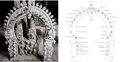 Display of all 28th nakshatra in silver arch with candles in Tirupperunthurai (Athmanathaswamy temple) near Aranthangi, India, 10th century CE. (SMH 2025).
-
 Display of all 28th nakshatra in a door frame in Tirupperunthurai (Athmanathaswamy temple) near Aranthangi, India, 10th century CE. (SMH 2025).


Mythology
mnemonic tales and cultural significance
Weblinks
References
- References (general)
- ↑ 1.0 1.1 Bill M. Mak (2026). Foreign Astral Sciences in ChinaFrom the Six Dynasties to the Northern Song, Routledge
- ↑ 2.0 2.1 David Brown (2018). The interactions of ancient astral science, Hempen Verlag, Bremen.
- ↑ 3.0 3.1 Pingree, D. and Morrissey, P., “On the Identification of the Yogataras of the Indian Naksatras”, Journal for the History of Astronomy, vol. 20, p. 99, 1989. doi:10.1177/002182868902000202.
- ↑ Sen P C and Shukla K S, 2000, History of Indian Astronomy, Indian National Science Academy. New Delhi.
- ↑ Sarma S R, 2020, online catalogue of astrolabes, https://srsarma.in/catalogue.php
- ↑ Saha, M. N. and Lahiri, N. C, Indian Calendar, reprint 1992, CSIR, New Delhi, 1954, p. 263.
- ↑ Abhyankar, K.D., 2006. Dhruvaka-Vikṣepa system of astronomical coordinates. Indian Journal of History of Science, 41(2), 151 –157
- ↑ Subbarayappa, B V and Sarma, K V, 1985, Indian Astronomy- A Source Book, Nehru Centre, Mumbai
- ↑ Subbarayappa B V and Srama K V, 185, Indian Astronomy A Source Book, Nehru Cntre, Mumbai
- ↑ R. Venketeswara Pai and B. S. Shylaja , 2016, Measurement of coordinates of Nakśatras in Indian astronomy, Current Science, vol 111, issue 9, 1551-8
- ↑ Yadhumurthy https://yadhumooray.wordpress.com/2011/12/20/avudaiyarkoil/
- ↑ Jones, A, Asiatic researches, or, Transactions of the Society, instituted in Bengal for inquiring into the history and antiquities, the arts, sciences and literature of Asia, London, [s.n.], 1799- https://www.biodiversitylibrary.org/bibliography/42394 v.2 1799: https://www.biodiversitylibrary.org/item/93171