Wia: Difference between revisions
Ericmamajek (talk | contribs) |
|||
| (5 intermediate revisions by 2 users not shown) | |||
| Line 17: | Line 17: | ||
In the decan diagonal clocks and in the celestial diagrams of NK there is a clear decan named Hery-ib-Wia, which means The Core/Middle of the Boat. Leitz (1995, 90)<ref>Leitz, Ch., 1995. Altägyptische Sternuhren. OLA, 62. Leuven: Peeters.</ref> identifies it with [[Nunki]] (σ Sgr) or τ Sgr, while Belmonte and Lull (2023) strongly believe this is [[Kaus Australis]] (ε Sgr). In any case, as a rough estimate, the middle of [[Sagittarius]], where the teapot is usually seen, seems to be consensus. | In the decan diagonal clocks and in the celestial diagrams of NK there is a clear decan named Hery-ib-Wia, which means The Core/Middle of the Boat. Leitz (1995, 90)<ref>Leitz, Ch., 1995. Altägyptische Sternuhren. OLA, 62. Leuven: Peeters.</ref> identifies it with [[Nunki]] (σ Sgr) or τ Sgr, while Belmonte and Lull (2023) strongly believe this is [[Kaus Australis]] (ε Sgr). In any case, as a rough estimate, the middle of [[Sagittarius]], where the teapot is usually seen, seems to be consensus. | ||
In the circular zodiac of the Hathor Temple in Dendera that shows strong Babylonian influences,<ref>Hoffmann, S.M. (2022). Preliminary Observations on the Dendera Zodiac (Egypt). in Hoffmann and Wolfschmidt (eds.). Astronomy in Culture – Cultures of Astronomy, tredition Hamburg/ OpenScienceTechnology Berlin, 524-541</ref> this boat is depicted as tiny barge below the front feet of Sagittarius. This area, roughly in Sgr/ CrA, hosts the Babylonian constellation [[MA2.GUR8|MA<sub>2</sub>.GUR<sub>8</sub>]], The Ship. This Boat at the feet of Sagittarius in the Circular Zodiac can be either Wia, or the parazodiacal Babylonian Boat, | In the circular zodiac of the Hathor Temple in Dendera that shows strong Babylonian influences,<ref>Hoffmann, S.M. (2022). Preliminary Observations on the Dendera Zodiac (Egypt). in Hoffmann and Wolfschmidt (eds.). Astronomy in Culture – Cultures of Astronomy, tredition Hamburg/ OpenScienceTechnology Berlin, 524-541</ref> this boat is depicted as tiny barge below the front feet of Sagittarius. This area, roughly in Sgr/ CrA, hosts the Babylonian constellation [[MA2.GUR8|MA<sub>2</sub>.GUR<sub>8</sub>]], The Ship. This Boat at the feet of Sagittarius in the Circular Zodiac can be either Wia, or the parazodiacal Babylonian Boat, or even both in an abstract or mnemonic representation. | ||
==== Decan Star Clocks ==== | |||
Decan star clocks (also "diagonal star clocks") represent one of the earliest known systematic methods of stellar timekeeping, as they are preserved from the Middle Kingdom (2100-1800 BCE). During the night, the successive appearance of decans provided a way to divide the night into approximately twelve parts for the twelve hours of the night. These constellations shift successively, so that the Egyptian schema needs to be read diagonally: every ten days, another constellation is considered to rule the same hour, or in other words, each constellation (decan) rules a different hour depending on the time of the year. Hoffmann (2022)<ref>Hoffmann, S.M. (2022). Comparison of some General Concepts.,in Hoffmann and Wolfschmidt (eds.). Astronomy in Culture – Cultures of Astronomy, tredition Hamburg, 542-560</ref> writes: "The pattern of this systematic shift of constellations through the hours of the day within a year is depicted on Egyptian diagonal star clocks, when the sequence of decans was observed in culmination instead of in rising (Symons 2007<ref>Symons, Sarah (2007), A star's year: the annual cycle in the ancient egyptian sky, in J. M. Steele, ed., `Calendars and Years: Astronomy and Time in the Ancient World', Oxbow, Oxford (UK), pp. 1--33.</ref>), leading to a reduction of deviations throughout the year." | |||
==== Depictions on Astronomical Ceilings and Sarcophaguses ==== | |||
River boats are frequently depicted in Egyptian art. They were used for rituals where statues of gods were moved in processions (on boats), while the cheering people could watch them passing by from the shores of the Nile river. | |||
==== Extension of the Boat and Identification of its Decans<ref name=":0" /> ==== | ==== Extension of the Boat and Identification of its Decans<ref name=":0" /> ==== | ||
| Line 52: | Line 58: | ||
File:20182AuOrLull constWia LateEgyptVariants.jpeg|Wja - Late Egyptian Variants of Ptolemic Era (CC BY Lull 2018). | File:20182AuOrLull constWia LateEgyptVariants.jpeg|Wja - Late Egyptian Variants of Ptolemic Era (CC BY Lull 2018). | ||
</gallery> | </gallery> | ||
[[File:Wja+Kenmu sarcophagus NeuesMuseumBerlin.gif|thumb|Constellations Wia + Kenmu on Nectanebo's sarcophagus (Staatliche Museen zu Berlin – Ägyptisches Museum und Papyrussammlung, ÄM 7.)]] | |||
== Religion/ Tales/ Mythology == | == Religion/ Tales/ Mythology == | ||
In ancient Egyptian cosmology, boats carried the sun god Ra, and the deceased pharaoh's soul on its journey through the afterlife. The WjA constellation symbolized these vital spiritual and solar voyages. | In ancient Egyptian cosmology, boats carried the sun god Ra, and the deceased pharaoh's soul on its journey through the afterlife. The WjA constellation symbolized these vital spiritual and solar voyages. | ||
Therefore, the constellation is also engraved on the granite sarcophagus lid of Djehapimu, the Royal Audit Officer and a relative of King Nectanebo II (Nakhthorheb, ''Nḫt-Ḥr-Ḥbt)'', c. 346-332 BCE, granite, displayed in the exhibition of the Neues Museum Berlin, Germany. | |||
== IAU WGSN star name discussion == | == IAU WGSN star name discussion == | ||
| Line 64: | Line 73: | ||
* Heryabwja | * Heryabwja | ||
* Heryibwia | * Heryibwia | ||
In 2026, the name "Heryib Wia" was proposed to WGSN for the star η Sgr (HR 6832, HD 167618, HIP 89642), a red giant (spectral type M2III) star with apparent magnitude V=3.10 at distance 42 parsecs. The star is the primary of a multiple star system (WDS J18176-3646, BU 760), and the faint (8th magnitude) companion η Sgr B (HD 167618 B) lies about 3.5 arcseconds away. The name would apply to the primary star. | In 2026, the name "Heryib Wia" was proposed to WGSN for the star η Sgr (HR 6832, HD 167618, HIP 89642), a red giant (spectral type M2III) star with apparent magnitude V=3.10 at distance 42 parsecs. The star is the primary of a multiple star system (WDS J18176-3646, BU 760), and the faint (8th magnitude) companion η Sgr B (HD 167618 B) lies about 3.5 arcseconds away. The name would apply to the primary star.<gallery> | ||
File:Heryibwia_profileCard_SadeghFaghanpour-IAU-WGSN.jpg|Heryibwia profile card (CC BY M.Sadegh Faghanpour for IAU-WGSN). | |||
File:Heryibwia_stickfigure_SadeghFaghanpour-IAU-WGSN.jpg|Heryibwia stick figure (CC BY M.Sadegh Faghanpour for IAU-WGSN). | |||
File:Magur_stickfigure_SadeghFaghanpour-IAU-WGSN.jpg|Babylonian "River Boat" constellation: see [[Magur]]. | |||
File:Kenemu_profileCard_SadeghFaghanpour-IAU-WGSN.jpg|Kenemu profile card (CC BY M.Sadegh Faghanpour for IAU-WGSN). | |||
File:Kenemu_stickfigure_SadeghFaghanpour-IAU-WGSN.jpg|Kenemu stick figure (CC BY M.Sadegh Faghanpour for IAU-WGSN). | |||
File:Qedty_profileCard_SadeghFaghanpour-IAU-WGSN.jpg|Qedty profile card (CC BY M.Sadegh Faghanpour for IAU-WGSN). | |||
File:Qedty_stickfigure_SadeghFaghanpour-IAU-WGSN.jpg|Qedty stick figure (CC BY M.Sadegh Faghanpour for IAU-WGSN). | |||
</gallery> | |||
== Weblinks == | == Weblinks == | ||
Latest revision as of 11:16, 24 September 2026
Authors: Susanne M Hoffmann, Juan Antonio Belmonte Avilés, Eric Mamajek


Wia (wỉʒ), The Boat, is an Egyptian constellation.[1] It forms a super-constellation with its Crew, Kenemu. It is current consensus that the star "in the middle of Wja" is in Sagittarius.
Concordance, Etymology, History
Variants:
- Wia
- Wja
Origin of Constellation
The original Egyptian constellation of Wia, the Boat, was huge, stretching from eastern Libra through Scorpius through Sagittarius. Wia is huge in RA (covering several hours) as proven by the decan diagonal clocks and celestial diagrams (see Fig. 4.10 in Belmonte & Lull 2023). This is also illustrated in Fig. 4.41.
In the decan diagonal clocks and in the celestial diagrams of NK there is a clear decan named Hery-ib-Wia, which means The Core/Middle of the Boat. Leitz (1995, 90)[2] identifies it with Nunki (σ Sgr) or τ Sgr, while Belmonte and Lull (2023) strongly believe this is Kaus Australis (ε Sgr). In any case, as a rough estimate, the middle of Sagittarius, where the teapot is usually seen, seems to be consensus.
In the circular zodiac of the Hathor Temple in Dendera that shows strong Babylonian influences,[3] this boat is depicted as tiny barge below the front feet of Sagittarius. This area, roughly in Sgr/ CrA, hosts the Babylonian constellation MA2.GUR8, The Ship. This Boat at the feet of Sagittarius in the Circular Zodiac can be either Wia, or the parazodiacal Babylonian Boat, or even both in an abstract or mnemonic representation.
Decan Star Clocks
Decan star clocks (also "diagonal star clocks") represent one of the earliest known systematic methods of stellar timekeeping, as they are preserved from the Middle Kingdom (2100-1800 BCE). During the night, the successive appearance of decans provided a way to divide the night into approximately twelve parts for the twelve hours of the night. These constellations shift successively, so that the Egyptian schema needs to be read diagonally: every ten days, another constellation is considered to rule the same hour, or in other words, each constellation (decan) rules a different hour depending on the time of the year. Hoffmann (2022)[4] writes: "The pattern of this systematic shift of constellations through the hours of the day within a year is depicted on Egyptian diagonal star clocks, when the sequence of decans was observed in culmination instead of in rising (Symons 2007[5]), leading to a reduction of deviations throughout the year."
Depictions on Astronomical Ceilings and Sarcophaguses
River boats are frequently depicted in Egyptian art. They were used for rituals where statues of gods were moved in processions (on boats), while the cheering people could watch them passing by from the shores of the Nile river.
Extension of the Boat and Identification of its Decans[1]


The Boat occurs on the astronomical ceilings in tombs and several other occasions. Lull (2018) used these archaeological proofs for the identification:
- astronomical ceiling in Esna
- clepsydra of Amenhetep III (Karnak)
- astronomical ceiling of Senenmut (chamber of Seti, KV 17)
- astronomical ceiling of the Ramesseum
- tomb of Karakhamun (TT23), belongs to the 'family of Senenmut'
- coffin of Harendotes (BM 6678)
- tomb of Montuemhat (TT34) - boat unrelated to decan
- tomb of Pedamenope (TT33) - boat unrelated to decan
- tomb of Queen Khenuwa (South Begrawiyah 503, Meroitic period = 3rd c. BCE)
-
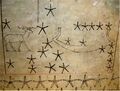 Boat of Wja+Knmw in the tomb of Senenmut (Lull 2018).
 -
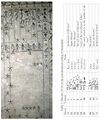 Decans of Wja+Knmw in the tomb of Senenmut (Lull 2018).
 -
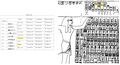 Decans of Wja+Knmw in the Book of Nut (Lull 2018).
 -
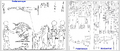 astronomical ceiling and decan lists in the tombs of Pedamenope + Montuemhat (Lull 2018).


He[1] concludes:
"As we have seen, the constellation of the Boat should cover the eastern third of Libra and the constellations of Scorpius and Sagittarius. However, the part belonging to Sagittarius should be the most important of the Boat, for “the (star) which is in the middle of Boat” and “guides” stood in it, in the brightest part of the Milky Way. His representation throughout the centuries, one of the few southern constellations which enjoyed such honor, somehow can also indicate the importance of this constellation for the Egyptians."
Transfer and Transformation of the Constellation

Lull (2018)[1] first explains the importance of the huge boat in ancient Egypt and then states a change:
"during the Ptolemaic era a notable change occurs in the Egyptian heaven: the zodiacal constellations of Mesopotamian origin are introduced. With this change the ancient Egyptian constellations occupying the zodiacal band were eliminated in favor of the new constellations or, at best, minimized. This last option is what must have happened in the case of the constellation of the Boat."
-
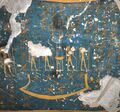 Boat and Decans in tomb of Karakhamun (CC BY Elena Pischikova and Miguel A. Molinero, in Lull 2018).
 -
Decans of Wja+Knmw in the Book of Nut (Lull 2018).
-
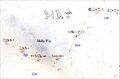 Old Egyptian variant of constellation Wja (CC BY Lull 2018).
 -
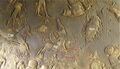 Wja - circular zodiac of Dendera (CC BY Lull 2018).
 -
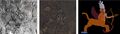 The figure in the place of Sagittarius on the circular zodiac in Denderah (two photos, one drawing for Stellarium, CC BY WGSN).
 -
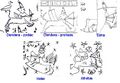 Wja - Late Egyptian Variants of Ptolemic Era (CC BY Lull 2018).


Religion/ Tales/ Mythology
In ancient Egyptian cosmology, boats carried the sun god Ra, and the deceased pharaoh's soul on its journey through the afterlife. The WjA constellation symbolized these vital spiritual and solar voyages.
Therefore, the constellation is also engraved on the granite sarcophagus lid of Djehapimu, the Royal Audit Officer and a relative of King Nectanebo II (Nakhthorheb, Nḫt-Ḥr-Ḥbt), c. 346-332 BCE, granite, displayed in the exhibition of the Neues Museum Berlin, Germany.
IAU WGSN star name discussion
The name was suggested to WGSN in 2025. Wia is a huge Egyptian constellation as Reret of Nekhet, spreading from Scorpius to Sagittarius, so we do not find it appropriate to name a single star after it. Much more appropriate might be Hery-ib-Wia ("In the Middle of the Boat") if we find a star close to Kaus Australis without a name (see Fig 4.1 and Table 4.5 in Belmonte and Lull, 2023, for ideas). In case of this name, Lull, Belmonte, and Leitz agree that it must be in Sagittarius.
Options:
- Heryib Wia
- Heryabwja
- Heryibwia
In 2026, the name "Heryib Wia" was proposed to WGSN for the star η Sgr (HR 6832, HD 167618, HIP 89642), a red giant (spectral type M2III) star with apparent magnitude V=3.10 at distance 42 parsecs. The star is the primary of a multiple star system (WDS J18176-3646, BU 760), and the faint (8th magnitude) companion η Sgr B (HD 167618 B) lies about 3.5 arcseconds away. The name would apply to the primary star.
-
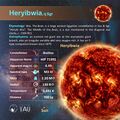 Heryibwia profile card (CC BY M.Sadegh Faghanpour for IAU-WGSN).
 -
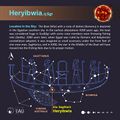 Heryibwia stick figure (CC BY M.Sadegh Faghanpour for IAU-WGSN).
 -
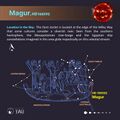 Babylonian "River Boat" constellation: see Magur.
 -
 Kenemu profile card (CC BY M.Sadegh Faghanpour for IAU-WGSN).
 -
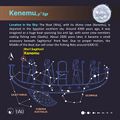 Kenemu stick figure (CC BY M.Sadegh Faghanpour for IAU-WGSN).
 -
 Qedty profile card (CC BY M.Sadegh Faghanpour for IAU-WGSN).
 -
 Qedty stick figure (CC BY M.Sadegh Faghanpour for IAU-WGSN).


Weblinks
References
- References (general)
- ↑ 1.0 1.1 1.2 1.3 1.4 1.5 José Lull (2018). Ancient Egyptian constellation of WjA (Boat) and its link to Sagittarius in the Ptolemaic and Roman era. Aula Orientalis 36/2, 257-277
- ↑ Leitz, Ch., 1995. Altägyptische Sternuhren. OLA, 62. Leuven: Peeters.
- ↑ Hoffmann, S.M. (2022). Preliminary Observations on the Dendera Zodiac (Egypt). in Hoffmann and Wolfschmidt (eds.). Astronomy in Culture – Cultures of Astronomy, tredition Hamburg/ OpenScienceTechnology Berlin, 524-541
- ↑ Hoffmann, S.M. (2022). Comparison of some General Concepts.,in Hoffmann and Wolfschmidt (eds.). Astronomy in Culture – Cultures of Astronomy, tredition Hamburg, 542-560
- ↑ Symons, Sarah (2007), A star's year: the annual cycle in the ancient egyptian sky, in J. M. Steele, ed., `Calendars and Years: Astronomy and Time in the Ancient World', Oxbow, Oxford (UK), pp. 1--33.





