Paushna: Difference between revisions
No edit summary |
|||
| (31 intermediate revisions by 3 users not shown) | |||
| Line 1: | Line 1: | ||
{{DISPLAYTITLE:Pauṣṇa (पौष्ण)}} | |||
Authors: {{PAGEAUTHORS}} | Authors: {{PAGEAUTHORS}} | ||
---- | ---- | ||
[[File:Revati nakshatras in Temple draw+lbl 4ase.jpg|thumb|Revati 10th century (Athmanathaswamy temple)]] | |||
[[File:Revati.jpg|thumb|The possible identification of the five stars of Revati from the temple engraving (identification by B.S. Shylaja). They are ε, δ, ζ, 89 and 96 Psc. ]] | |||
Pauṣṇa ('''पौष्ण''')<ref name=":0">Pai, R.V., Shylaja, B.S. From ''Nadyantaka'' to ''Pauṣṇa'': compilation of stars catalogued in ''Sarvasiddhāntarāja''. ''J Astrophys Astron'' '''42''', 113 (2021). https://doi.org/10.1007/s12036-021-09736-0</ref> is another name for [[Revati]], (रेवती), the 27th nakṣatra of Vedic astral science, located in the [[Pisces]]/[[Andromeda]] area. The yogatara (main star) is ζ Psc and the asterism consists of more than one star. | |||
==Etymology and History== | |||
'''Name & Spelling Variants''' | |||
* ''Revati'' | |||
* ''Pauṣṇa (पौष्ण)'' | |||
** Paushna | |||
** Pauchna | |||
** Poushna | |||
** Pooshna | |||
** Pauṣṇa | |||
** Pushan (deity) | |||
** Pūṣan (deity) | |||
... ( | The spelling variant ''Pauṣṇa (पौष्ण)''<ref>R. Venketeswara Pai and B. S. Shylaja (2016) "Measurement of coordinates of Nakśatras in Indian astronomy" (Sarvasiddhāntarāja by Nityānanda, 1639 CE)</ref> or "Paushna" seems to be most correct, as it is used in scientific papers.<ref name=":0" /><ref>"''The Pañcasiddhāntikā''" by Varāhamihira, Otto Neugebauer, David Edwin Pingree (1970): [https://www.google.com/books/edition/The_Pa%C3%B1casiddh%C4%81ntik%C4%81/hFY_AQAAIAAJ?hl=en&gbpv=1&bsq=%22Pausna%22%20 Google]</ref><ref>"''Sūryasiddhānta: An Astro-linguistic Study''" by Sudhi Kant Bharadwaj (1991), [https://www.google.com/books/edition/S%C5%ABryasiddh%C4%81nta/_w4cAAAAIAAJ?hl=en&gbpv=1&bsq=%22Pausna%22 Google]</ref> The word ''Pauṣṇa'' is derived from ''Pūṣan''. The ''yogatara'' (main star), ζ Psc, has the presiding deity as ''Pūṣan'', the Sun. | ||
== | ===Identification and Main Star === | ||
''' | ''Revati's'' shape in temple illustrations shows a group of five stars ε , δ , ζ, 89 and 96 Psc. It matches a characteristic arch pattern, including its determinative star (ζ Psc). We arrive at the identification with ζ Psc as determined from the coordinates of ''Sūryasiddhānta'' (4th/5th century). | ||
Other identifications give longer list of stars: ε Psc, 71 Piscium, BD+07 153, FK5 36, GC 1258, HD 6186, HIP 4906, HR 294, PPM 144204, SAO 109627. | |||
In the catalogue of stars provided by Nityananda<ref>Venketeswara R Pai and Shylaja B S, 2021, JOAA, 42, 113 | |||
https://doi.org/10.1007/s12036-021-09736- </ref> of 17th century, the entry corresponds to the name ''Pauṣṇa'', the ecliptic longitude if 359 degrees and the latitude zero. This position is midway between ζ Psc and ε Psc:<ref name=":0" /> <blockquote>The star '''''Pauṣṇa''''' (popularly known as '''''Revatī''''') has the ''dhruvaka'' and ''śara'' which are equal to twenty-nine (''golocana'') degrees and one-third of a degree subtracted from two degrees respectively. The star is situated along the southern direction with sixth order brightness (''sūkṣmatara''). These are the only five [stars] which are situated in the ''Māīna''[-''rāśi'']. There are a total of 84 (''yugāṣṭa'') stars are situated in the entire ''rāśicakra'' (or ecliptic). </blockquote> | |||
{| class="wikitable" | |||
|+Shylaja's identification (based on the Nityananda star catalog) | |||
|ε Piscium | |||
|71 Piscium | |||
|BD+07 153 | |||
|HR 294 | |||
|HIP 4906 | |||
| | |||
|- | |||
|δ Psc, | |||
| 63 Piscium, | |||
|BD+06°107, | |||
| HR 224 | |||
|HIP 3786 | |||
| | |||
|- | |||
|ζ Psc, | |||
|86 Piscium, | |||
|BD+06°174 | |||
|HR 361 | |||
|HIP 5737 | |||
|''[[Revati]]'' | |||
|- | |||
|89 Psc | |||
| | |||
|BD +02 185 | |||
| | |||
|HIP 6061 | |||
| | |||
|- | |||
|96 Psc | |||
|96 G.Piscium | |||
|BD +04 123 | |||
|HR 4628 | |||
|HIP 3765 | |||
| | |||
|} | |||
====Stars within the Constellation Area==== | ==== Stars within the Constellation Area ==== | ||
In 2025, Susanne M Hoffmann contributed a new "Indian Vedic" sky culture to Stellarium, which maps the depictions of the nakshatras engraved in a door frame of the Athmanathaswamy temple near Aranthangi, India, 10th century CE. When the geometrical pattern is identified with the stars as common, we used an algorithm to make this list of all stars brighter than 6.5 mag in V-band inside the convex hull computed from the identified individual stars: | |||
{| class="wikitable sortable mw-collapsible" | {| class="wikitable sortable mw-collapsible" | ||
!id | !id | ||
!Label | !Label | ||
| Line 28: | Line 77: | ||
|- | |- | ||
|1 | |1 | ||
|Alpherg | |[[Alpherg]] | ||
|HIP 7097 | |HIP 7097 | ||
|Constellation lines (Vertex) | |Constellation lines (Vertex) | ||
| 3.62 | |3.62 | ||
|- | |- | ||
|2 | |2 | ||
|Torcular | |[[Torcular]] | ||
|HIP 8198 | |HIP 8198 | ||
|Constellation lines (Vertex) | |Constellation lines (Vertex) | ||
| Line 40: | Line 89: | ||
|- | |- | ||
|3 | |3 | ||
|Revati | |[[Revati]] | ||
(ζ Piscium A) | |||
|HIP 5737 | |HIP 5737 | ||
| Constellation lines (Vertex) | |Constellation lines (Vertex) | ||
|5.19 | |5.19 | ||
|- | |- | ||
| Line 79: | Line 129: | ||
|HIP 7243 | |HIP 7243 | ||
|Inside the hull | |Inside the hull | ||
| 6.33 | |6.33 | ||
|- | |- | ||
|10 | |10 | ||
| Line 85: | Line 135: | ||
|HIP 7819 | |HIP 7819 | ||
|Inside the hull | |Inside the hull | ||
| 6.345 | |6.345 | ||
|- | |- | ||
|11 | |11 | ||
| Line 95: | Line 145: | ||
|12 | |12 | ||
|* 96 Psc | |* 96 Psc | ||
| HIP 6915 | |HIP 6915 | ||
|Constellation lines (Vertex) | |Constellation lines (Vertex) | ||
|6.54 | |6.54 | ||
|- | |- | ||
| 13 | |13 | ||
|* 104 Psc | |* 104 Psc | ||
|HIP 7710 | |HIP 7710 | ||
| Line 113: | Line 163: | ||
|15 | |15 | ||
| - | | - | ||
| HIP 8327 | |HIP 8327 | ||
|Constellation lines (Vertex) | |Constellation lines (Vertex) | ||
|8.77 | |8.77 | ||
|} | |} | ||
=== Transfer and Transformation === | === Transfer and Transformation === | ||
<gallery> | <gallery> | ||
| Line 131: | Line 182: | ||
==Mythology/ Religion== | ==Mythology/ Religion== | ||
[[File:Poushna.jpg|thumb|The position is indicated by the blue symbol between ζ and ε Psc]] | |||
== IAU Working Group on Star Names == | |||
The name ''Pauṣṇa'' for ε Psc was suggested to WGSN in 2023. Based on the identification of the position of the 27th nakshatra in a 17th century star catalogue, which lists a coordinate between Zeta and Epsilon Pisces, the name ''Pauṣṇa'' was proposed as a star name for Epsilon (Zeta is already named Revati). | |||
An alternative could be Zeta Psc B, as this star is also above the visibility threshold and unnamed. | |||
==Weblinks== | ==Weblinks== | ||
Latest revision as of 04:50, 14 September 2026
Authors: ASE Tech Team, Shylaja, Susanne M Hoffmann


Pauṣṇa (पौष्ण)[1] is another name for Revati (रेवती), (रेवती), the 27th nakṣatra of Vedic astral science, located in the Pisces/Andromeda area. The yogatara (main star) is ζ Psc and the asterism consists of more than one star.
Etymology and History
Name & Spelling Variants
- Revati
- Pauṣṇa (पौष्ण)
- Paushna
- Pauchna
- Poushna
- Pooshna
- Pauṣṇa
- Pushan (deity)
- Pūṣan (deity)
The spelling variant Pauṣṇa (पौष्ण)[2] or "Paushna" seems to be most correct, as it is used in scientific papers.[1][3][4] The word Pauṣṇa is derived from Pūṣan. The yogatara (main star), ζ Psc, has the presiding deity as Pūṣan, the Sun.
Identification and Main Star
Revati's shape in temple illustrations shows a group of five stars ε , δ , ζ, 89 and 96 Psc. It matches a characteristic arch pattern, including its determinative star (ζ Psc). We arrive at the identification with ζ Psc as determined from the coordinates of Sūryasiddhānta (4th/5th century).
Other identifications give longer list of stars: ε Psc, 71 Piscium, BD+07 153, FK5 36, GC 1258, HD 6186, HIP 4906, HR 294, PPM 144204, SAO 109627.
In the catalogue of stars provided by Nityananda[5] of 17th century, the entry corresponds to the name Pauṣṇa, the ecliptic longitude if 359 degrees and the latitude zero. This position is midway between ζ Psc and ε Psc:[1]
The star Pauṣṇa (popularly known as Revatī) has the dhruvaka and śara which are equal to twenty-nine (golocana) degrees and one-third of a degree subtracted from two degrees respectively. The star is situated along the southern direction with sixth order brightness (sūkṣmatara). These are the only five [stars] which are situated in the Māīna[-rāśi]. There are a total of 84 (yugāṣṭa) stars are situated in the entire rāśicakra (or ecliptic).
| ε Piscium | 71 Piscium | BD+07 153 | HR 294 | HIP 4906 | |
| δ Psc, | 63 Piscium, | BD+06°107, | HR 224 | HIP 3786 | |
| ζ Psc, | 86 Piscium, | BD+06°174 | HR 361 | HIP 5737 | Revati (रेवती) |
| 89 Psc | BD +02 185 | HIP 6061 | |||
| 96 Psc | 96 G.Piscium | BD +04 123 | HR 4628 | HIP 3765 |
Stars within the Constellation Area
In 2025, Susanne M Hoffmann contributed a new "Indian Vedic" sky culture to Stellarium, which maps the depictions of the nakshatras engraved in a door frame of the Athmanathaswamy temple near Aranthangi, India, 10th century CE. When the geometrical pattern is identified with the stars as common, we used an algorithm to make this list of all stars brighter than 6.5 mag in V-band inside the convex hull computed from the identified individual stars:
| id | Label | IAU design. | description | Vmag |
|---|---|---|---|---|
| 1 | Alpherg | HIP 7097 | Constellation lines (Vertex) | 3.62 |
| 2 | Torcular | HIP 8198 | Constellation lines (Vertex) | 4.26 |
| 3 | Revati (रेवती)
(ζ Piscium A) |
HIP 5737 | Constellation lines (Vertex) | 5.19 |
| 4 | π Piscium | HIP 7535 | Inside the hull | 5.535 |
| 5 | ζ Piscium B | HIP 5743 | Inside the hull | 6.1 |
| 6 | 118 G. Psc | HIP 6868 | Inside the hull | 6.214 |
| 7 | 101 Psc | HIP 7436 | Inside the hull | 6.219 |
| 8 | - | HD 9496A | Inside the hull | 6.33 |
| 9 | 121 G. Psc | HIP 7243 | Inside the hull | 6.33 |
| 10 | 124 G. Psc | HIP 7819 | Inside the hull | 6.345 |
| 11 | CY Psc | HIP 7505 | Inside the hull | 6.42 |
| 12 | * 96 Psc | HIP 6915 | Constellation lines (Vertex) | 6.54 |
| 13 | * 104 Psc | HIP 7710 | Constellation lines (Vertex) | 6.75 |
| 14 | - | HIP 7456 | Constellation lines (Vertex) | 7.51 |
| 15 | - | HIP 8327 | Constellation lines (Vertex) | 8.77 |
Transfer and Transformation
-
 Revati 10th century
 -
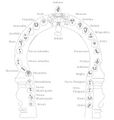 Display of all 28th nakshatras in silver arch with candles in Tirupperunthurai (Athmanathaswamy temple) near Aranthangi, India, 10th century CE. (SMH 2025).
 -
 Display of all 28th nakshatras in a door frame in Tirupperunthurai (Athmanathaswamy temple) near Aranthangi, India, 10th century CE. (SMH 2025).
 -
 Revati, Tibetean
 -
 Revati, Chinese
 -
 Revati Hindu
 -

-
 Lord Revati
 -
 Revati as reconstructed by Jones (1720)


Mythology/ Religion

IAU Working Group on Star Names
The name Pauṣṇa for ε Psc was suggested to WGSN in 2023. Based on the identification of the position of the 27th nakshatra in a 17th century star catalogue, which lists a coordinate between Zeta and Epsilon Pisces, the name Pauṣṇa was proposed as a star name for Epsilon (Zeta is already named Revati).
An alternative could be Zeta Psc B, as this star is also above the visibility threshold and unnamed.
Weblinks
Reference
- ↑ 1.0 1.1 1.2 Pai, R.V., Shylaja, B.S. From Nadyantaka to Pauṣṇa: compilation of stars catalogued in Sarvasiddhāntarāja. J Astrophys Astron 42, 113 (2021). https://doi.org/10.1007/s12036-021-09736-0
- ↑ R. Venketeswara Pai and B. S. Shylaja (2016) "Measurement of coordinates of Nakśatras in Indian astronomy" (Sarvasiddhāntarāja by Nityānanda, 1639 CE)
- ↑ "The Pañcasiddhāntikā" by Varāhamihira, Otto Neugebauer, David Edwin Pingree (1970): Google
- ↑ "Sūryasiddhānta: An Astro-linguistic Study" by Sudhi Kant Bharadwaj (1991), Google
- ↑ Venketeswara R Pai and Shylaja B S, 2021, JOAA, 42, 113 https://doi.org/10.1007/s12036-021-09736-