Revati: Difference between revisions
No edit summary |
|||
| (8 intermediate revisions by 3 users not shown) | |||
| Line 27: | Line 27: | ||
| cat = IAU-Star Name | | cat = IAU-Star Name | ||
}} | }} | ||
[[File:Revati nakshatras in Temple draw+lbl 4ase.jpg|thumb|Revati, 27th nakshatra, . | [[File:Revati nakshatras in Temple draw+lbl 4ase.jpg|thumb|Revati, 27th nakshatra, Athmanathaswamy temple (10th c. CE). ]] | ||
{{Infobox constellation | {{Infobox constellation | ||
| name = रेवती (Revati) | | name = रेवती (Revati) | ||
| Line 55: | Line 55: | ||
[[File:27 Revati stellarium2.gif|thumb|Revati's shape in temples matches a characteristic star pattern north of its determinative star. Here mapped to Stellarium (SMH for WGSN 2025).]] | [[File:27 Revati stellarium2.gif|thumb|Revati's shape in temples matches a characteristic star pattern north of its determinative star. Here mapped to Stellarium (SMH for WGSN 2025).]] | ||
Revati (रेवती), Prosperous, is a modern star name adopted by the International Astronomical Union in the IAU-Catalog of Star Names (IAU-CSN). Its origin is Indian. It is the name of HIP 5737 (ζ Psc, HR 361) in the constellation | Revati (रेवती), Prosperous, is a modern star name adopted by the International Astronomical Union in the IAU-Catalog of Star Names (IAU-CSN). Its origin is Indian. It is the name of HIP 5737 (ζ Psc, HR 361) in the constellation [[Pisces]]. | ||
==Etymology and History== | ==Etymology and History== | ||
| Line 61: | Line 61: | ||
* Revati | * Revati | ||
* | * [[Paushna]] | ||
Revatī (रेवती) is the name of the 27th nakshatra and specifically its ''yogatara'' (main star) ζ Psc. The Sun passing this star designates the beginning of a new (solar) year now. | Revatī (रेवती) is the name of the 27th nakshatra and specifically its ''yogatara'' (main star) ζ Psc. The Sun passing this star designates the beginning of a new (solar) year now. | ||
| Line 72: | Line 72: | ||
In 2025, Susanne M Hoffmann contributed a new "Indian Vedic" sky culture to Stellarium which maps the depictions of the nakshatras engraved in a door frame of the Athmanathaswamy temple near Aranthangi, India, 10th century CE. When the geometrical pattern is identified with the stars as common, we used an algorithm to make this list of all stars brighter than 6.5 mag in V-band inside the convex hull computed from the identified individual stars: | In 2025, Susanne M Hoffmann contributed a new "Indian Vedic" sky culture to Stellarium which maps the depictions of the nakshatras engraved in a door frame of the Athmanathaswamy temple near Aranthangi, India, 10th century CE. When the geometrical pattern is identified with the stars as common, we used an algorithm to make this list of all stars brighter than 6.5 mag in V-band inside the convex hull computed from the identified individual stars: | ||
{| class="wikitable sortable mw-collapsible" | {| class="wikitable sortable mw-collapsible" | ||
|+Stars inside the convex hull (identification by | |+Stars inside the convex hull (identification by SMH based on the temple image - differs from SMH's ident. based on Jones 1720) | ||
|- | |- | ||
!id | !id | ||
| Line 81: | Line 81: | ||
|- | |- | ||
|1 | |1 | ||
|Alpherg | |[[Alpherg]] | ||
|HIP 7097 | |HIP 7097 | ||
|Constellation lines (Vertex) | |Constellation lines (Vertex) | ||
| Line 87: | Line 87: | ||
|- | |- | ||
|2 | |2 | ||
|Torcular | |[[Torcular]] | ||
|HIP 8198 | |HIP 8198 | ||
|Constellation lines (Vertex) | |Constellation lines (Vertex) | ||
| Line 93: | Line 93: | ||
|- | |- | ||
|3 | |3 | ||
|Revati | |'''Revati''' | ||
|HIP 5737 | |HIP 5737 | ||
| Constellation lines (Vertex) | | Constellation lines (Vertex) | ||
| Line 189: | Line 189: | ||
==IAU Working Group on Star Names== | ==IAU Working Group on Star Names== | ||
[[File:Revati profileCard SadeghFaghanpour-IAU-WGSN.png|thumb|Revati profile card (CC BY Sadegh Faghanpour for IAU WGSN).]] | [[File:Revati profileCard SadeghFaghanpour-IAU-WGSN.png|thumb|Revati profile card (CC BY Sadegh Faghanpour for IAU WGSN).]] | ||
The name was | The name '''Revati''' was proposed to IAU WGSN for ζ Psc in 2017, however there is the question of which star the name should be assigned. | ||
ζ Psc is a | ζ Psc is a multiple star system with at least five components. Summaries of the ζ Psc system appear in [https://ui.adsabs.harvard.edu/abs/2019avds.book.....A/abstract Argyle, Swan & James (2019, "An Anthology of Visual Double Stars", p.96)] and [https://articles.adsabs.harvard.edu/pdf/1984PASP...96..179B Beavers, Salzer & Chen (1984, 1984PASP...96..179B)]. | ||
The bright pair [https://simbad.cds.unistra.fr/simbad/sim-id?Ident=zet+Psc+A ζ Psc A] (HD 7344, HR 361, HIP 5737; Vmag = 5.21) and [https://simbad.cds.unistra.fr/simbad/sim-id?Ident=zet+Psc+B ζ Psc B] (HD 7345, HR 362, HIP 5743; V = 6.44 mag) are separated by about 23 arcseconds. Although the discovery of the AB pair is often attributed to [https://ui.adsabs.harvard.edu/abs/1782RSPT...72..112H/abstract William Herschel (1782, p.] [https://ui.adsabs.harvard.edu/abs/1782RSPT...72..112H/abstract 137)], Herschel flags his description of the pair with an asterisk flagging it as one previously reported by Christian Mayer. To make matters more confusing, the discoverer ID for the pair in Washington Double Star catalog is "STF 100", where "STF" refers to Friederich Georg Wilhelm von Struve -- who did not observe the star until decades later. [https://ui.adsabs.harvard.edu/abs/1919JRASC..13..191P/abstract J.S. Plaskett (1919, 1919JRASC..13..191P]) discovered that both A and B show radial velocity variations of tens of kilometers per second, consistent with being spectroscopic binaries. The companion to A ("Ab") was detected via photoelectric photometry during a lunar occultation [https://ui.adsabs.harvard.edu/abs/1995A%26AS..110..107M/abstract (C. Meyer et al. 1995, 1995A&AS..110..107M)] , and estimated to be 0.8 mag fainter than Aa in a photometric band with effective wavelength similar to Johnson V. Although an orbit for Aa+Ab has not been published, Ba+Bb has had spectroscopic binary orbits published by [https://ui.adsabs.harvard.edu/abs/1933ApJ....77..310C/abstract Christie (1933, 1933ApJ....77..310C)] and [https://ui.adsabs.harvard.edu/abs/1984PASP...96..179B/abstract Beavers et al. (1984, 1984PASP...96..179B)] -- with that latter reporting spectral types for Ba and Bb as F7V and G7V, and an orbital period of 9.07530 days. | |||
There is also another faint resolved component C discovered by [https://ui.adsabs.harvard.edu/abs/1889AN....120..289B/abstract S.W. Burnham (1889; 1889AN....120..289B]; IDed in Washington Double Star Catalog as BU 1029 BC). The Gaia DR3 astrometry for C (ID: Gaia DR3 2577061264719259264) confirms that it is co-distant and co-moving with A and B. The change in position angle of C with respect to B between 1888 and 2021 suggests an orbital period of approximately three centuries. The absolute magnitude of C calculated using Gaia DR3 values (M_G = 6.43) would be consistent with an early K dwarf star. | |||
The name '''Revati''' was adopted by WGSN 30 June 2017 and adopted for the primary component [https://simbad.cds.unistra.fr/simbad/sim-id?Ident=zet+Psc+A ζ Psc Aa]. The unresolved light of ζ Psc A has been spectral typed as either A7IV [https://ui.adsabs.harvard.edu/abs/1975A%26AS...19...91L/abstract (Levato 1975, 1975A&AS...19...91L)] or A7IIIn [https://ui.adsabs.harvard.edu/abs/1995ApJS...99..135A/abstract (Abt] [https://ui.adsabs.harvard.edu/abs/1995ApJS...99..135A/abstract & Morrell 1995, 1995ApJS...99..135A)], however its absolute magnitude (Mv = 2.15) is similar to that of main sequence A7 stars. The nature of its companion Ab is unknown.<gallery> | |||
File:Revati profileCard SadeghFaghanpour-IAU-WGSN.png|Revati profile card for zeta Psc (CC BY Sadegh Faghanpour for IAU WGSN). | File:Revati profileCard SadeghFaghanpour-IAU-WGSN.png|Revati profile card for zeta Psc (CC BY Sadegh Faghanpour for IAU WGSN). | ||
File:Revati stickfigure SadeghFaghanpour-IAU-WGSN.jpg|Revati stickfigure (CC BY Sadegh Faghanpour for IAU WGSN). | File:Revati stickfigure SadeghFaghanpour-IAU-WGSN.jpg|Revati stickfigure (CC BY Sadegh Faghanpour for IAU WGSN). | ||
Latest revision as of 05:01, 14 September 2026
Authors: Susanne M Hoffmann, Eric Mamajek, Youla Azkarrula, Shylaja, ASE Tech Team
| Asterism Info | |
| Native | रेवती |
|---|---|
| Translation | a Hindu mother goddess |
| Position (2000) | |
| Right ascension | 18.43285834 |
| Declination | 7.575359937 |
| Area | 0 sq. deg. |
| Stars | |
| Bright stars | 1 |
| Bayer/Flamsteed stars | 1 |
| Stars brighter than 3.00m | 0 |
| Brightest star | Revati (5.19m) |
| Taxonomy | |
| category of asterism | IAU-Star Name |
| IAU- constellations | Psc |

| Asterism Info | |
| Native | रेवती |
|---|---|
| Romanisation | Revati |
| IPA | ɾeːʋɐtiː |
| Translation | Revati |
| Position (2000) | |
| Right ascension | 18.43285834 to 26.8399438 |
| Declination | 7.294091915 to 15.34583184 |
| Area | 39.11 sq. deg. |
| Stars | |
| Bright stars | 15 |
| Bayer/Flamsteed stars | 12 |
| Stars brighter than 3.00m | 0 |
| Brightest star | Alpherg (3.62m) |
| Taxonomy | |
| category of asterism | constellation |
| IAU- constellations | Psc, Ari |

Revati (रेवती), Prosperous, is a modern star name adopted by the International Astronomical Union in the IAU-Catalog of Star Names (IAU-CSN). Its origin is Indian. It is the name of HIP 5737 (ζ Psc, HR 361) in the constellation Pisces.
Etymology and History
Name Variants
- Revati
- Pauṣṇa (पौष्ण)
Revatī (रेवती) is the name of the 27th nakshatra and specifically its yogatara (main star) ζ Psc. The Sun passing this star designates the beginning of a new (solar) year now.
Identification and Main Star
Revati's shape in temple illustrations shows a jar with 29 stars inside [1], one above and one below. It matches a characteristic oval star pattern north of its determinative star (ζ Psc) in the Pisces/Andromeda area. The star above the jar would then mark the position of the Andromeda Galaxy.
The engraving of 27 stars in a temple of 10th century provides a different pattern of only five stars - the pattern seems to include δ, ε, ζ, 89 and 91 Psc.

Stars within the Constellation Area
In 2025, Susanne M Hoffmann contributed a new "Indian Vedic" sky culture to Stellarium which maps the depictions of the nakshatras engraved in a door frame of the Athmanathaswamy temple near Aranthangi, India, 10th century CE. When the geometrical pattern is identified with the stars as common, we used an algorithm to make this list of all stars brighter than 6.5 mag in V-band inside the convex hull computed from the identified individual stars:
| id | Label | IAU design. | description | Vmag |
|---|---|---|---|---|
| 1 | Alpherg | HIP 7097 | Constellation lines (Vertex) | 3.62 |
| 2 | Torcular | HIP 8198 | Constellation lines (Vertex) | 4.26 |
| 3 | Revati | HIP 5737 | Constellation lines (Vertex) | 5.19 |
| 4 | π Piscium | HIP 7535 | Inside the hull | 5.535 |
| 5 | ζ Piscium B | HIP 5743 | Inside the hull | 6.1 |
| 6 | 118 G. Psc | HIP 6868 | Inside the hull | 6.214 |
| 7 | 101 Psc | HIP 7436 | Inside the hull | 6.219 |
| 8 | - | HD 9496A | Inside the hull | 6.33 |
| 9 | 121 G. Psc | HIP 7243 | Inside the hull | 6.33 |
| 10 | 124 G. Psc | HIP 7819 | Inside the hull | 6.345 |
| 11 | CY Psc | HIP 7505 | Inside the hull | 6.42 |
| 12 | * 96 Psc | HIP 6915 | Constellation lines (Vertex) | 6.54 |
| 13 | * 104 Psc | HIP 7710 | Constellation lines (Vertex) | 6.75 |
| 14 | - | HIP 7456 | Constellation lines (Vertex) | 7.51 |
| 15 | - | HIP 8327 | Constellation lines (Vertex) | 8.77 |
Transfer and Transformation
-
 Revati 10th century
 -
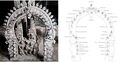 Display of all 28th nakshatras in silver arch with candles in Tirupperunthurai (Athmanathaswamy temple) near Aranthangi, India, 10th century CE. (SMH 2025).
 -
 Display of all 28th nakshatras in a door frame in Tirupperunthurai (Athmanathaswamy temple) near Aranthangi, India, 10th century CE. (SMH 2025).
 -
 Revati, Tibetean
 -
 Revati, Chinese
 -
 Revati Hindu
 -

-
 Lord Revati
 -
 Revati as reconstructed by Jones (1720)


Mythology/ Religion
Revati is a significant figure in Hindu mythology, best known as the consort of Balarama (elder brother of Krishna) and daughter of King Kakudmi. Renowned for her immense stature, she is often considered an incarnation of the goddess Jyotsna or a form of Lakshmi (goddess of opulence). Her story famously explores themes of time dilation.
Revati also the name of consort of Balarama, brother of Lord Krishna. She was the daughter of Raivata, who wanted a very noble man as his his son-in-law. He went to the creator, Lord Brahma to check who would be the son-in-law. He was assured that a young man has just been born. By the time he made this trip and returned a yuga had passed (432000years). So, the girl Revati married Balarama of the next yuga.
IAU Working Group on Star Names

The name Revati was proposed to IAU WGSN for ζ Psc in 2017, however there is the question of which star the name should be assigned.
ζ Psc is a multiple star system with at least five components. Summaries of the ζ Psc system appear in Argyle, Swan & James (2019, "An Anthology of Visual Double Stars", p.96) and Beavers, Salzer & Chen (1984, 1984PASP...96..179B).
The bright pair ζ Psc A (HD 7344, HR 361, HIP 5737; Vmag = 5.21) and ζ Psc B (HD 7345, HR 362, HIP 5743; V = 6.44 mag) are separated by about 23 arcseconds. Although the discovery of the AB pair is often attributed to William Herschel (1782, p. 137), Herschel flags his description of the pair with an asterisk flagging it as one previously reported by Christian Mayer. To make matters more confusing, the discoverer ID for the pair in Washington Double Star catalog is "STF 100", where "STF" refers to Friederich Georg Wilhelm von Struve -- who did not observe the star until decades later. J.S. Plaskett (1919, 1919JRASC..13..191P) discovered that both A and B show radial velocity variations of tens of kilometers per second, consistent with being spectroscopic binaries. The companion to A ("Ab") was detected via photoelectric photometry during a lunar occultation (C. Meyer et al. 1995, 1995A&AS..110..107M) , and estimated to be 0.8 mag fainter than Aa in a photometric band with effective wavelength similar to Johnson V. Although an orbit for Aa+Ab has not been published, Ba+Bb has had spectroscopic binary orbits published by Christie (1933, 1933ApJ....77..310C) and Beavers et al. (1984, 1984PASP...96..179B) -- with that latter reporting spectral types for Ba and Bb as F7V and G7V, and an orbital period of 9.07530 days.
There is also another faint resolved component C discovered by S.W. Burnham (1889; 1889AN....120..289B; IDed in Washington Double Star Catalog as BU 1029 BC). The Gaia DR3 astrometry for C (ID: Gaia DR3 2577061264719259264) confirms that it is co-distant and co-moving with A and B. The change in position angle of C with respect to B between 1888 and 2021 suggests an orbital period of approximately three centuries. The absolute magnitude of C calculated using Gaia DR3 values (M_G = 6.43) would be consistent with an early K dwarf star.
The name Revati was adopted by WGSN 30 June 2017 and adopted for the primary component ζ Psc Aa. The unresolved light of ζ Psc A has been spectral typed as either A7IV (Levato 1975, 1975A&AS...19...91L) or A7IIIn (Abt & Morrell 1995, 1995ApJS...99..135A), however its absolute magnitude (Mv = 2.15) is similar to that of main sequence A7 stars. The nature of its companion Ab is unknown.
-
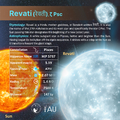 Revati profile card for zeta Psc (CC BY Sadegh Faghanpour for IAU WGSN).
 -
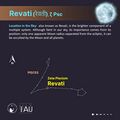 Revati stickfigure (CC BY Sadegh Faghanpour for IAU WGSN).

Weblinks
- Website of the IAU WGSN: https://exopla.net/
Reference
- References (general)
- Saha&Lahiri (1955)
- ↑ Jones, A, 1792, Asiatic Society Journal





