Qed: Difference between revisions
| (20 intermediate revisions by 3 users not shown) | |||
| Line 1: | Line 1: | ||
{{DISPLAYTITLE:}} | {{DISPLAYTITLE:}} | ||
Authors: {{PAGEAUTHORS}} | Authors: {{PAGEAUTHORS}} | ||
---- | ---- | ||
[[File:Qed+Qedty_Belmonte2003.png|thumb|Qed+Qedty (Belmonte 2003)]] | |||
[[File:Fishing_and_Fowling,_from_the_Tomb_of_Ipuy_MET_eg30.4.120.jpg|thumb|Fishing and Fowling, from the Tomb of Ipuy, Upper Egypt, Thebes, Deir el-Medina, Tomb of Ipuy, TT217 (CC0, Charles Wilkinson); epoch: circa 1279–1213 BCE = New Kingdom, Ramesside = Dynasty 19, Reign: reign of Ramesses II]] | |||
[[File:SethyI Sawyqed fotoAlicia.JPG|thumb|Astronomical ceiling in the tomb of Sethy I (photograph by Alicia Maravelia)]] | |||
Qed (''ḳd'' or ''z3wy-qd''')''''' is an Egyptian name that can be translated as circle, sheepfold or net. Decan star clocks include both Qed and [[Qedty]] (in dual form) for two different asterisms. They were not present on RSC which used more appealing constellations further north such as Aped and [[Wia]], respectively, to cover the same RA range. | |||
==Concordance, Etymology, History== | ==Concordance, Etymology, History== | ||
[[File:SenmutBN Juan.jpg|thumb|Astronomical ceiling in the tomb of Senmut (photograph by Juan Belmonte)]] | |||
Hannig [see ''Lexica'', p. 706, No 25705] mentions also a decan named '''''z3wy-qd''''', as there is also one called ''z3wy-knmt'' (Decan no33 in Leitz 1995), and so on for ''z3wy-zrt''/''zjt'' (Decan no16 in Leitz 1995<ref name=":0" />). Yet '''''z3wy-qd''''' is not mentioned in Leitz (1995)<ref name=":0" />. | |||
'''Variants''' | '''Variants''' | ||
* Qed | * Qed | ||
* Qedty | * Sawy-Qed (dual case; from Middle Kingdom onwards) | ||
* Zawy-Qed (dual case, Old Kingdom) | |||
* [[Qedty]] (different constellation) | |||
Based on ancient Hellenic spellings of this decan, it could also be '''Kat''' (Hellenic: '''''Κάτ'''''). | |||
=== Origin of Constellation === | === Origin of Constellation === | ||
In the decan star clocks there are two decans called Qed, in singular, and [[Qedty]], in dual. They are far away in RA. One possibly close to [[Pisces]] and before Aret, the other possibly to the South of [[Sagittarius]]. These are mentioned in NK celestial diagrams but never depicted as constellations. | In the decan star clocks there are two decans called Qed, in singular, and [[Qedty]], in dual. They are far away in RA. One possibly was close to [[Pisces]] and before [[Aret]], the other possibly to the South of [[Sagittarius]]. These are mentioned in NK celestial diagrams but never depicted as constellations. | ||
==== Decan Star Clocks ==== | |||
Decan star clocks (also "diagonal star clocks")<ref name=":0">Leitz, Ch., 1995. Altägyptische Sternuhren. OLA, 62. Leuven: Peeters.</ref> represent one of the earliest known systematic methods of stellar timekeeping, as they are preserved from the Middle Kingdom (2100-1800 BCE). During the night, the successive appearance of decans provided a way to divide the night into approximately twelve parts for the twelve hours of the night. These constellations shift successively, so that the Egyptian schema needs to be read diagonally: every ten days, another constellation is considered to rule the same hour, or in other words, each constellation (decan) rules a different hour depending on the time of the year. Hoffmann (2022)<ref>Hoffmann, S.M. (2022). Comparison of some General Concepts.,in Hoffmann and Wolfschmidt (eds.). Astronomy in Culture – Cultures of Astronomy, tredition Hamburg, 542-560</ref> writes: "The pattern of this systematic shift of constellations through the hours of the day within a year is depicted on Egyptian diagonal star clocks, when the sequence of decans was observed in culmination instead of in rising (Symons 2007<ref>Symons, Sarah (2007), A star's year: the annual cycle in the ancient egyptian sky, in J. M. Steele, ed., `Calendars and Years: Astronomy and Time in the Ancient World', Oxbow, Oxford (UK), pp. 1--33.</ref>), leading to a reduction of deviations throughout the year." <gallery> | |||
File:EgStarClockSarg BettinaHoffmann.jpeg|Schema of Egyptian star clock in a coffin lid (CC BY Bettina Hoffmann). | |||
File:EgStarClockSchema BettinaHoffmann.jpeg|Schema of Egyptian star clock: how it works (CC BY Bettina Hoffmann). | |||
File:Digaonalsternuhr.jpg|Diagonal star clock in coffins from the Middle Kingdom of Ancient Egypt (Coffin of Nacht, probably from Asyut, 11th/12th Dynasty). | |||
</gallery> | |||
==== Concordance ==== | |||
* Qed is mentioned | |||
* Zawy-Qed is written | |||
** astronomical ceiling of the tomb of Senmut (Theban tomb no. 353, 18th Dynasty Egypt, circa 1479–1458 BCE) | |||
** in the tomb of Sethy I (19th Dynasty Egypt, 1290 BCE to 1279 BCE) | |||
==== Identification ==== | |||
Leitz (1995,<ref name=":02">Leitz, Ch., 1995. Altägyptische Sternuhren. OLA, 62. Leuven: Peeters.</ref> 78) describes a graphical identification method for the decan constellations and says that he basically follows the identifications of Neugebauer and Parker (Astronomische Texte I, 97-100). Yet, on the following pages, Leitz (1995) gives his own arguments, always citing NP but occasionally giving alternatives. | |||
Qed (''ḳd'') is the 22nd decan and reads in Leitz (1995, 92):<blockquote>Der mit Abstand hellste Stern vor dem 22. Untergangshorizont ist Sirrah (α Andromedae), ein weißer Stern (Spektralklasse B9) der Größe m = 2.0, der mit laut Karte 1.°3 Horizontabstand etwa 0.°5 bis 1° zu tief steht. </blockquote><blockquote>By far the brightest star visible before the 22nd sunset horizon is Sirrah (α Andromedae), a white star (spectral class B9) of magnitude m = 2.0, which, with a horizon distance of 1.°3 according to the map, is about 0.°5 to 1° too low.</blockquote>So, Leitz suggests an identification that he immediately rejects without presenting any alternative. Belmonte and Lull (2023) agree with the rejection and consider Alpha Andromedae far too north for a decan. | |||
Qed means net, circle, or sheepfold, so [[Qedty]] means two nets or a pair of nets, and hence we expect them to have a nearly round, circular or enclosed form, which fits the two shapes of star bows south of the Egyptian ship-constellation Wia: the stars of the tail of Scorpius and those of Corona Australis. | |||
In a complete independent analysis, a tentative interpretation on these two decans was given by Belmonte (2003)<ref>Belmonte, J. A., 2003. The Ramesside star clocks and the ancient Egyptian constellations. In M. Blomberg, P. E. Blomberg and G. Henriksson (Eds.), ''Calendars, Symbols, and Orientations: Legacies of Astronomy in Culture'' (pp. 57–65). ''Uppsala Astronomical Observatory report'', 59. Uppsala Ocarina Books.</ref> in MSAIT on the Decans, and simultaneously on his PUV book on "La Astronomía del antiguo Egipto" by Jose Lull in 2004. Both of them independently coincided in their hypothesis for Qed and Qedty after their analyses because they fit in RA within the errors. So this, among others, is why they published a paper in JHA in 2006 together. Table 4.7 is just a final count of 20 years of discussion and analyses. | |||
Belmonte and Lull identify the pentagonal head of [[Cetus]] for Qed, and an area south of [[Sagittarius]] in which [[Corona Australis]] (quite circular) would be one of the pair [[Qedty]]. | |||
Maravelia (2006,<ref>Maravelia, A.–A. (2006). Les astres dans les textes religieux en Égypte antique et dans les Hymnes Orphiques, Oxford (Archaeopress / BAR International Series 1527). </ref> 450, Tab. 4, #23) <blockquote>la tête de Cetus a une apparence circulaire (DC & GR.). Il s'agit peut-être du "kraal" de troupeau. </blockquote><blockquote>'''Engl.:''' the head of Cetus has a circular appearance (Diagonal Star Clocks and graphical representations). Perhaps it is a "kraal" of the herd.</blockquote>"kraal" is an African term for a (circular) enclosure, here referring to α,ν, ξ, γ, μ Ceti, next to δ Ceti. | |||
==== Image Variants of Fishing Nets ==== | |||
For a depiction in the tomb of Menna (TT 69), Thebes, tp. Amenhotep III, New Kingdom also see Hartwig (2015)<ref>Hartwig, Melinda. (2015). “Style.” In A Companion to Ancient Egyptian Art, edited by Melinda Hartwig, pp. 39-59. Blackwell Companions to Art History Series. Boston & Oxford: Wiley-Blackwell.</ref>.<gallery> | For a depiction in the tomb of Menna (TT 69), Thebes, tp. Amenhotep III, New Kingdom also see Hartwig (2015)<ref>Hartwig, Melinda. (2015). “Style.” In A Companion to Ancient Egyptian Art, edited by Melinda Hartwig, pp. 39-59. Blackwell Companions to Art History Series. Boston & Oxford: Wiley-Blackwell.</ref>.<gallery> | ||
File:Fishing_with_Net_(1878)_-_TIMEA.jpg|A team of men catching fish with a large net. (Weidenbach 1878) | File:Fishing_with_Net_(1878)_-_TIMEA.jpg|A team of men catching fish with a large net. (Weidenbach 1878) | ||
| Line 33: | Line 61: | ||
<gallery> | <gallery> | ||
File:SethyI Sawyqed JuanGIF.gif|term "Zawy-Qed" | |||
File:SethyI Sawyqed fotoAlicia.JPG|Astronomical ceiling in the tomb of Sethy I (photograph by Alicia Maravelia) | |||
File:SenmutBN Juan.jpg|Astronomical ceiling in the tomb of Senmut (photograph by Juan Belmonte) | |||
File:Astronomical Ceiling, Tomb of Senenmut MET DT207429.jpg|Astronomical Ceiling, Tomb of Senenmut MET DT207429 | |||
File:Senenmut-Grab.JPG|Astronomical Ceiling, Tomb of Senenmut MET DT207429 | |||
</gallery> | </gallery> | ||
| Line 44: | Line 72: | ||
== IAU Working Group on Star Names == | == IAU Working Group on Star Names == | ||
Qed was proposed to WGSN in 2023 by Juan Belmonte: "Delta Ceti would instead be ideal for Qed (another decan), since Jose Lull and Juan Belmonte agree that Qed (circle or Sheepfold) could be related to the head of Cetus and its close to circular form in the sky. RA here fits very well. Delta being immediately below is a perfect candidate." Alicia Maravelia in 2026 added: "Not knowing the ''exact'' vocalisation of anient Egyptian words, even Qede or Qedo (but NOT Qedi, neither Qeda nor Qedu) would be acceptable variants, without having recourse to the other decan '''Zawy-Qed'''. Based on ancient Hellenic spellings of this decan, it could also be '''Kat''' (Hellenic: '''''Κάτ''''')." | |||
Delta Ceti for Qed, or Gamma, or Nu, or Mu, or Lambda, no preference. | |||
== Weblinks == | == Weblinks == | ||
Latest revision as of 10:12, 11 November 2026
Authors: Susanne M Hoffmann, ASE Tech Team, Juan Antonio Belmonte Avilés


Qed (ḳd or z3wy-qd) is an Egyptian name that can be translated as circle, sheepfold or net. Decan star clocks include both Qed and Qedty (in dual form) for two different asterisms. They were not present on RSC which used more appealing constellations further north such as Aped and Wia, respectively, to cover the same RA range.
Concordance, Etymology, History

Hannig [see Lexica, p. 706, No 25705] mentions also a decan named z3wy-qd, as there is also one called z3wy-knmt (Decan no33 in Leitz 1995), and so on for z3wy-zrt/zjt (Decan no16 in Leitz 1995[1]). Yet z3wy-qd is not mentioned in Leitz (1995)[1].
Variants
- Qed
- Sawy-Qed (dual case; from Middle Kingdom onwards)
- Zawy-Qed (dual case, Old Kingdom)
- Qedty (different constellation)
Based on ancient Hellenic spellings of this decan, it could also be Kat (Hellenic: Κάτ).
Origin of Constellation
In the decan star clocks there are two decans called Qed, in singular, and Qedty, in dual. They are far away in RA. One possibly was close to Pisces and before Aret, the other possibly to the South of Sagittarius. These are mentioned in NK celestial diagrams but never depicted as constellations.
Decan Star Clocks
Decan star clocks (also "diagonal star clocks")[1] represent one of the earliest known systematic methods of stellar timekeeping, as they are preserved from the Middle Kingdom (2100-1800 BCE). During the night, the successive appearance of decans provided a way to divide the night into approximately twelve parts for the twelve hours of the night. These constellations shift successively, so that the Egyptian schema needs to be read diagonally: every ten days, another constellation is considered to rule the same hour, or in other words, each constellation (decan) rules a different hour depending on the time of the year. Hoffmann (2022)[2] writes: "The pattern of this systematic shift of constellations through the hours of the day within a year is depicted on Egyptian diagonal star clocks, when the sequence of decans was observed in culmination instead of in rising (Symons 2007[3]), leading to a reduction of deviations throughout the year."
-
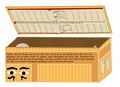 Schema of Egyptian star clock in a coffin lid (CC BY Bettina Hoffmann).
-
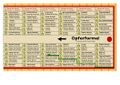 Schema of Egyptian star clock: how it works (CC BY Bettina Hoffmann).
-
 Diagonal star clock in coffins from the Middle Kingdom of Ancient Egypt (Coffin of Nacht, probably from Asyut, 11th/12th Dynasty).


Concordance
- Qed is mentioned
- Zawy-Qed is written
- astronomical ceiling of the tomb of Senmut (Theban tomb no. 353, 18th Dynasty Egypt, circa 1479–1458 BCE)
- in the tomb of Sethy I (19th Dynasty Egypt, 1290 BCE to 1279 BCE)
Identification
Leitz (1995,[4] 78) describes a graphical identification method for the decan constellations and says that he basically follows the identifications of Neugebauer and Parker (Astronomische Texte I, 97-100). Yet, on the following pages, Leitz (1995) gives his own arguments, always citing NP but occasionally giving alternatives.
Qed (ḳd) is the 22nd decan and reads in Leitz (1995, 92):
Der mit Abstand hellste Stern vor dem 22. Untergangshorizont ist Sirrah (α Andromedae), ein weißer Stern (Spektralklasse B9) der Größe m = 2.0, der mit laut Karte 1.°3 Horizontabstand etwa 0.°5 bis 1° zu tief steht.
By far the brightest star visible before the 22nd sunset horizon is Sirrah (α Andromedae), a white star (spectral class B9) of magnitude m = 2.0, which, with a horizon distance of 1.°3 according to the map, is about 0.°5 to 1° too low.
So, Leitz suggests an identification that he immediately rejects without presenting any alternative. Belmonte and Lull (2023) agree with the rejection and consider Alpha Andromedae far too north for a decan.
Qed means net, circle, or sheepfold, so Qedty means two nets or a pair of nets, and hence we expect them to have a nearly round, circular or enclosed form, which fits the two shapes of star bows south of the Egyptian ship-constellation Wia: the stars of the tail of Scorpius and those of Corona Australis.
In a complete independent analysis, a tentative interpretation on these two decans was given by Belmonte (2003)[5] in MSAIT on the Decans, and simultaneously on his PUV book on "La Astronomía del antiguo Egipto" by Jose Lull in 2004. Both of them independently coincided in their hypothesis for Qed and Qedty after their analyses because they fit in RA within the errors. So this, among others, is why they published a paper in JHA in 2006 together. Table 4.7 is just a final count of 20 years of discussion and analyses.
Belmonte and Lull identify the pentagonal head of Cetus for Qed, and an area south of Sagittarius in which Corona Australis (quite circular) would be one of the pair Qedty.
Maravelia (2006,[6] 450, Tab. 4, #23)
la tête de Cetus a une apparence circulaire (DC & GR.). Il s'agit peut-être du "kraal" de troupeau.
Engl.: the head of Cetus has a circular appearance (Diagonal Star Clocks and graphical representations). Perhaps it is a "kraal" of the herd.
"kraal" is an African term for a (circular) enclosure, here referring to α,ν, ξ, γ, μ Ceti, next to δ Ceti.
Image Variants of Fishing Nets
For a depiction in the tomb of Menna (TT 69), Thebes, tp. Amenhotep III, New Kingdom also see Hartwig (2015)[7].
-
 A team of men catching fish with a large net. (Weidenbach 1878)
-
 Fishing and Fowling, from the Tomb of Ipuy (Ramses II)
-
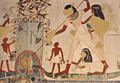 On this painting adorning the tomb of Menna, a noble scribe during the reign of Amenhotep III (XVIIIth Dynasty), two Nile perches, fish with delicious flesh, are clearly visible. (image citation from Comptoir
-
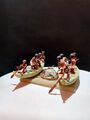 modern replica for sale, original in the Egyptian Museum in Cairo


Transfer and Transformation of the Constellation
-
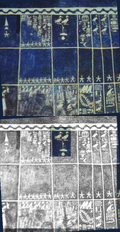 term "Zawy-Qed"
-
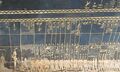 Astronomical ceiling in the tomb of Sethy I (photograph by Alicia Maravelia)
-
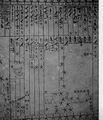 Astronomical ceiling in the tomb of Senmut (photograph by Juan Belmonte)
-
 Astronomical Ceiling, Tomb of Senenmut MET DT207429
-
 Astronomical Ceiling, Tomb of Senenmut MET DT207429


Religion/ Tales/ Mythology
As far as we know, there is not any mythological or cultural context for these two decans (asterisms) as we have for many other Egyptian stars and constellations apart from the utility and hour keepers in diagonal star clocks (which is indeed important).
IAU Working Group on Star Names
Qed was proposed to WGSN in 2023 by Juan Belmonte: "Delta Ceti would instead be ideal for Qed (another decan), since Jose Lull and Juan Belmonte agree that Qed (circle or Sheepfold) could be related to the head of Cetus and its close to circular form in the sky. RA here fits very well. Delta being immediately below is a perfect candidate." Alicia Maravelia in 2026 added: "Not knowing the exact vocalisation of anient Egyptian words, even Qede or Qedo (but NOT Qedi, neither Qeda nor Qedu) would be acceptable variants, without having recourse to the other decan Zawy-Qed. Based on ancient Hellenic spellings of this decan, it could also be Kat (Hellenic: Κάτ)."
Delta Ceti for Qed, or Gamma, or Nu, or Mu, or Lambda, no preference.
Weblinks
References
- References (general)
- ↑ 1.0 1.1 1.2 Leitz, Ch., 1995. Altägyptische Sternuhren. OLA, 62. Leuven: Peeters.
- ↑ Hoffmann, S.M. (2022). Comparison of some General Concepts.,in Hoffmann and Wolfschmidt (eds.). Astronomy in Culture – Cultures of Astronomy, tredition Hamburg, 542-560
- ↑ Symons, Sarah (2007), A star's year: the annual cycle in the ancient egyptian sky, in J. M. Steele, ed., `Calendars and Years: Astronomy and Time in the Ancient World', Oxbow, Oxford (UK), pp. 1--33.
- ↑ Leitz, Ch., 1995. Altägyptische Sternuhren. OLA, 62. Leuven: Peeters.
- ↑ Belmonte, J. A., 2003. The Ramesside star clocks and the ancient Egyptian constellations. In M. Blomberg, P. E. Blomberg and G. Henriksson (Eds.), Calendars, Symbols, and Orientations: Legacies of Astronomy in Culture (pp. 57–65). Uppsala Astronomical Observatory report, 59. Uppsala Ocarina Books.
- ↑ Maravelia, A.–A. (2006). Les astres dans les textes religieux en Égypte antique et dans les Hymnes Orphiques, Oxford (Archaeopress / BAR International Series 1527).
- ↑ Hartwig, Melinda. (2015). “Style.” In A Companion to Ancient Egyptian Art, edited by Melinda Hartwig, pp. 39-59. Blackwell Companions to Art History Series. Boston & Oxford: Wiley-Blackwell.