Wia: Difference between revisions
No edit summary |
No edit summary |
||
| Line 1: | Line 1: | ||
{{DISPLAYTITLE:}} | {{DISPLAYTITLE:}} | ||
Authors: {{PAGEAUTHORS}} | Authors: {{PAGEAUTHORS}} | ||
----[[File:20182AuOrLull constWia Lull-Stellarium.jpeg|thumb|Old Egyptian variant of constellation Wja (CC BY Lull 2018).]] | ----[[File:20182AuOrLull constWia Lull-Stellarium.jpeg|thumb|Old Egyptian variant of constellation Wja (CC BY Lull 2018<ref name=":0" />).]] | ||
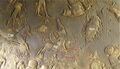
[[File:20182AuOrLull constWia inSenenmut lull.jpeg|thumb|Boat of Wja+Knmw in the tomb of Senenmut (Lull 2018).]] | [[File:20182AuOrLull constWia inSenenmut lull.jpeg|thumb|Boat of Wja+Knmw in the tomb of Senenmut (Lull 2018<ref name=":0" />).]] | ||
[[File:20182AuOrLull constWia Boat+Decans Karakhamun ElenaPischikova+MiguelAMolinero.jpeg|thumb|Boat and Decans in tomb of Karakhamun (CC BY Elena Pischikova and Miguel A. Molinero, in Lull 2018).]] | [[File:20182AuOrLull constWia Boat+Decans Karakhamun ElenaPischikova+MiguelAMolinero.jpeg|thumb|Boat and Decans in tomb of Karakhamun (CC BY Elena Pischikova and Miguel A. Molinero, in Lull 2018).]] | ||
Wia (wỉʒ), The Boat, ... ... is an Egyptian constellation.<ref name=":0">José Lull (2018). Ancient Egyptian constellation of WjA (Boat) and its link to Sagittarius in the Ptolemaic and Roman era. ''Aula Orientalis'' 36/2, 257-277 </ref> It forms a super-constellation with its Crew, [[Kemenu]]. | Wia (wỉʒ), The Boat, ... ... is an Egyptian constellation.<ref name=":0">José Lull (2018). Ancient Egyptian constellation of WjA (Boat) and its link to Sagittarius in the Ptolemaic and Roman era. ''Aula Orientalis'' 36/2, 257-277 </ref> It forms a super-constellation with its Crew, [[Kemenu]]. | ||
Revision as of 10:12, 9 July 2026
Authors: Susanne M Hoffmann, Juan Antonio Belmonte Avilés, Eric Mamajek


Wia (wỉʒ), The Boat, ... ... is an Egyptian constellation.[1] It forms a super-constellation with its Crew, Kemenu.
Concordance, Etymology, History
What does the term mean, does it always have the same meaning - was it changed over time.
Variants:
- Wia
- Wja
Origin of Constellation
The original Egyptian constellation of Wia, the Boat, was huge, stretching from eastern Libra through Scorpius through Sagittarius. Wia is huge in RA (covering several hours) as proven by the decan diagonal clocks and celestial diagrams (see Fig. 4.10 in Belmonte & Lull 2023). This is also illustrated in Fig. 4.41.
In the decan diagonal clocks and in the celestial diagrams of NK there is a clear decan named Hery-ib-Wia, which meams The Core of the Boat. Belmonte and Lull (2023) strongly believe this is Kaus Australis.
In the circular zodiac of the Hathor Temple in Dendera that shows strong Babylonian influences,[2] this boat is depicted as tiny barge below the front feet of Sagittarius. This area, roughly in Sgr/ CrA, hosts the Babylonian constellation MA2.GUR8, The Ship. This Boat at the feet of Sagittarius in the Circular Zodiac can be either Wia, or the parazodiacal Babylonian Boat, rr even both in an abstract or mnemonic representation
Extension of the Boat and Identification of its Decans[1]


The Boat occurs on the astronomical ceilings in tombs and several other occasions. Lull (2018) used these archaeological proofs for the identification:
- astronomical ceiling in Esna
- clepsydra of Amenhetep III (Karnak)
- astronomical ceiling of Senenmut (chamber of Seti, KV 17)
- astronomical ceiling of the Ramesseum
- tomb of Karakhamun (TT23), belongs to the 'family of Senenmut'
- coffin of Harendotes (BM 6678)
- tomb of Montuemhat (TT34) - boat unrelated to decan
- tomb of Pedamenope (TT33) - boat unrelated to decan
- tomb of Queen Khenuwa (South Begrawiyah 503, Meroitic period = 3rd c. BCE)
-
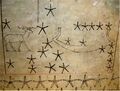 Boat of Wja+Knmw in the tomb of Senenmut (Lull 2018).
 -
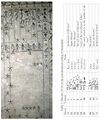 Decans of Wja+Knmw in the tomb of Senenmut (Lull 2018).
 -
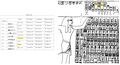 Decans of Wja+Knmw in the Book of Nut (Lull 2018).
 -
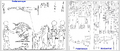 astronomical ceiling and decan lists in the tombs of Pedamenope + Montuemhat (Lull 2018).


He[1] concludes:
"As we have seen, the constellation of the Boat should cover the eastern third of Libra and the constellations of Scorpius and Sagittarius. However, the part belonging to Sagittarius should be the most important of the Boat, for “the (star) which is in the middle of Boat” and “guides” stood in it, in the brightest part of the Milky Way. His representation throughout the centuries, one of the few southern constellations which enjoyed such honor, somehow can also indicate the importance of this constellation for the Egyptians."
Transfer and Transformation of the Constellation

Lull (2018)[1] first explains the importance of the huge boat in ancient Egypt and then states a change:
"during the Ptolemaic era a notable change occurs in the Egyptian heaven: the zodiacal constellations of Mesopotamian origin are introduced. With this change the ancient Egyptian constellations occupying the zodiacal band were eliminated in favor of the new constellations or, at best, minimized. This last option is what must have happened in the case of the constellation of the Boat."
-
 ancient manuscript 1
 -
modern mapping by author XY
-
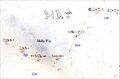 Old Egyptian variant of constellation Wja (CC BY Lull 2018).
 -
 Wja - circular zodiac of Dendera (CC BY Lull 2018).
 -
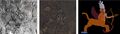 The figure in the place of Sagittarius on the circular zodiac in Denderah (two photos, one drawing for Stellarium, CC BY WGSN).
 -
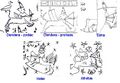 Wja - Late Egyptian Variants of Ptolemic Era (CC BY Lull 2018).


Religion/ Tales/ Mythology
In ancient Egyptian cosmology, boats carried the sun god Ra, and the deceased pharaoh's soul on its journey through the afterlife. The WjA constellation symbolized these vital spiritual and solar voyages.
IAU WGSN star name discussion
The name was suggested to WGSN in 2025. Wia is a huge Egyptian constellation as Reret of Nekhet, spreading from Scorpius to Sagittarius, so I do not see appropriate to name a single star after it. Much more appropriate might be Hery-ib-Wia ("In the Middle of the Boat") if we find a star close to Kaus Australis without a name (see Fig 4.1 and Table 4.5 in Belmonte and Lull, 2023, for ideas).
Weblinks
References
- References (general)
- ↑ 1.0 1.1 1.2 1.3 1.4 1.5 José Lull (2018). Ancient Egyptian constellation of WjA (Boat) and its link to Sagittarius in the Ptolemaic and Roman era. Aula Orientalis 36/2, 257-277
- ↑ Hoffmann, S.M. (2022). Preliminary Observations on the Dendera Zodiac (Egypt). in Hoffmann and Wolfschmidt (eds.). Astronomy in Culture – Cultures of Astronomy, tredition Hamburg/ OpenScienceTechnology Berlin, 524-541





