Ashvini: Difference between revisions
→Identification: inserted explanation |
→Identification: added the references and details |
||
| Line 2: | Line 2: | ||
Authors: {{PAGEAUTHORS}} | Authors: {{PAGEAUTHORS}} | ||
---- | ---- | ||
[[File:Ashvini nakshatras in Temple draw+lbl 4ase.jpg|thumb|Ashvini | [[File:Ashvini nakshatras in Temple draw+lbl 4ase.jpg|thumb|Ashvini ''nakṣatra'' in Tirupperunthurai (Athmanathaswamy temple) near Aranthangi, India, 10th century CE. (SMH 2025).]] | ||
{{Infobox constellation | {{Infobox constellation | ||
| name = अश्विनी (Ashvini) | | name = अश्विनी (Ashvini) | ||
| Line 47: | Line 47: | ||
===Origin of Constellation=== | ===Origin of Constellation=== | ||
''Aśvinī'' is mythologically associated with the twin physicians of the Gods. As an asterism, it is represented with a horse head. All alternative names of the ''nakṣatra'' mean "horse", and so does the word “aśva” (अश्व) and all other names listed above. The list is not exhaustive. | |||
====Identification==== | ====Identification==== | ||
The coordinates of stars | The coordinates of stars (Sen and Shukla, 2000) fix a unique star for identification. The star lists (Sarma, 2020) in manuals of astrolabes by Mahendra Suri and Malayendu with coordinates, provide important clues. These coordinates differ from the currently used ecliptic longitude – latitude system. (Saha and Lahiri, 1950; Abhyankar, 2006) . The bright star among the group constituting the ''nakṣatra'' is called the ''yogatāra'' (Brahmagupta, KK, 1.9.3-6). Thus, the same name is to be understood as an asterism (''nakṣatra'') with a group of stars, and also as a single brightest star in the group (''yogatāra'') depending on the context. | ||
( | This is true for all 28 ''nakṣatra''s used for marking the positions of the moon (the sun and planets also), listed in the Atharva Veda. The number of stars in each ''nakṣatra'' is specified in the Atharva Veda Parisista , N''nakṣatra''kalpa (19.7.1-5). | ||
The star ''Aśvinī'' was used to estimate the errors, so that the other (of the 28) faint stars can be identified with the least confusion in this coordinate conversion. Its coordinates agree with β Arietis, though it is not the brightest. (Shylaja and Venketeswara Pai, 2016,) | |||
The search for a diagrammatic representation of the ''nakṣatra''s led to a 1000-year-old engraving in a temple named Avudaiyarkoil in Tamil Nadu near Pudukkottai; the image from a tourist notebook is reproduced below. | |||
Alexander Jones prepared the sketches of the ''nakṣatra''s based on the description provided to him by local astronomers. The scales of the drawings are not specified. An alternate identification with the 6-star pattern for ''Aśvinī'' is also shown below. | |||
The number of stars in the ''nakṣatra'' are | |||
{| class="wikitable" | {| class="wikitable" | ||
|+ | |+ | ||
! | ! | ||
! | !Atharva Veda | ||
!Tirupperunthurai | |||
! | !Chinese | ||
Tirupperunthurai | !(Jones 1790) | ||
! | |||
Chinese | |||
! | |||
(Jones 1790) | |||
|- | |- | ||
| | | | ||
| | |2 stars | ||
|6 stars | |6 stars | ||
|3 stars | |3 stars | ||
| Line 142: | Line 146: | ||
| 5.892 | | 5.892 | ||
|} | |} | ||
===Transfer and Transformation of the Constellation=== | |||
=== Transfer and Transformation of the Constellation === | |||
<gallery> | <gallery> | ||
File:Ashvini nakshatras in Temple draw+lbl 4ase.jpg|Ashvini 10th century CE | File:Ashvini nakshatras in Temple draw+lbl 4ase.jpg|Ashvini 10th century CE | ||
Revision as of 15:14, 15 November 2026
Authors: Susanne M Hoffmann, Shylaja, Youla Azkarrula

| Asterism Info | |
| Native | अश्विनी |
|---|---|
| Romanisation | Ashvini |
| IPA | ɐʃʋiːniː |
| Translation | Aśvini |
| Position (2000) | |
| Right ascension | 28.38255387 to 34.53137755 |
| Declination | 17.81755601 to 23.46241755 |
| Area | 18.61 sq. deg. |
| Stars | |
| Bright stars | 10 |
| Bayer/Flamsteed stars | 9 |
| Stars brighter than 3.00m | 2 |
| Brightest star | Hamal (2.01m) |
| Taxonomy | |
| category of asterism | constellation |
| IAU- constellations | Ari |

Aśvini (अश्विनी) is the name of an Indian twin deity that is asscoiated with the first nakshatra. As gods they initially represent physicians; as asterism they are associated with the star β and γ Arietis in Aries. However, the oldest reconstruction of the image shows a horse head with three stars, suggesting that α Arietis might also have belonged to the asterism.
Etymology and History
Name Variant:
- Adya,
- Asva,
- Asvi,
- Dasra,
- Hari,
- Haya,
- Turaga,
- Turanaga,
- Vaaji

Origin of Constellation
Aśvinī is mythologically associated with the twin physicians of the Gods. As an asterism, it is represented with a horse head. All alternative names of the nakṣatra mean "horse", and so does the word “aśva” (अश्व) and all other names listed above. The list is not exhaustive.
Identification
The coordinates of stars (Sen and Shukla, 2000) fix a unique star for identification. The star lists (Sarma, 2020) in manuals of astrolabes by Mahendra Suri and Malayendu with coordinates, provide important clues. These coordinates differ from the currently used ecliptic longitude – latitude system. (Saha and Lahiri, 1950; Abhyankar, 2006) . The bright star among the group constituting the nakṣatra is called the yogatāra (Brahmagupta, KK, 1.9.3-6). Thus, the same name is to be understood as an asterism (nakṣatra) with a group of stars, and also as a single brightest star in the group (yogatāra) depending on the context.
This is true for all 28 nakṣatras used for marking the positions of the moon (the sun and planets also), listed in the Atharva Veda. The number of stars in each nakṣatra is specified in the Atharva Veda Parisista , Nnakṣatrakalpa (19.7.1-5).
The star Aśvinī was used to estimate the errors, so that the other (of the 28) faint stars can be identified with the least confusion in this coordinate conversion. Its coordinates agree with β Arietis, though it is not the brightest. (Shylaja and Venketeswara Pai, 2016,)
The search for a diagrammatic representation of the nakṣatras led to a 1000-year-old engraving in a temple named Avudaiyarkoil in Tamil Nadu near Pudukkottai; the image from a tourist notebook is reproduced below.
Alexander Jones prepared the sketches of the nakṣatras based on the description provided to him by local astronomers. The scales of the drawings are not specified. An alternate identification with the 6-star pattern for Aśvinī is also shown below.
The number of stars in the nakṣatra are
| Atharva Veda | Tirupperunthurai | Chinese | (Jones 1790) | |
|---|---|---|---|---|
| 2 stars | 6 stars | 3 stars | 3 stars |
Stars within the Constellation Area
| id | Label | HIP | description | Vmag |
|---|---|---|---|---|
| 1 | Hamal | HIP 9884 | Constellation lines (Vertex) | 2.01 |
| 2 | Sheratan | HIP 8903 | Constellation lines (Vertex) | 2.65 |
| 3 | Mesarthim | HIP 8832 | Constellation lines (Vertex) | 4.52 |
| 4 | * gam01 Ari | HIP 8832 | Constellation lines (Vertex) | 4.589 |
| 5 | κ Arietis | HIP 9836 | Inside the hull | 5.019 |
| 6 | ι Arietis | HIP 9110 | Constellation lines (Vertex) | 5.105 |
| 7 | η Arietis | HIP 10306 | Constellation lines | 5.2 |
| 8 | θ Arietis | HIP 10732 | Constellation lines (Vertex) | 5.572 |
| 9 | 15 Ari | HIP 10155 | Inside the hull | 5.688 |
| 10 | - | HIP 9307 | Inside the hull | 5.892 |
Transfer and Transformation of the Constellation
-
 Ashvini 10th century CE
-
 Ashvini Tibetean
-
 Ashvini (Chinese)
-
 Ashvini reconstructed by Jones (1720).
-
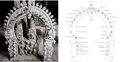 Display of all 28th nakshatra in silver arch with candles in Tirupperunthurai (Athmanathaswamy temple) near Aranthangi, India, 10th century CE. (SMH 2025).
-
 Display of all 28th nakshatra in a door frame in Tirupperunthurai (Athmanathaswamy temple) near Aranthangi, India, 10th century CE. (SMH 2025).


Mythology
mnemonic tales and cultural significance
Weblinks
References
- References (general)