Qed
Authors: Susanne M Hoffmann, Juan Antonio Belmonte Avilés, Juan A. Belmonte

Qed is an Egyptian name that can be translated as circle, sheepfold or net. Decan star clocks incclude bith Qed and Qedty (in dual form) for two different asterisms. They were not present on RSC which used more appealing constellations further north such as Aped and Wia, respectively, to cover the same RA range.
Concordance, Etymology, History
Variants
- Qed
- Qedty
Origin of Constellation
In the decan star clocks there are two decans called Qed, in singular, and Qedty, in dual. They are far away in RA. One possibly was close to Pisces and before Aret, the other possibly to the South of Sagittarius. These are mentioned in NK celestial diagrams but never depicted as constellations.
Qed means net, circle, or sheepfold, so Qedty means two nets or a pair of nets, and hence we expect them to have a nearly round, circular or enclosed form.
In a complete independent analysis, a tentative interpretation on these two decans was given by Belmonte (2003)[1] in MSAIT on the Decans, and simultaneously on his PUV book on "La Astronomía del antiguo Egipto" by Jose Lull in 2004. Both of them independently coincided in their hypothesis for Qed and Qedty after their analyses because they fit in RA within the errors. The pentagonal head of Cetus for Qed, and an area south of Sagittarius in which Corona Australis (quite circular) would be one of the pair Qedty.
So this, among others, is why they published a paper in JHA in 2006 together. Table 4.7 is just a final count of 20 years of discussion and analyses.
Leitz (1995) locates Qed in Alpha Andromedae, which is far too north for a decan.
Image Variants of Fishing Nets
For a depiction in the tomb of Menna (TT 69), Thebes, tp. Amenhotep III, New Kingdom also see Hartwig (2015)[2].
-
 A team of men catching fish with a large net. (Weidenbach 1878)
 -
 Fishing and Fowling, from the Tomb of Ipuy (Ramses II)
 -
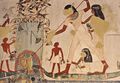 On this painting adorning the tomb of Menna, a noble scribe during the reign of Amenhotep III (XVIIIth Dynasty), two Nile perches, fish with delicious flesh, are clearly visible. (image citation from Comptoir
 -
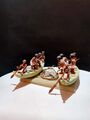 modern replica for sale, original in the Egyptian Museum in Cairo
_-_TIMEA.jpg)


Transfer and Transformation of the Constellation
-
 ancient manuscript 1
 -
modern mapping by author XY
-
ancient manuscript 2
-
modern mapping by author AB
-
something else ...

Religion/ Tales/ Mythology
As far as we know, there is not any mythological or cultural context for these two decans (asterisms) as we have for many other Egyptian stars and constellations apart from the utility and hour keepers in diagonal star clocks (which is indeed important).
IAU Working Group on Star Names
Weblinks
References
- References (general)
- ↑ Belmonte, J. A., 2003. The Ramesside star clocks and the ancient Egyptian constellations. In M. Blomberg, P. E. Blomberg and G. Henriksson (Eds.), Calendars, Symbols, and Orientations: Legacies of Astronomy in Culture (pp. 57–65). Uppsala Astronomical Observatory report, 59. Uppsala Ocarina Books.
- ↑ Hartwig, Melinda. (2015). “Style.” In A Companion to Ancient Egyptian Art, edited by Melinda Hartwig, pp. 39-59. Blackwell Companions to Art History Series. Boston & Oxford: Wiley-Blackwell.





