Pouṣṇa (पौष्ण)
Paushna
Authors: ASE Tech Team, Shylaja, Susanne M Hoffmann


Pouṣṇa (पौष्ण) is another name for Revati, (रेवती), the 27th nakṣatra of Vedic astral science. The yogatara (main star) is ζ PSc and it consists of more than one star.
Etymology and History
Name & Spelling Variants
- Revati
- Pouṣṇa (पौष्ण)
- Poushna
- Pouchna
- Pooshna
- Pushan
Pouṣṇa (पौष्ण) is also the name of the 27th nakshatra and specifically its yogatara (main star) Revati is assigned ζ Psc. This has the presiding deity as Pūṣan, the Sun. The word Pouṣṇa is derived from Pūṣan.
Identification and Main Star
Revati's shape in temple illustrations shows a group of five stars ε , δ , ζ, 89 and 96 Psc. It matches a characteristic arch pattern including its determinative star (ζ Psc) in the Pisces/Andromeda area.
Other identifications give longer list of stars: ε Psc, 71 Piscium, BD+07 153, FK5 36, GC 1258, HD 6186, HIP 4906, HR 294, PPM 144204, SAO 109627.
In the catalogue of stars provided by Nityananda[1] of 17th century the entry corresponds to the name Pouṣṇa, the ecliptic longitude if 359 degrees and the latitude zero. This position is midway between ζ Psc and ε Psc. Hence we propose the name Pouṣṇa for ε Psc.
Stars within the Constellation Area
| ε Piscium | 71 Piscium | BD+07 153 | HR 294 | HIP 4906 | |
| δ Psc, | 63 Piscium, | BD+06°107, | HR 224 | HIP 3786 | |
| ζ Psc, | 86 Piscium, | BD+06°174 | HR 361 | HIP 5737 | Revati |
| 89 Psc | BD +02 185 | HIP 6061 | |||
| 96 Psc | 96 G.Piscium | BD +04 123 | HR 4628 | HIP 3765 |
Transfer and Transformation
-
 Revati 10th century
 -
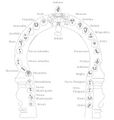 Display of all 28th nakshatras in silver arch with candles in Tirupperunthurai (Athmanathaswamy temple) near Aranthangi, India, 10th century CE. (SMH 2025).
 -
 Display of all 28th nakshatras in a door frame in Tirupperunthurai (Athmanathaswamy temple) near Aranthangi, India, 10th century CE. (SMH 2025).
 -
 Revati, Tibetean
 -
 Revati, Chinese
 -
 Revati Hindu
 -

-
 Lord Revati
 -
 Revati as reconstructed by Jones (1720)


Mythology/ Religion

IAU Working Group on Star Names
We arrive at the identification with ζ Psc as determined from the coordinates of Sūryasiddhānta.
Weblinks
Reference
- ↑ Venketeswara R Pai and Shylaja B S, 2021, JOAA, 42, 113 https://doi.org/10.1007/s12036-021-09736-