Authors: Susanne M Hoffmann, Youla Azkarrula, Ian Ridpath
Coma Berenices, modern boundaries, IAU and Sky & Telescope.
Πλόκαμος (Plokamos)
Asterism Info
Native
Πλόκαμος
Romanisation
Plokamos
Translation
The Lock [in Leo]
Position (2000)
Right ascension
182.6920632 to 188.71280339999998
Declination
22.629206 to 28.9371919
Area
23.02 sq. deg.
Stars
Bright stars
20
Bayer/Flamsteed stars
12
Stars brighter than 3.00m
0
Brightest star
γ Comae Berenices (4.34m)
Taxonomy
category of asterism
Almagest constellation
IAU- constellations
Com
Photograph of the Coma star cluster. This file is from Wikimedia Commons and may be used by other projects. Open cluster Melotte 111, or Coma Star Cluster. http://sternwarte-kempten.de/
One of the 88 IAU constellations. The ancient "Greek" constellation originates from Egypt. It has been invented by Konon, the royal astronomer of king Ptolemy III and it was named after the king's wife, Queen Berenice II Euergetis as reported by Eratosthenes. However, the asterism always used to have names in other cultures. In this area of the sky close the pole of the ecliptic, there are not many bright stars, but a clearly recognizable star cluster of triangular shape (the visual appearance is an isosceles triangle).
[1]This figure has only been regarded as a constellation since Tycho Brahe included it in his catalogue in 1602, but the figure itself is ancient. It is treated as an association of faint stars in the constellation Leo; in the Almagest, for example, it is described as a ‘nebulous mass’ representing a ‘curl’.
The Almagest does not define whose curly hair is being represented here. It is not mentioned in Aratos, but the figure appears in Eratosthenes. Interestingly, he mentions it twice and somewhat confusedly: In one of the two surviving text versions of Eratosthenes on the lion, there is a supplement to the list of stars in which he speaks of a triangle of stars next to the lion's tail and calls it the ‘curl of Berenice’. However, the fact that he also mentions a curl in the constellation of the Northern Crown – the curl of Ariadne – causes more confusion. Philologists therefore speculate whether, after Berenice II was removed by her son for political reasons, it was not appropriate for a time to speak of the "Lock of Berenice". There are astronomical reasons against this, but if the curl was – at least temporarily – assigned to Ariadne, this was not permanent, as the cult of Berenice subsequently became more important.
Origin of Constellation
Berenice was the name of several queens of Egypt.[1] According to Eratosthenes, this refers to Berenice II Euergetis, the wife of the Greek ruler Ptolemy III. The royal couple were already revered for their charity during their lifetime: they were regarded as a pair of gods in Egypt and worshipped in Crete and Athens. The constellation is said to have been invented by Konon of Samos in 241 BCE. While Eratosthenes worked as a librarian and teacher of princes in Alexandria, Konon was the king's astronomer.
In Mesopotamia, the panicle of the date palm of the goddess Erua was in this place - neither a tuft of hair nor a curl of a queen.
In Ptolemaic times (1st century BCE), when Egypt was ruled by the Romans, new Egyptian temples were built: a Chnum temple in Esna and a Hathor temple Dendera (south and north of Thebes/ Luxor). They display a cultural mixture of Babylonian and Egyptian constellations.
The contemporary poet Kallimachos described why Konon invented the constellation, and the Roman poet Catullus translated it into Latin around 200 years later.
Berenice was a princess from Cyrene who married the king of Egypt in 246 BCE. The same year, he went to war against the Seleucids in the Third Syrian War. Eratosthenes, who also came from Cyrene but was now working in Athens, was brought in as tutor to the princes when their son Ptolemy IV Philopator was born in 245 BCE. However, Berenice prayed that her husband would return from the war in one piece and vowed to sacrifice her head of hair (or a lock of it) as soon as this happened.
On the king's return, she cut her hair and brought it to the temple of Arsinoë. Disturbance ensued when it disappeared the following day. Konon showed the excited crowd, which had gathered suspiciously, that the gods had moved the hair of the benevolent queen to the sky.
Nowadays, the constellation is often used for romantic narratives: As a constellation symbolising conjugal love and fidelity, it can be wonderfully used in planetariums and other contexts.
Spirit of the Awarra Palm: constellation of the Lokono People in South America. Screenshot from Stellarium (2024), sky culture produced by Konrad Rybka.
Sissinu: the branch/ frond/ spadix of the date palm in Babylonian astronomy
Babylonian Goddess Erua with a frond and a spadix of a date palm (drawn in a map by Papke 1987).
Asterism of the Ivy Leaf as described in Ptolemy's Almagest (Stellarium 2024)
The Tassel (Arabic Indigenous constellation) of the Lion, screenshot from Stellarium (by Khalid al-Ajaji)
Chinese constellation Langwei (reconstructed by Boshun Yang)


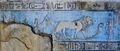 Leo (and Com); rectangular zodiac of Dendera
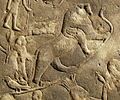 Leo with Com, Hya, Crv, circular zodiac of Dendera (CC BY Musée du Louvre, Département des Antiquités égyptiennes)
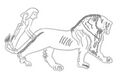 Constellation of a Lion with a Lady on its Tail in Leo+Coma Berenices on the circular Zodiac of Dendera, Egypt (drawing by SMH for Stellarium 2026).
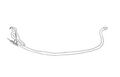 Constellation of a Serpent with a Bird in Hydra+Corvus on the circular Zodiac of Dendera, Egypt (drawing by SMH for Stellarium 2026).


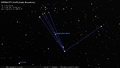 (1952) H.A. Rey's stick figure of Coma Berenices
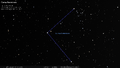 (1988) O. Hlad's stick figure of Coma Berenices
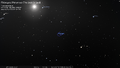 Reconstruction of Stickfigure based on the depiction of Almagest (100-170 CE). CC-BY Susanne Hoffmann in Stellarium.
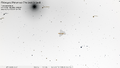 Image in Almagest
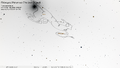 Image of the Farnese Globe (2nd century CE) taken by Susanne Hoffmann and imported into Stellarium.


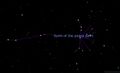 Spirit of the Awarra Palm: constellation of the Lokono People in South America. Screenshot from Stellarium (2024), sky culture produced by Konrad Rybka.
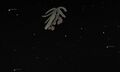 Sissinu: the branch/ frond/ spadix of the date palm in Babylonian astronomy
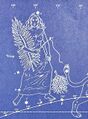 Babylonian Goddess Erua with a frond and a spadix of a date palm (drawn in a map by Papke 1987).
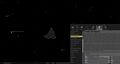 Asterism of the Ivy Leaf as described in Ptolemy's Almagest (Stellarium 2024)
 The Tassel (Arabic Indigenous constellation) of the Lion, screenshot from Stellarium (by Khalid al-Ajaji)
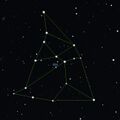 Chinese constellation Langwei (reconstructed by Boshun Yang)







