Dhanuśarāgra (धनुशराग्र)
Authors: Shylaja, Eric Mamajek, Susanne M Hoffmann, ASE Tech Team, Ian Ridpath

| Asterism Info | |
| Native | धनुशराग्र |
|---|---|
| Translation | The Arrow |
| Position (2000) | |
| Right ascension | 271.2551101 |
| Declination | -29.58008951 |
| Area | 0 sq. deg. |
| Stars | |
| Bright stars | 1 |
| Bayer/Flamsteed stars | 1 |
| Stars brighter than 3.00m | 0 |
| Brightest star | Dhanuśarāgra (4.69m) |
| Taxonomy | |
| category of asterism | IAU-Star Name |
| IAU- constellations | Sgr |


Dhanuśarāgra (धनुशराग्र), The Arrow, is an Indian star name found in the recent few centuries (starting from the 14th century CE) for a star in Sagittarius. It is obviously a translation of a Greek name or a Sanskrit name for a feature in the imported Greek constellation figure. Note that is star name is occasionally mixed up with the star name Dhanuśira (धनुशिर) for μ Sgr in the Bow.
Concordance, Etymology and History
The term Dhanuśarāgra (धनुशराग्र) literally means tip of the arrow. Dhanu - bow, śara - arrow, agra - tip.
Name Variants
- Dhanuśarāgra (धनुशराग्र)
- Dhanusharagra
Origin of Constellation
The star name is found on instruments. Although the original diagram responsible for the nomenclature is not traceable, the depiction here supports the meaning (arrow tip) of the name.
The position on the astrolabe agrees with the position corresponding to the tip of the arrow. There are two stars γ1 and γ2 Sgr, shown inside the red circle in the diagram. This star name thus can be for γ1 Sagittarii. (W Sagittarii, HR 6742, HD 164975, SAO 186237, HIP 88567, ADS 11029, CCDM 18050-2935)
Concordance

This name has been found in the catalogue of astrolabes translated from Persian. The name has been coined as shown in the two examples below. [1]
The astrolabes were introduced into Indian astronomy by seafarers from the Middle East. In the earliest manual prepared by Mahendra Suri in the 1370 CE, only 32 bright stars were listed. Subsequently, other faint stars were also marked. Based on the original data, the star names were literally translated in most of the cases. The name is listed in the manual by Mahendra Suri as the 26th star. It may be seen that there was no Persian name for Dhanuśarāgra. Therefore, this must have been coined to suit the imaginary picture.
Astrolabe C006 (1644 CE)
In the astrolabe C006 (1644 CE) made by Maniarama from Gujarat, India, the stars are marked with two-letter abbreviations and the numeral corresponding to the list of Mahendra Suri. Dhanu 26 on the rete, therefore, will correspond to Dhanuśarāgra . The identification was done by stars overlay on the rete.
The close-up view here shows the pointer on the rete. Using Spica (S) and Altair (A) as references, we see that the pointer is for a different star in Ophiuchus. It is possible that the engraved number is in error.
Astrolabe C001 (1605)
C001 in the catalogue was prepared by Damodara of Ahmedabad, India, in 1605. The engraving on the dial reads Dhanuśirā; this is μ Sgr. The catalogue reports Dhanuśarāgra as a correction. This is a curious case of misidentification. The position on the rete matches with neither with Dhanuśira (μ Sgr) nor Dhanuśarāgra (γ Sgr). However, this brings out the important information that the star name Dhanuśarāgra was in use.
The position actually corresponds to the supernova of 1604 CE. [2] [3]
The accuracy of the star dials cannot distinguish between the two stars γ1 and γ2. Therefore, Dhanuśarāgra is proposed for γ1, which now has no name (W Sgr form the variable star catalogue).
Transfer and Transformation
-
 Stars overlay on the rete of C006; reference stars are Altair (A) and Spica (S). The red circle is the pointer for Dhanuśarāgra – it appears to be for some star in Ophiuchus.
 -
 Close up of the region in C006 showing numbers 26 Dhanu and 27.
 -
 The region of Dhanuśarāgra in C001 with stars overlay shows the pointer to the location of the SN1604 with both μ Sgr and γ Sgr far from it.
 -
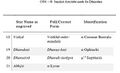 This table shows that the star was misidentified as μ Sgr in the catalogue


Mythology/ Religion
There is no specific Indian mythology because the constellation is imported; see the original Babylonian constellation name and its Greek adaptation.
IAU Working Group on Star Names

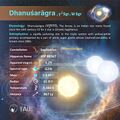
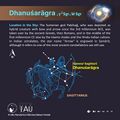
In August 2016, the IAU WGSN adopted the name Dhanusaragra for the primary star of the multiple star designated γ1 Sagittarii (W Sgr, HR 6742, HD 164975, HIP 88567, ADS 11029A, SBC9 2001, WDS J18050-2935Aa). The General Catalog of Variable Stars (GCVS) lists the star as a Classical Cepheid variable showing remarkable variability -- ranging from apparent V magnitude 4.29 to 5.14 every 7.595 days. Harlow Shapley (1916) reported that the spectral type of the Cepheid W Sagittarii varied widely between A8 at its brightest and G2 near its faintest. A Hubble Space Telescope survey of the star by Evans, Massa, Proffitt (2009) characterize the system as a triple with the Cepheid primary, a cool companion, and a hot companion ~0.16" away, however rather than adopt their component IDs, we follow the component nomenclature of the Washington Double Star catalog (WDS J18050-2935) and list their designations as Aa1, Aa2, Ab. There are more distant B and C in older literature, both of which appear to be widely separated (34" and 41") and unrelated to the triple. WDS also reports faint components D and E at separations 6" and 13", however it is unclear if these stars are related. Thus, the γ1 Sagittarii system appears to be at least a triple system, in the foreground of the high stellar density Galactic bulge. As is customary for IAU WGSN names, for the first naming of a star in a multiple system, the name applies to the primary, in this case Dhanusaragra is adopted for the Cepheid variable primary component Aa1.
-
 (CC BY Sadegh Faghanpour for IAU WGSN)
 -
 (CC BY Sadegh Faghanpour for IAU WGSN)

Weblinks
- SIMBAD page for gam01 Sgr: https://simbad.cds.unistra.fr/simbad/sim-id?Ident=gam01+Sgr
References
- ↑ Sarma S R, 2023, A Descriptive Catalogue of Indian Astronomical Instruments, https://srsarma.in/catalogue.php
- ↑ Shylaja B S, 2019, Records of Supernovae, Current Science, 116, 1430
- ↑ Shylaja B S, 2026, Astrolabes as records of previous eruptions of recurrent nova T CrB, 47, 39
- ↑ Sidney Hall and Shylaja,https://upload.wikimedia.org/wikipedia/commons/7/7e/Sidney_Hall_-_Urania%27s_Mirror_-_Sagittarius_and_Corona_Australis%2C_Microscopium%2C_and_Telescopium.png






