Euphrates
Authors: Susanne M Hoffmann

Euphrates Fluvius or River Euphrates is an obsolete constellation. It was invented twice in different times and places: First in Southern Mesopotamia in the first millennium BCE and second, (independently) in Europe in the early 17th century.
Concordance, Etymology, History
Spelling Variants
- ...
Origin of Constellation
Ancient Mesopotamia

mul ídIDIGNA (𒀯𒀀𒇉𒈦𒄘𒃼), the Tigris-river asterism, is a constellation that is mentioned in late cuneiform texts in the area of northeastern Pisces and western Andromeda. Together with the Euphrates' asterism (BURANUN) it formed a super-constellation that corresponds to the ribbons of classical Pisces and ZIBme in cuneiform, a late form of KUNme(š) mulSIM.MAḪ, the Tails of the Swallow, in MUL.APIN I iv 36.
Some star lists from the first millennium BCE equate the constellations Anunitu and Swallow with the two river constellations Euphrates and Tigris. The uranology MLC 1866 explicitly mentions that they meet at the "tip of The Tails (ZIBme)"ː
- [MU]L.MEŠ ídIDIGNA u ídBURANUNki ina ṣip-ri mulZIB<me>,
- "The stars of the Tigris and the Euphrates at the tip of the Tails" (D i 8)
Beaulieu et al. (2018, 35, 39, Section A)[1].
Early Modern Constellation

Ian Ridpath[2] only mentions Euphrates briefly in his entry on the Tigris[3] constellation:
(...) river Tigris, a real river of Mesopotamia which joins with the Euphrates in the modern Iraq. The constellation was introduced in 1612 by the Dutchman Petrus Plancius (...)
As Plancius did not write any documentation on his newly introduced constellations, we can only speculate about some likely biblical reference. Hints are given in his personal life as a clergyman, frequently persecuted because of his belief, and his biblical (geographical) maps (Plancius 1590), where the Jordan River is featured very similarly to the celestial illustration on his globe gores, and Tigris is depicted next to the Tree of Life in Eden.
The first written explanation on the river constellations Tigris and Jordanus is preserved from Bartsch (1624), where Euphrates is not featured. Bartsch likely copies the idea from his mentor I. Habrecht (1621) and not directly from Plancius, so the reasons (for Habrecht?) to drop Euphrates are unknown.
Source
-
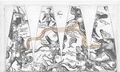 Tigris and Euprates on Plancius (1612) and van den Keere's globe gores.
 -
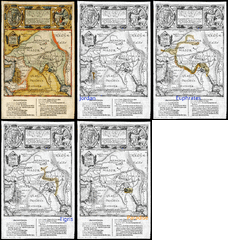 Plancius (1590): Biblical Maps, with modern highlighting of Jor-Dan, Euphrates, Tigris and the Paradise south of Babylon.
 -
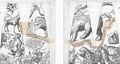 Jordanus on Globe gores by van den Keere & Plancius (1612)
 -
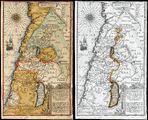 Plancius (1590): Biblical Maps, with modern highlighting of Jor-Dan.


Identifications
- (a) Mesopotamia: western Pisces
- (b) Plancius (1612): southern Cygnus
- (c) other authors in the 17th century copied Tigris from Plancius but left out Euphrates
Transfer and Transformation of the Constellation
-
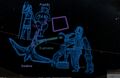 Tigris and Euphrates BURANUN in ancient Mesopotamian uranologies, mapped
 -
Tigris and Euphrates on Plancius' globe gores (1612).
-
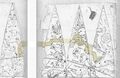 Tigris on globe gores by Habrecht (1621)
 -
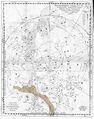 Tigris in Jakob Barsch (1661) Planisphaerium Stellatum


IAU Nomenclature
The name "Euphrates" was proposed as modern star name, but could not be used as there has been a small body name for asteroid (13963) Euphrates with the original identifier 1991 PT4. The IAU WGSN used the Sumerian original name of the river Buranun instead.
Asteroid (13963) Euphrates
The asteroid was discovered on 3 August 1991, by Belgian astronomer Eric Elst at ESO's La Silla Observatory site in Chile. It is named after the Mesopotamian river.
Mythology
Ian Ridpath[2] writes in the mythology of Pisces[4]:
The goddess Aphrodite and her son Eros took cover among the reeds on the banks of the Euphrates, but when the wind rustled the undergrowth Aphrodite became fearful. Holding Eros in her lap she called for help to the water nymphs and leapt into the river. In one version of the story, two fish swam up and carried Aphrodite and Eros to safety on their backs, although in another version the two refugees were themselves changed into fish. The mythologists said that because of this story the Syrians would not eat fish, regarding them as gods or the protectors of gods.
An alternative story, given by Hyginus in the Fabulae, is that an egg fell into the Euphrates and was rolled to the shore by two fish. Doves sat on the egg and from it hatched Aphrodite who, in gratitude, put the fish in the sky.
Weblinks
References
- References (general)
- ↑ Beaulieu, P.-A., Frahm, E., Horowitz, W. & Steele, J. (2018), The Cuneiform Uranology Texts: Drawing the Constellations, American Philosophical Society Press, Philadelphia, USA.
- ↑ 2.0 2.1 Ridpath, Ian, Star Tales (Cambridge: Lutterworth Press, 1988) ISBN 0-7188-2695-7 [Internet Archive link] -- a revised and expanded edition was published in 2018 [ISBN 978-07188-9478-8] -- online version on Ridpath's website.
- ↑ Ian Ridpath, Star Tales, online edition: Tigris
- ↑ Ian Ridpath, Star Tales online (Pisces)





