Kamelos
Authors: Susanne M Hoffmann, Youla Azkarrula, Ian Ridpath

| Asterism Info | |
| Native | καμήλα |
|---|---|
| Translation | camel |
| Position (2000) | |
| Right ascension | 100.1203209 |
| Declination | 77.99578275 |
| Area | 0 sq. deg. |
| Stars | |
| Bright stars | 1 |
| Bayer/Flamsteed stars | 1 |
| Stars brighter than 3.00m | 0 |
| Brightest star | Kamelos (5.72m) |
| Taxonomy | |
| category of asterism | IAU-Star Name |
| IAU- constellations | Cam |
The name "Kamelos" is borrowed from a name variant of the constellation Camelopardalis. It is a modern IAU-star name for the heart of Camelopardalis, HIP 31940 (HD 45866).
Concordance, Etymology, History


"Kamelos" is Greek for camel, a pun with the name of the constellation "Camelopardalis" whose Latin term is a Greek loanword, literally meaning "checkered camel" = giraffe. The constellation "Camelopardalis" was invented in 1612 by Petrus Plancius and represents a giraffe. Its name is Greek Καμηλοπάρδαλις, which was adopted by ancient authors into Latin Camelopardalis (e.g. Pliny the Elder, Naturalis Historia VIII, 69), derived from the words for “camel” (κάμηλος, kamelos) and “leopard”, reflecting an animal suited to hot climates like a camel, yet marked with spots like a leopard.

On this base, Jacob Bartsch proposed 1624 "Camelus Rebeccae" as an alternative name for the constellation Camelopardalis, a reference to the story of Abraham's daughter-in-law, Rebecca.
Mythology

Rebekah was a key matriarch in Genesis, known for her faith and her pivotal, though controversial, role in securing Jacob's lineage.
Abraham had sent out his servant to find a wife for his (Abraham's) son. After a long journey, arriving at a well outside a settlement, Abraham's servant prayed for a sign, and Rebekah fulfilled it by offering water to him and his camels, demonstrating her hospitality and hard work. Then, she courageously agreed to leave her family to marry a stranger, Isaac, whom she had never met, and he loved her greatly.
After years of barrenness, Isaac prayed and Rebekah conceived twins; God revealed that the older (Esau) would serve the younger (Jacob). Rebekah, favoring Jacob, helped him deceive Isaac into giving him the firstborn's blessing instead of Esau, fulfilling the prophecy through manipulation. To escape Esau's wrath, Rebekah sent Jacob away to her brother Laban; she died before he returned and was buried in the Cave of the Patriarchs.
The key themes of her story are divine guidance, faith and courage, the consequences of favouritism, and human action on God's plan.
IAU Working Group on Star Names
The name was discussed and adopted by the IAU WGSN in 2025.
-
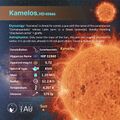 Kamelos profile card (CC BY M. Sadegh Faghanpour for IAU WGSN).
 -
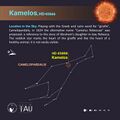 Kamelos stick figure (CC BY M. Sadegh Faghanpour for IAU WGSN).





