Volans: Difference between revisions
IanRidpath (talk | contribs) Copy edit, added link |
|||
| Line 2: | Line 2: | ||
---- | ---- | ||
[[File:Volans IAU.svg|alt=star chart|thumb|Volans star chart (IAU and Sky & Telescope magazine, Roger Sinnott & Rick Fienberg).]] | [[File:Volans IAU.svg|alt=star chart|thumb|Volans star chart (IAU and Sky & Telescope magazine, Roger Sinnott & Rick Fienberg).]] | ||
One of the [[:Category:88_IAU-Constellations|88 IAU constellations]]. Flying fish are | One of the [[:Category:88_IAU-Constellations|88 IAU constellations]]. Flying fish are found in the Mediterranean, but this constellation is not ancient. It is located in the southernmost part of today's constellation [[Argo]], and was not included in the star catalogues of antiquity: the ancient constellation Argo was much smaller than the modern one. The constellation was invented by Dutch sailors in the 1590s. | ||
==Etymology and History== | ==Etymology and History== | ||
| Line 13: | Line 13: | ||
[[File:DeHoutman vlieghendeVisch.JPG|alt=screenshot of text|thumb|de Houtman (1603) "de vlieghende Visch", the Flying Fish (Volans). screenshot of star catalogue.]] | [[File:DeHoutman vlieghendeVisch.JPG|alt=screenshot of text|thumb|de Houtman (1603) "de vlieghende Visch", the Flying Fish (Volans). screenshot of star catalogue.]] | ||
===Origin of Constellation=== | ===Origin of Constellation=== | ||
The name "Volans" occurs first on Plancius/ Hondius globe | The name "Volans" occurs first on the Plancius/Hondius globe of 1598 and was taken over in Bayer's Uranometria (1603). | ||
<ref>Hoffmann, Susanne M. Wie der Löwe an den Himmel kam. Franckh Kosmos Verlag, Stuttgart 2021</ref>When the first Dutch expedition set out to open up new trade routes and markets in the East Indies, navigators Pieter Keyser and Frederick de Houtman also made some observations of the southern night sky. They limited themselves to a few patterns that they considered relevant for navigation – after all, the journey took them from Europe around Africa to Madagascar, where they had to pause for six months and lost 71 men to illness. From there, they sailed to Indonesia to start the spice trade with Java and Borneo. However, due to Portuguese intervention, this was accompanied by armed conflict. The expedition was therefore underway for a very long time. | <ref>Hoffmann, Susanne M. Wie der Löwe an den Himmel kam. Franckh Kosmos Verlag, Stuttgart 2021</ref>When the first Dutch expedition set out to open up new trade routes and markets in the East Indies, navigators Pieter Keyser and Frederick de Houtman also made some observations of the southern night sky. They limited themselves to a few patterns that they considered relevant for navigation – after all, the journey took them from Europe around Africa to Madagascar, where they had to pause for six months and lost 71 men to illness. From there, they sailed to Indonesia to start the spice trade with Java and Borneo. However, due to Portuguese intervention, this was accompanied by armed conflict. The expedition was therefore underway for a very long time. | ||
| Line 20: | Line 20: | ||
The first book of Merula's ''Cosmographiae'' was written mostly in 1597 and in a letter, dated 30 August 1600, to Marcus Welser in Augsburg, Merula claims that the first part of his work was ready to be printed. | The first book of Merula's ''Cosmographiae'' was written mostly in 1597 and in a letter, dated 30 August 1600, to Marcus Welser in Augsburg, Merula claims that the first part of his work was ready to be printed. | ||
We suspect that Merula's description is based on a list which he received from Plancius around 1597/98 when was | We suspect that Merula's description is based on a list which he received from Plancius around 1597/98 when he was still busy forming his constellations. For a few constellations, he had not yet decided which figures and names would finally be shown on his celestial globe; e.g. the constellations [[Hydrus]], [[Grus]] and [[Apus]] also were given with alternative names. | ||
=== The Animal === | === The Animal === | ||
Since flying fish are found in many places in the tropics and subtropics, it is likely that sailors witnessed a natural spectacle somewhere in which these animals rise out of the water and glide through the air as they flee from their natural predators. Historically, it could happen that individual animals landed on a ship's deck. One of the flying fish's predators is the dolphinfish – a very large South Sea fish | Since flying fish are found in many places in the tropics and subtropics, it is likely that sailors witnessed a natural spectacle somewhere in which these animals rise out of the water and glide through the air as they flee from their natural predators. Historically, it could happen that individual animals landed on a ship's deck. One of the flying fish's predators is the dolphinfish – a very large South Sea fish which is immortalised in the constellation [[Dorado]] (goldfish). The constellation pattern shows the flying fish at the edge of the [[Argo]] – however, Dorado always precedes it in the sky, as it is located further west than the flying fish. | ||
===Transfer and Transformation of the Constellation=== | ===Transfer and Transformation of the Constellation=== | ||
| Line 46: | Line 46: | ||
==Weblinks== | ==Weblinks== | ||
* | *Ian Ridpath's ''Star Tales'' – [http://www.ianridpath.com/startales/volans.html Volans] | ||
==References== | ==References== | ||
Latest revision as of 21:34, 22 July 2026
Authors: Susanne M Hoffmann, Youla Azkarrula, Ian Ridpath

One of the 88 IAU constellations. Flying fish are found in the Mediterranean, but this constellation is not ancient. It is located in the southernmost part of today's constellation Argo, and was not included in the star catalogues of antiquity: the ancient constellation Argo was much smaller than the modern one. The constellation was invented by Dutch sailors in the 1590s.
Etymology and History
Name Variants

Origin of Constellation
The name "Volans" occurs first on the Plancius/Hondius globe of 1598 and was taken over in Bayer's Uranometria (1603).
[3]When the first Dutch expedition set out to open up new trade routes and markets in the East Indies, navigators Pieter Keyser and Frederick de Houtman also made some observations of the southern night sky. They limited themselves to a few patterns that they considered relevant for navigation – after all, the journey took them from Europe around Africa to Madagascar, where they had to pause for six months and lost 71 men to illness. From there, they sailed to Indonesia to start the spice trade with Java and Borneo. However, due to Portuguese intervention, this was accompanied by armed conflict. The expedition was therefore underway for a very long time.
Some name alternatives are given by Merula:[2] Cosmographiae generalis libri tres (1605), Part I, Book II, pp. 105-108 (Volans is no. III).

The first book of Merula's Cosmographiae was written mostly in 1597 and in a letter, dated 30 August 1600, to Marcus Welser in Augsburg, Merula claims that the first part of his work was ready to be printed.
We suspect that Merula's description is based on a list which he received from Plancius around 1597/98 when he was still busy forming his constellations. For a few constellations, he had not yet decided which figures and names would finally be shown on his celestial globe; e.g. the constellations Hydrus, Grus and Apus also were given with alternative names.
The Animal
Since flying fish are found in many places in the tropics and subtropics, it is likely that sailors witnessed a natural spectacle somewhere in which these animals rise out of the water and glide through the air as they flee from their natural predators. Historically, it could happen that individual animals landed on a ship's deck. One of the flying fish's predators is the dolphinfish – a very large South Sea fish which is immortalised in the constellation Dorado (goldfish). The constellation pattern shows the flying fish at the edge of the Argo – however, Dorado always precedes it in the sky, as it is located further west than the flying fish.
Transfer and Transformation of the Constellation
-
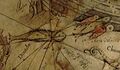 Dorado and Volans on the globe by Blaeu (1602) that is a copy of Plancius/ Hondius (1598). RMG
 -
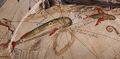 Dorado and Volans on Blaeu's second globe (1603) that is based on de Houtman's data. RMG
 -
 Bayer (1603): Dorado hunts Volans
 -
 Doppelmayr's (1742) version of Dorado's hunt of Volans
 -
 Lacaille's "Dorado" hunts Volans (1756, here repro 1799)
 -
 Fortin's hunt of Volans by Dorado (1776-1795)
 -
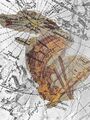 Bode (1782) depicts Dorado hunting Volans next to Argo.
 -
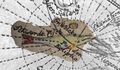 Bode (1782) labels Dorado "Schwerdt-Fisch" (swordfish)
 -
 Dorado and Volans in Fortin's Atlas Céleste, 3rd edition (1795).
 -
 Goldbach's own version of Dorado hunting Volans next to Argo (1799)
 -
 Goldbach's own "Dorado" is labelled "Goldfisch" (goldfish) in German (1799).
 -
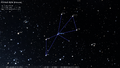 H.A. Rey's stick figure of Volans (1952)
 -
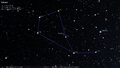 O. Hlad's stick figure of Volans (1988)


Mythology
no mythology
Weblinks
- Ian Ridpath's Star Tales – Volans







