Frosty Leo: Difference between revisions
infobox |
|||
| (2 intermediate revisions by the same user not shown) | |||
| Line 2: | Line 2: | ||
---- | ---- | ||
[[File:FrostyLeo1987 b.png|thumb|Frosty Leo in IR (highlighted by WGSN) in Forveille et al. (1987)<ref name=":0">Forveille, T., Morris, M., Omont, A., and Likkel, L., “IRAS 09371+1212 : an icy evolved, mass-losing star with a unique IR spectrum.”, <nowiki><i>Astronomy and Astrophysics</i></nowiki>, vol. 176, EDP, pp. L13–L16, 1987.</ref>. ]] | [[File:FrostyLeo1987 b.png|thumb|Frosty Leo in IR (highlighted by WGSN) in Forveille et al. (1987)<ref name=":0">Forveille, T., Morris, M., Omont, A., and Likkel, L., “IRAS 09371+1212 : an icy evolved, mass-losing star with a unique IR spectrum.”, <nowiki><i>Astronomy and Astrophysics</i></nowiki>, vol. 176, EDP, pp. L13–L16, 1987.</ref>. ]] | ||
{{Infobox constellation | |||
| name = Frosty Leo | |||
| native = Frosty Leo | |||
| translation = Frosty Leo | |||
| pronounce = | |||
| IPA = | |||
| culture = IAU | |||
| RA = 144.97483 | |||
| dec = 11.98128 | |||
| areatotal = 0 | |||
| numbermainstars = 1 | |||
| numberbfstars = 1 | |||
| numberstarsplanets = | |||
| numberbrightstars = 0 | |||
| numbernearbystars = | |||
| brighteststarname = Frosty Leo | |||
| starmagnitude = 10.97 | |||
| neareststarname = | |||
| stardistance = | |||
| numbermessierobjects = | |||
| meteorshowers = | |||
| bordering = Leo | |||
| notes = | |||
| cat = IAU-Star Name | |||
}} | |||
Frosty Leo is a modern star name adopted by the International Astronomical Union in the IAU-Catalog of Star Names (IAU-CSN). Its origin is modern astrophysics English. It is the name of the star IRAS 09371+1212 in constellation [[Leo]]. It is "an icy evolved, mass-losing star with a unique IR spectrum" (1987)<ref name=":0" />. | Frosty Leo is a modern star name adopted by the International Astronomical Union in the IAU-Catalog of Star Names (IAU-CSN). Its origin is modern astrophysics English. It is the name of the star IRAS 09371+1212 in constellation [[Leo]]. It is "an icy evolved, mass-losing star with a unique IR spectrum" (1987)<ref name=":0" />. | ||
| Line 43: | Line 68: | ||
[[Category:IAU-Star Name]] | [[Category:IAU-Star Name]] | ||
[[Category:English]] | [[Category:English]] | ||
[[Category:Modern]] | [[Category:Modern]] [[Category:Asterism]] [[Category:Star Name]] [[Category:Leo]] | ||
Latest revision as of 07:05, 13 August 2026
Authors: Susanne M Hoffmann, Youla Azkarrula

| Asterism Info | |
| Native | Frosty Leo |
|---|---|
| Translation | Frosty Leo |
| Position (2000) | |
| Right ascension | 144.97483 |
| Declination | 11.98128 |
| Area | 0 sq. deg. |
| Stars | |
| Bright stars | 1 |
| Bayer/Flamsteed stars | 1 |
| Stars brighter than 3.00m | 0 |
| Brightest star | Frosty Leo (10.97m) |
| Taxonomy | |
| category of asterism | IAU-Star Name |
| IAU- constellations | Leo |
Frosty Leo is a modern star name adopted by the International Astronomical Union in the IAU-Catalog of Star Names (IAU-CSN). Its origin is modern astrophysics English. It is the name of the star IRAS 09371+1212 in constellation Leo. It is "an icy evolved, mass-losing star with a unique IR spectrum" (1987)[1].
Concordance, Etymology, History
Variants
- Frosty Leonis
- Frosty
The star name developed after a discovery of a circumstellar shell in 1987.
Forveille, Morris, Omont and Likkel (1987)[1] proposed in their abstract:
With the IRAM 30m telescope, we have detected the CO (1-0) line in IRAS09371+1212, an object with a uniquely sharp maximum in the 60μm IRAS band. Its CO characteristics (V = -10 km/s, full width at zero power = 49 km/s, anlfline shape) are incompatible with a galaxy, and, together with its M visible spectrum, identify it as a post-AGB circumstellar envelope. Comparison of its gas and radiation momenta suggest a recent decrease in luminosity by at least an order of magnitude. Its far-IR IRAS spectrum is incompatible with the emissivities of silicate and carbon grains; it is well explained by the 46 μmice band, assuming that most H2O has condensed onto grains. This is in agreement with the absence of OH emission.
The last sentence of their paper is "Finally, if our interpretation is correct, we propose to christen IRAS09371+1212 the "Frosty Leo nebula"."[1] The suggestion was taken up ever since, sometimes in the variants given above. A research note by Mauron,Borgne and Picquette (1989)[2] uses "Frosty" as a name even in the title. It is used in SIMBAD for star itself instead of the nebula as "Frosty Leo".
-
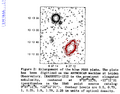 Frosty Leo in IR in Forveille et al. (1987).
 -
![Frosty Leo in IR from Forveille et al. (1987) with highlighted polarisation (Mauron et al. 1989)[2].](/images/thumb/9/98/FrostyLeo1987-9.png/120px-FrostyLeo1987-9.png) Frosty Leo in IR from Forveille et al. (1987) with highlighted polarisation (Mauron et al. 1989)[2].
Frosty Leo in IR from Forveille et al. (1987) with highlighted polarisation (Mauron et al. 1989)[2].
![Frosty Leo in IR from Forveille et al. (1987) with highlighted polarisation (Mauron et al. 1989)[2].](/index.php/File:FrostyLeo1987-9.png)
Mythology
no mythology.
IAU Working Group on Star Names
The name was adopted by the IAU WGSN in 2026, as it has been in popular use among astrophysicists and listed in SIMBAD already and used since 1987.
-
 InfoCard1
 -
InfoCard2

Weblinks
Reference
- ↑ 1.0 1.1 1.2 1.3 Forveille, T., Morris, M., Omont, A., and Likkel, L., “IRAS 09371+1212 : an icy evolved, mass-losing star with a unique IR spectrum.”, <i>Astronomy and Astrophysics</i>, vol. 176, EDP, pp. L13–L16, 1987.
- ↑ 2.0 2.1 Mauron, N., Le Borgne, J.-F., and Picquette, M., “Optical observations of the "frosty" Leo nebula (IRAS 09371+1212).”, <i>Astronomy and Astrophysics</i>, vol. 218, EDP, pp. 213–21, 1989.