Zibbatu
Authors: Susanne M Hoffmann, ASE Tech Team

| Asterism Info | |
| Native | Zibbatu |
|---|---|
| Translation | Tails of the Swallow |
| Position (2000) | |
| Right ascension | 285.7658552 |
| Declination | -19.2456835 |
| Area | 0 sq. deg. |
| Stars | |
| Bright stars | 1 |
| Bayer/Flamsteed stars | 1 |
| Stars brighter than 3.00m | 0 |
| Brightest star | Zibbatu (6m) |
| Taxonomy | |
| category of asterism | IAU-Star Name |
| IAU- constellations | Psc |

Zibbatu is a modern star name adopted by the International Astronomical Union in the IAU-Catalog of Star Names (IAU-CSN). Its origin is Akkadian. It is the name of the star 112 Psc (HIP 9353) in constellation Pisces.
Concordance, Etymology, History
see concordance of the original Babylonian constellations
- mulZIBmeš (𒀯𒍦𒈨), The Tails that occurs in Late Babylonian literature
- mulSIM.MAḪ (𒀯𒋆𒈤), The Swallow [bird], that occurs in Middle Babylonian literature and whose tails KUNme(š) are reported in the "path of the moon"
Sumerian mulZIBmeš (𒀯𒍦𒈨), equalling Akkadian zibbātu, 'The Tails,' is a late Babylonian name for the zodiacal sign and constellation Pisces. The term is used exclusively in the Astronomical Diaries from Babylon for the section of the ecliptic. In this late time, traditional cuneiform names of constellations used to be abbreviated. The original name of the constellation in the Path of the Moon in MUL.APIN (I iv 36) is given:
<mul>KUNmeš mulSIM.MAḪ, mulA-nu-ni-tu4
Tails (of) Swallow, Anunitu
The term mulAnunītu is a byname of the goddess Inanna/ Ishtar. In the time of MUL.APIN (before 1000 BCE), the term "Tails of the Swallow" refers to an asterism within the constellation of SIM.MAḪ, The Swallow, whose body was imagined in modern Cetus.
In later time, as reconstructed from normal star lists, the constellation of "the Tails" (KUN or ZIB or zibbatu) was visualized as a fish-tail and bird-tail joined (Beaulieu et al. 2018: 44-45). Yet the origin is the earlier and much larger constellation of The Swallow mulSIM.MAḪ mentioned in MUL.APIN whose V-shaped tails match the V-shaped chains of stars in Pisces.
The modern star name is placed next to the star Alrescha where the two ribbons of Pisces join, as if it was an alternative name for the knot in the band.
-
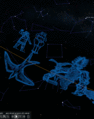 animated transformation from Babylonian to Greek constellations (SMH 2017)
-
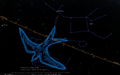 "Swallow" in Middle Babylonian (MUL.APIN), map: Stellarium 2026, drawing: Robert Perdok (LWL Planetarium Münster, Germany) 2016, adoption: SMH for IAU-WGSN 2026
-
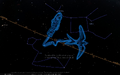 "Swallow" in "Swallow-Fish" in Late Babylonian (e.g. normal star lists described with ribbon), map: Stellarium 2026, drawing: Robert Perdok (LWL Planetarium Münster, Germany) 2016, adoption: SMH for IAU-WGSN 2026
-
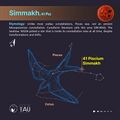 Simmakh as modern star name (CC BY Sadegh Faghanpour for IAU WGSN)
-
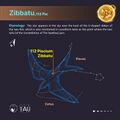 Zibbatu as modern star name (CC BY Sadegh Faghanpour for IAU WGSN)


Mythology
IAU Working Group on Star Names
The name ZIB/ Zibbatu was suggested to the IAU WGSN in 2023. In the Babylonian Astronomical Diaries, the term ZIB was used, but IAU WGSN guidelines depreciate names with only three characters; recommended are at least four. The more characters, the smaller the chance for confusion with similar terms, abbreviations or other names. Therefore, the Akkadian equivalent of the term, "Zibbatu" was preferred by WGSN. In September 2026, the WGSN chose to adopt the name for the star 112 Psc (5.87 mag) in the IAU-CSN.
-
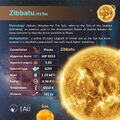 (CC BY Sadegh Faghanpour for IAU WGSN)
-
(CC BY Sadegh Faghanpour for IAU WGSN)